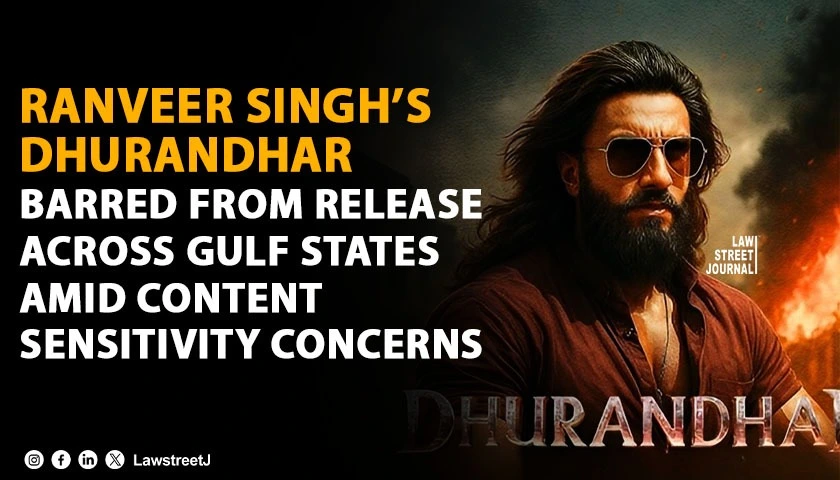
New Delhi: The Hindi-language espionage thriller Dhurandhar, led by actor Ranveer Singh, has not received release clearance in six Gulf Cooperation Council (GCC) countries, including Bahrain, Kuwait, Oman, Qatar, Saudi Arabia, and the United Arab Emirates. The development has been reported by entertainment industry publications citing distribution and exhibition sources familiar with the certification process in the region.
Despite strong box office performance in India and select international markets, the film’s absence from Gulf theatres has significantly limited its overseas commercial footprint. The Gulf region represents one of the most lucrative overseas markets for Hindi cinema, accounting for a substantial portion of international theatrical revenue due to the large South Asian diaspora.
According to reports carried by Bollywood Hungama and corroborated by trade analysts, the primary factor behind the non-release is apprehension among regional authorities that the film may be perceived as politically sensitive, particularly in relation to India–Pakistan relations. Film exhibition in GCC countries is governed by national media and content regulation laws, administered by state authorities such as the General Authority for Media Regulation (Saudi Arabia), the National Media Council (UAE), and equivalent bodies in other Gulf states. These agencies evaluate films based on established criteria covering political neutrality, national security sensitivities, religious values, and regional diplomatic considerations.
Unlike India’s Central Board of Film Certification (CBFC), which classifies films for age-based viewing, Gulf regulators operate on an approval-or-rejection model. A film may be denied release entirely if it is assessed to conflict with public order laws, diplomatic neutrality policies, or regional security interests. Industry sources cited by Bollywood Hungama stated that Dhurandhar was flagged during certification review due to concerns that its narrative could be interpreted as portraying Pakistan in a negative light. No official censorship orders or written reasons have been publicly released by Gulf authorities, consistent with standard regulatory practice in the region.
The producers of Dhurandhar reportedly submitted the film for certification across multiple Gulf jurisdictions. However, approval was not granted in any of the six countries, leading distributors to halt release plans across the region.
Precedents of Similar Restrictions on Hindi Films
The restriction on Dhurandhar aligns with a broader pattern observed in recent years involving Hindi films centred on military, intelligence, or geopolitical themes. Several films addressing cross-border terrorism, intelligence operations, or regional conflicts have faced certification hurdles in Gulf markets.
A notable precedent is Fighter (2024), starring Hrithik Roshan and Deepika Padukone, which depicted the Pulwama terror attack and subsequent military developments. The film was initially denied release across multiple Gulf countries due to allegations that it promoted an “anti-Pakistan” narrative. While the UAE briefly approved the film, its release was later suspended, according to regional exhibitors. Trade analysts note that Gulf regulators generally adopt a cautious approach to films involving South Asian geopolitical conflicts, particularly where narratives may intersect with the region’s diplomatic relations or internal security considerations.
Legal experts familiar with international film distribution frameworks emphasise that such decisions fall within the sovereign regulatory authority of host countries. International trade agreements, including those under the World Trade Organization, allow member states to restrict cultural imports on grounds of public order, morality, or national security.
The non-release of Dhurandhar in the Gulf is expected to affect the film’s overall overseas revenue, given that GCC markets typically contribute between 30 to 40 per cent of international box office earnings for mainstream Hindi films. The setback highlights the continued commercial risks associated with politically sensitive storytelling in global markets.
Industry insiders indicate that the film’s producers anticipated possible regulatory challenges and had engaged with regional distributors ahead of submission. However, similar films in the past have failed to secure approvals despite edits or contextual clarifications. As of the latest reporting, the makers of Dhurandhar have not issued an official public statement addressing the Gulf ban. No legal challenge or re-certification request has been publicly confirmed.
Film trade bodies note that content-based restrictions in international markets are increasingly shaping production decisions, particularly for films intended for global theatrical release. The issue has prompted ongoing discussions within the Indian film industry regarding risk assessment, alternate distribution strategies, and regional market sensitivities.
The exclusion of Dhurandhar from Gulf cinemas underscores the complex intersection of cinema, regulation, and geopolitics in international film distribution. While the film continues to perform in approved markets, its absence from a key overseas region reflects the legal and regulatory constraints that govern cross-border cultural exchange. As certification authorities in the Gulf maintain strict content evaluation standards, filmmakers addressing geopolitically sensitive themes remain subject to regulatory outcomes beyond domestic certification. The case of Dhurandhar adds to a growing list of Hindi films encountering similar challenges in overseas markets governed by stringent content laws.

![Screening of Film Dhurandar Cannot Be Stalled Merely Because a Section of Society Has a Different View: Madras HC Dismisses PIL Seeking Ban During Tamil Nadu Elections [Read Order]](/secure/uploads/2026/04/lj_3494_Screening_of_Film_Dhurandar.webp)
![Bombay HC Orders Takedown in Jio Studios–MasterChow ‘Dhurandhar’ Copyright Dispute [Read Order]](/secure/uploads/2026/05/lj_7978_Bombay_HC_Orders_Takedown.webp)
![Delhi HC Refuses OTT Stay on Dhurandhar in ‘Tirchi Topiwale’ Copyright Dispute [Read Order]](/secure/uploads/2026/05/lj_7055_Delhi_HC_Refuses_OTT.webp)