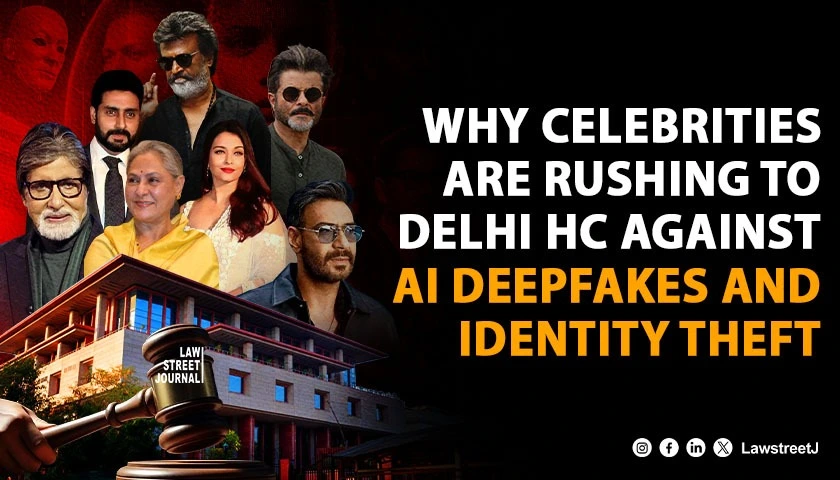
New Delhi: Imagine receiving a distressing notification: a perfectly cloned version of you — using your voice and likeness — is circulating online, soliciting funds for a crypto scam or being maliciously manipulated in sexually explicit deepfakes. This is the terrifying reality faced by India’s A-list celebrities today, a group that includes figures spanning decades of fame such as Amitabh Bachchan, Aishwarya Rai Bachchan, Anil Kapoor, Abhishek Bachchan, and podcaster Raj Shamani.
These individuals, whose economic value is intertwined with their public identity, are now engaged in a pitched legal battle against an enemy that is difficult to fight and impossible to fully capture: the algorithm. The astonishing fact is that this battleground is overwhelmingly concentrated in one judicial precinct — the Delhi High Court — which has effectively transformed into the nation’s de facto “digital rights fortress.” Why has this court, far from the film studios of Mumbai or the tech hubs of Bengaluru, become the universal destination for defending India’s most valuable personas? And why are Bombay, Madras, or other High Courts rarely prioritized in this fight? The answer lies in the Delhi High Court’s proactive creation of a specialized, precedent-driven legal infrastructure designed specifically to tackle the existential threat of modern technological misuse.
The immediate reason celebrities are rushing to the courts is the sophisticated and pervasive threat of identity theft fuelled by Artificial Intelligence deepfakes and synthetic media. This is not merely unauthorized merchandise but the theft and manipulation of the very core elements of their public existence — face, voice, gestures, and catchphrases. The sheer maliciousness of the misuse highlights the urgency. For instance, Aishwarya Rai Bachchan filed a petition in the Delhi High Court specifically confronting AI-generated pornographic content, deepfake videos, and malicious chatbots that impersonated her, sometimes generating “sexually coloured remarks.” Her husband, Abhishek Bachchan, sought parallel protection against sexually explicit fakes and videos creating false narratives about him. Similarly, podcaster Raj Shamani approached the court because AI-generated deepfakes were mimicking his voice and likeness to promote fraudulent crypto schemes and solicit funds, directly jeopardizing his reputation built on financial literacy. For these public figures, the unauthorized exploitation of their persona threatens not just revenue streams from endorsements — a “major source of livelihood” — but fundamentally compromises their dignity and reputation.
The decision to file these urgent, high-stakes cases in Delhi, despite the entertainment industry being centred in Mumbai, is anchored in the Delhi High Court’s deep-rooted supremacy and strategic positioning in Intellectual Property jurisprudence. According to legal experts, the Delhi High Court has historically been the “centre of intellectual property cases for many years” and has built a formidable reputation for effectively defending these rights. Lawyers choose the Delhi High Court because they want their clients’ rights safeguarded by what they believe to be the “most effective system.” Critically, Delhi hosts an “IP-focused ecosystem” of specialist practitioners, law firms, resources, and established precedents that would not be able to “flourish elsewhere in the nation.” As a result, Delhi accounts for over 70% of all IP cases in the country. Furthermore, Delhi’s geographical status as the seat of the Central Government is a key factor. It facilitates the swift enforcement of court orders involving agencies like the Ministry of Electronics and Information Technology and the Department of Telecommunications, which are often directed to block identified URLs or intervene against rogue platforms.
More important than tradition, the Delhi High Court cemented its magnetic pull by becoming the first court in India to create a dedicated Intellectual Property Division in July 2021. This specialized division, formalized under the Delhi High Court Intellectual Property Rights Division Rules, 2022, is designed specifically to handle IPR subject matters, including those related to the “breach of privacy and rights of publicity involving intellectual property issues” and matters concerning internet violations. This specialization ensures that judges who hear these technologically complex cases possess deep expertise, leading to consistent and expedited adjudication. The rules governing the IPD also facilitate rapid response, allowing for matters to be heard — and potentially disposed of — on the very first day of listing if satisfactory proof of service is furnished, a crucial advantage when combating viral deepfake proliferation.
The Delhi High Court’s jurisprudence on personality rights provides the foundational confidence for celebrities seeking protection. Although personality rights are not codified under a single statute in India, they are protected primarily through judicial interpretations rooted in Article 21 of the Constitution, which guarantees the Right to Life and Personal Liberty, encompassing dignity and privacy. The Delhi High Court was instrumental in evolving this common law tradition. Its 2010 decision in D.M. Entertainment v. Baby Gift House marked the country’s first significant ruling on the subject, recognizing a celebrity’s persona as a “quasi-property right of commercial worth.” Following this, the 2012 ruling in Titan Industries Ltd. v. M/S Ramkumar Jewellers established the key principle that a celebrity has the right to manage how their identity is used for profit. This body of clear, strong precedent — from recognizing personality as commercial property to allowing the celebrity control over their livelihood — provides the necessary legal structure for modern AI cases. When Amitabh Bachchan sought a universal injunction to protect his voice, name, and style, including catchphrases like “Computerji, lock kiya jaye,” the Delhi High Court relied directly on this established framework.
To counter the viral nature of AI misuse, the Delhi High Court has pioneered legal remedies that are unmatched in speed and scope, showcasing why it is the “go-to forum.” The court routinely issues powerful ex-parte interim injunctions, granting relief without immediate representation from the defendants to prevent immediate, irreparable harm. Furthermore, Delhi High Court orders often take the form of omnibus or John Doe injunctions, restraining not just identified defendants but the “world at large” from misusing a celebrity’s attributes for commercial purposes, including AI and deepfakes. The Amitabh Bachchan case produced the first blanket John Doe order granted in India for the protection of personality rights. Building on this, the Delhi High Court also developed the “dynamic plus injunction,” first used in the case involving Sadhguru Jaggi Vasudev. This automatically provides protection against future violations and allows the plaintiff to notify platforms of new infringing content without needing new court orders every time the content reappears — effectively combating the “digital hydra” effect of online dissemination. This suite of aggressive, high-tech legal tools ensures the enforcement mechanism is as nimble as the technology causing the infringement.
However, the Delhi High Court’s speed and decisive action, while crucial, have triggered an important intellectual debate regarding the expansion of rights. Legal scholars argue that Indian courts — particularly the Delhi High Court — have often failed to strictly differentiate between the dignitary aspect (personality rights) and the economic aspect (right of publicity). This ambiguity, critics suggest, sometimes leads to “performative protection,” where the court grants sweeping injunctions based merely on the “identifiability” of the celebrity, rather than requiring strict proof of “confusion, deception, or falsity” among consumers, a core standard in traditional trademark law. This rapid, broad application risks expanding personality rights dangerously close to private censorship, potentially suppressing legitimate public expression.
The Delhi High Court remains acutely aware of the constitutional tension and has attempted to establish a nuanced balancing act. It confirms that personality rights cannot override freedom of expression under Article 19(1)(a). The courts have been careful to protect genuine forms of expression such as parody, satire, criticism, news reporting, and non-commercial fan-created content. In the case of Karan Johar, the court prohibited fake endorsements but explicitly protected satire and parody. Similarly, in protecting Hrithik Roshan, the court refused to grant a blanket ex-parte takedown of non-commercial fan pages. It noted that using his songs for dance tutorials was transformative, and fan pages engaged in non-commercial use for “fun and recreation,” not profit. This demonstrates the court’s ongoing struggle to delineate where admiration ends and unlawful commercial exploitation begins. It recognizes the fundamental difference between exploiting a persona for profit and allowing critical or creative public engagement.
In conclusion, the mass convergence of celebrities on the Delhi High Court is a strategic legal response to the existential threat posed by AI-driven identity theft. While the lack of a single codified statute for personality rights in India means the law remains reliant on fragmented precedents, the Delhi High Court has proactively filled this vacuum. It has done so by building a specialized judicial infrastructure — the IPD — and aggressively pioneering powerful, technology-neutral injunctions such as dynamic and omnibus orders. This institutional readiness and judicial boldness, coupled with its geographical advantages for enforcing federal tech-related orders, make the Delhi High Court the only forum capable of providing the swift, high-impact relief necessary. It protects celebrity livelihood and dignity against violations that spread at the speed of light. The Delhi High Court therefore operates as the nation’s primary legal defense system, attempting to define the contours of human identity in a world where technology constantly challenges the definition of reality. This ongoing judicial endeavour ensures that in the digital era, the person — not the algorithm — retains ownership of their face, voice, and fame.
(This article has been written by Saket Sourav and Samriddhi Ojha, students, National Law University and Judicial Academy, Assam.)
![Delhi High Court Sets Aside Arbitral Tribunal's Award Against NHAI in Highway Project Delay Case [Read Judgment]](/secure/uploads/2023/07/lj_9605_23374c2e-392c-4491-a2fe-f2f12fc5272f.jpg)
![Delhi Court Rejects Stay Request in Defamation Case Against Rajasthan CM Ashok Gehlot [Read Order]](/secure/uploads/2023/08/lj_5208_80de1ddc-d76a-4f7f-b180-408e3ae14fb4.jpg)