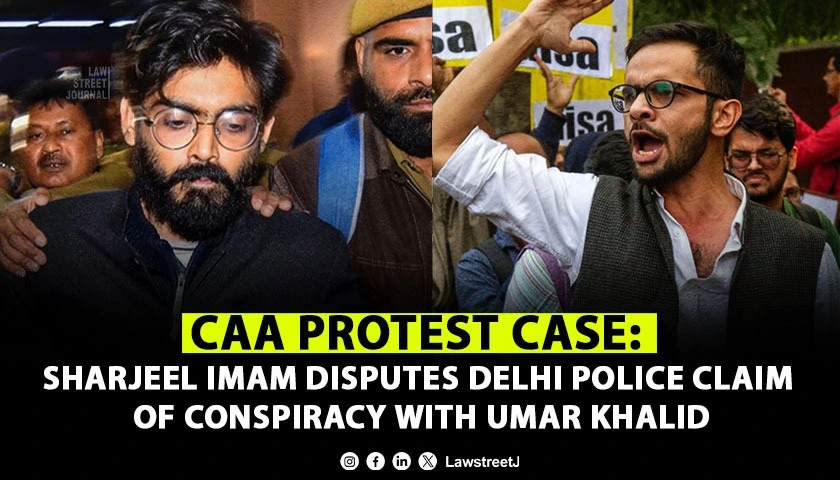
New Delhi: The Additional Sessions Judge’s Court in Delhi has heard arguments from Sharjeel Imam, who denied the Delhi Police’s allegation that fellow activist Umar Khalid was his “mentor” or “guru,” and that the two coordinated during the protests against the Citizenship (Amendment) Act (CAA) preceding the 2020 North-East Delhi riots. Imam made these submissions on 8 January 2026 before Additional Sessions Judge Sameer Bajpai at the Karkardooma Courts during proceedings on the framing of charges in the larger conspiracy case registered under the Unlawful Activities (Prevention) Act, 1967, and other penal provisions.
Counsel for Imam, Advocate Talib Mustafa, submitted that the prosecution’s claim of a conspiracy involving coordination between Imam and Khalid is unsupported by evidence. It was argued that Imam never regarded Khalid as a mentor or guru during their overlapping time as students at Jawaharlal Nehru University, and that there was no substantial interaction between them during Imam’s years at the university. The defence rejected the allegation that their activities were jointly planned in the context of the anti-CAA protests.
The matter arises from FIR No. 59 of 2020 registered by the Delhi Police Special Cell, which alleges a “larger conspiracy” behind the communal violence that erupted in north-east Delhi in February 2020. The chargesheet portrays a network of activists, including Imam and Khalid, as central to alleged efforts to incite violence linked to protests against the CAA and the proposed National Register of Citizens.
During the hearing, the defence argued that a charge of conspiracy requires proof of a meeting of minds and that no material has been placed on record to demonstrate any such understanding or collaboration between Imam and Khalid in relation to the violence. It was also submitted that Imam’s speeches, including one delivered at Jamia Millia Islamia during the anti-CAA movement, lacked a direct causal nexus with the riots.
The larger conspiracy case has been contested across multiple forums. Earlier this month, the Supreme Court of India declined to grant bail to both Sharjeel Imam and Umar Khalid, observing that the prosecution material prima facie indicated a central role attributed to them in the alleged conspiracy, while granting conditional bail to certain other co-accused whose roles were found to be qualitatively different.
Imam’s denial of any mentor-disciple relationship with Khalid forms part of the broader defence strategy challenging the prosecution’s portrayal of him as a key conspirator. Defence counsel have also argued that the investigation selectively interprets protest activity and speeches as constituting terrorism or conspiratorial conduct—an issue that continues to be debated at the stage of charge framing.
Case Details:
State v. Sharjeel Imam & Ors.
FIR No. 59 of 2020
Court: Court of the Additional Sessions Judge, Karkardooma Courts, Delhi
Date of Hearing: 08 January 2026
Advocates Appearing:
For the Accused (Sharjeel Imam): Talib Mustafa, Advocate