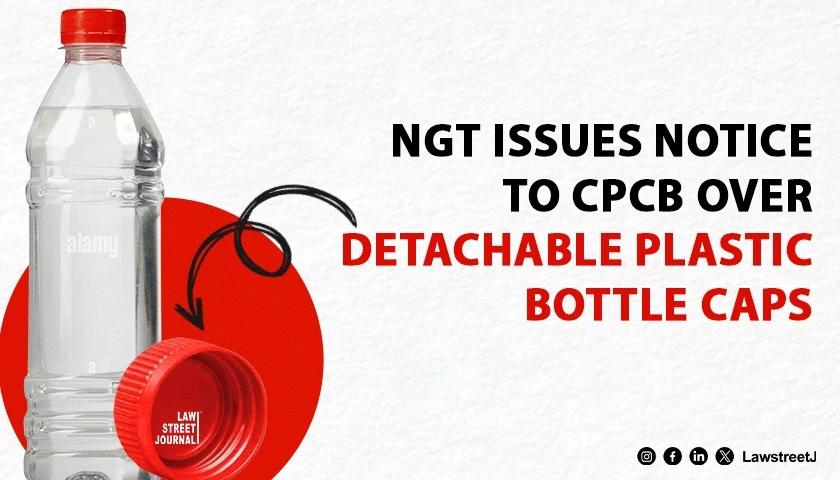
New Delhi: The National Green Tribunal, Principal Bench, New Delhi, issued notice to the Central Pollution Control Board and other respondents on February 20, 2026, in a petition concerning plastic pollution caused by detachable caps of packaged drinking water and beverage bottles. The Bench comprising Justice Prakash Shrivastava, Chairperson, and Dr. Afroz Ahmad, Expert Member, admitted the matter and directed the respondents to file their replies by affidavit through e-filing at least one week before the next date of hearing.
The petition, filed by Aakash Ranison through Advocates Narendra Pal Singh, Yogesh Kumar, and Ishika Singh, contends that while plastic bottles are covered under existing collection mechanisms, their detachable caps fall outside the effective scope of those mechanisms. Since caps are physically separated from bottles at the point of use, they do not enter the waste stream alongside the bottle and therefore evade the collection infrastructure that producers are otherwise obligated to maintain. The applicant submitted that this gap has been addressed in several foreign jurisdictions through the mandatory adoption of tethered caps—a product design standard requiring the cap to remain physically attached to the bottle even after opening—ensuring that both components are collected and processed together.
The European Union addressed this issue through Article 6 of its Single-Use Plastics Directive 2019/904, which made tethered caps mandatory from July 3, 2024, for single-use beverage containers of up to three litres. The directive was introduced because detached caps were identified as a recurring category of litter in European waterway and coastal clean-up data, and because their separation from bottles meant they consistently bypassed formal recycling infrastructure despite producer obligations nominally covering the full packaging unit.
In India, the legal framework governing plastic waste is primarily set out in the Plastic Waste Management Rules, 2016, as most recently amended by the Plastic Waste Management Amendment Rules, 2024, notified by the Ministry of Environment, Forest and Climate Change on March 14, 2024. The Extended Producer Responsibility (EPR) regime in India, although notified in 2022, is being implemented in phases through the fiscal year 2027–28, with the CPCB overseeing compliance through its Centralised EPR Portal for Plastic Packaging. Under this framework, producers, importers, and brand owners are obligated to collect and channel plastic packaging waste and must meet category-specific targets for collection, recycling, and reuse.
The petition essentially places before the Tribunal the question of whether EPR obligations, as currently framed, adequately account for detachable components such as bottle caps that become separated from their primary containers before entering the waste stream. This is a question the existing rules do not appear to address with any specificity. While the 2024 amendments introduced digital EPR certificates, mandatory use of recycled plastics, and enhanced penalties for non-compliance, the framework does not prescribe product design standards of the kind that would keep caps attached to bottles. By drawing the Tribunal’s attention to the tethered cap model, the petition implicitly invites consideration of whether design-based obligations should form part of India’s regulatory response.
The Tribunal directed that the matter be listed alongside OA No. 993/2024 and OA No. 926/2024, in which larger questions of plastic waste collection and regulation of the EPR regime are already pending, on February 26, 2026. The clubbing of the bottle caps petition with the two pending EPR cases suggests that the Tribunal intends to examine the adequacy of the current framework in a consolidated manner rather than on a case-by-case basis.
With the respondents yet to file their replies, the matter is at an early stage. However, the legal question it raises—whether India’s EPR framework must evolve to incorporate product design requirements in addition to collection and recycling targets—is one that the pending proceedings may be well-placed to answer.
Case Details
- Case: Aakash Ranison v. Central Pollution Control Board & Ors.
- Application No.: Original Application No. 137/2026
- Forum: National Green Tribunal, Principal Bench, New Delhi
- Date of Order: February 20, 2026
- Coram: Hon’ble Justice Prakash Shrivastava (Chairperson) and Dr. Afroz Ahmad (Expert Member)
- For Applicant: Mr. Narendra Pal Singh, Mr. Yogesh Kumar, Ms. Ishika Singh, Advocates
- Next Date of Hearing: February 26, 2026


![NGT seeks response on Artificial Light Pollution’s impact on environment and health [Read Order]](/secure/uploads/2024/12/lj_2102_NGT_Probes_Artificial_Light_Pollution’s_Impact_on_Health_and_Environment.jpg)
![Supreme Court questions NGT’s power to direct PMLA prosecution in Pollution Case [Read Order]](/secure/uploads/2025/01/lj_1504_Supreme_Court_questions_NGT’s.webp)