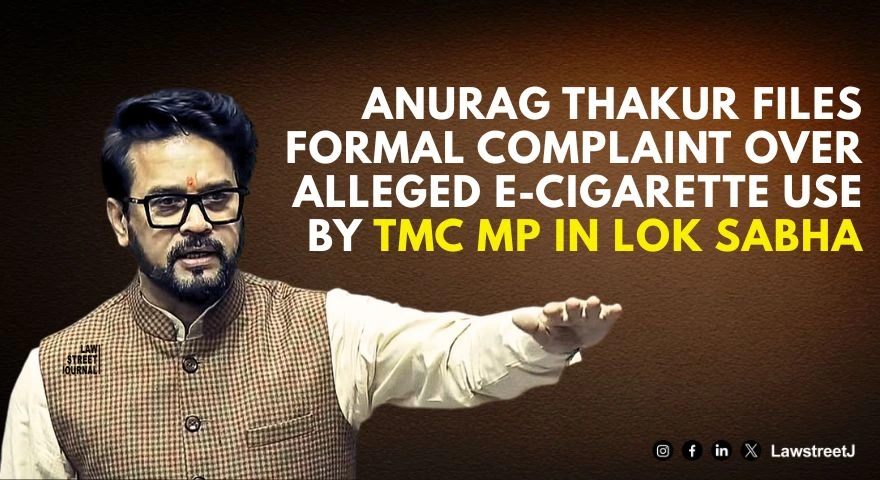
New Delhi: A formal complaint submitted by BJP MP Anurag Thakur to Lok Sabha Speaker Om Birla has stirred debate over parliamentary discipline and statutory compliance, following allegations that a Member of Parliament from the All India Trinamool Congress (AITC) used an electronic cigarette inside the Lok Sabha chamber during a sitting of the Winter Session.
The incident, reportedly witnessed on December 11, 2025, has prompted calls for institutional accountability and legal scrutiny, as the use of e-cigarettes remains prohibited under Indian law.
Parliamentary Decorum and the Complaint
In his written submission dated December 12, Thakur stated that the AITC MP was “seen openly using an electronic cigarette while seated in the House,” describing the act as a “blatant violation of parliamentary decorum and discipline.” The complaint emphasized that the Lok Sabha chamber represents the “sanctum sanctorum of Indian democracy,” and that such conduct undermines the dignity of the House. Thakur urged Speaker Om Birla to initiate disciplinary proceedings under the Rules of Procedure and Conduct of Business in Lok Sabha, which require members to uphold the decorum of the House and refrain from any behavior that disrupts proceedings or disrespects its institutional sanctity.
While the Speaker has not yet issued a formal response, sources within the Parliament Secretariat confirmed that the matter has been taken under review. The identity of the MP in question has not been officially disclosed, although preliminary reports suggest that TMC MP Kirti Azad may be involved. Azad has reportedly dismissed the allegations as “baseless,” stating that the issue is being exaggerated for political mileage.
The use of electronic cigarettes in India is banned under the Prohibition of Electronic Cigarettes Act, 2019, which was passed by both Houses of Parliament and came into effect on December 18, 2019. The Act defines e-cigarettes as electronic devices that heat a substance to create vapor for inhalation, typically containing nicotine or other chemicals.
Key provisions of the Act include:
Section 4: Prohibits the production, manufacture, import, export, transport, sale, distribution, storage, and advertisement of e-cigarettes.
Section 5: Violations are cognizable offences, punishable with imprisonment up to one year or a fine up to ₹1 lakh for first-time offenders. Repeat violations may attract imprisonment up to three years and a fine up to ₹5 lakh.
Section 6: Authorizes law enforcement agencies to conduct searches and seize prohibited items without a warrant under certain conditions.
The legislation was introduced following recommendations from the Indian Council of Medical Research (ICMR), which cited health risks, potential for addiction, and lack of long-term safety data as grounds for prohibition. The Ministry of Health and Family Welfare has reiterated that e-cigarettes pose significant public health concerns, particularly among youth.
Thakur’s complaint invokes the Act directly, arguing that the alleged use of a prohibited device within the Lok Sabha chamber constitutes not only a breach of parliamentary norms but also a statutory offence under laws enacted by the very institution in which the violation occurred.
Institutional Implications and Precedents
This incident marks a rare convergence of parliamentary misconduct and statutory violation within the House. While disciplinary action against MPs is governed by the Speaker’s discretion under Article 118 of the Constitution and the Lok Sabha’s procedural rules, legal breaches may warrant external investigation. The matter could be referred to the Committee on Ethics, which is empowered to examine complaints related to the conduct of members and recommend appropriate sanctions. If the Speaker deems the act to be in violation of national law, it may also be forwarded to law enforcement agencies for further action.
Historically, breaches of decorum such as unauthorized photography, mobile phone usage, and disruptive behavior have led to warnings or temporary suspensions. However, this case introduces a new dimension involving a banned substance, raising questions about enforcement mechanisms and institutional accountability.
As of December 13, 2025, no formal disciplinary action has been announced. The incident has triggered internal discussions across party lines, with several MPs expressing concern over the need to reinforce behavioral protocols and legal compliance within legislative spaces.


![Lakshadweep MP Mohammed Faizal Disqualified from Lok Sabha After Conviction Suspension Plea Rejected by Kerala High Court [Read Notice]](/secure/uploads/2023/10/lj_9640_87b5fd97-0e05-4ff8-9a99-3be1e4446192.jpg)