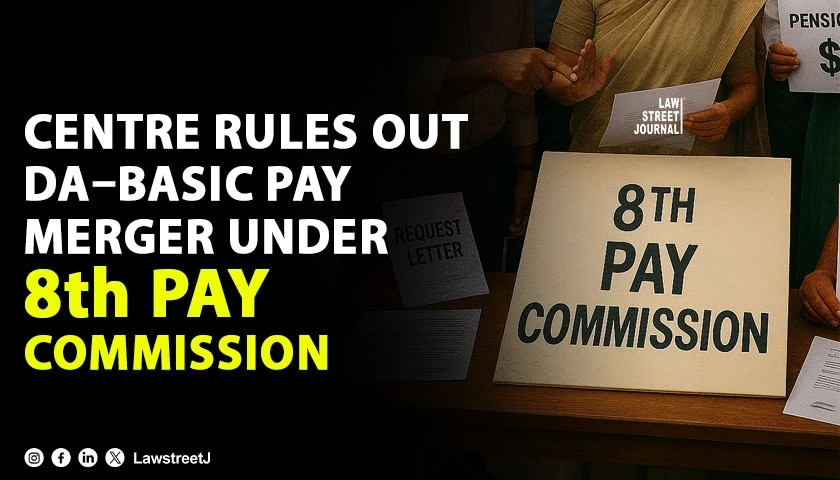
New Delhi: In a key clarification impacting nearly 50 lakh central government employees and pensioners, the Ministry of Finance has confirmed that it is not considering any proposal to merge Dearness Allowance (DA) or Dearness Relief (DR) with basic pay under the 8th Central Pay Commission (CPC). The statement, issued during the Winter Session of Parliament on December 2, 2025, addresses weeks of speculation about possible pay-structure changes amid persistent inflationary pressures.
Minister of State for Finance Pankaj Chaudhary delivered the clarification in a written reply in the Lok Sabha. He stated that no such merger proposal is under examination, bringing clarity to widespread assumptions within employee unions and administrative circles. The clarification comes as the 8th CPC begins its preliminary review process following its formal approval by the Union Cabinet in late October 2025.
Constitutional Basis and Government’s Explanation
The structure and revision of pay for central government employees are anchored in Article 309 of the Constitution, which empowers the President to regulate recruitment and service conditions. Pay Commissions are set up periodically to recommend changes to pay scales, allowances, and pensions based on economic indicators and workforce needs.
The 8th CPC, approved on October 28, 2025, is chaired by former Supreme Court judge Ranjana Prakash Desai and is expected to submit its recommendations by mid-2026.
Responding to questions on whether DA would be merged with basic pay before the new pay commission is implemented, the government emphasized that DA and DR are revised twice a year—January and July—based on the All India Consumer Price Index (AICPI). This mechanism aims to counteract the erosion of purchasing power caused by inflation.
As of December 2025, the DA rate stands at 58% of basic pay, reflecting cumulative adjustments since the start of the 7th CPC cycle.
Officials reiterated that DA/DR is a compensatory allowance, not a permanent component of basic salary. The merger of DA with basic pay is a policy decision requiring separate approval, and does not occur automatically when DA crosses a particular threshold. The Ministry clarified that no such decision is currently under consideration.
The legal framework for these provisions lies in the Central Civil Services (Pension) Rules, 2021, along with the definition of basic pay provided under Fundamental Rules (FR) 9(21). These rules reinforce the distinction between fixed salary elements and variable inflation-linked allowances.
Employee Union Demands and Government’s Stand
Employee unions have consistently demanded an interim merger of 50% DA with basic pay, citing rising household expenses and historical precedent. Their demand is rooted in the recommendations of the 5th Pay Commission, which advised merging 50% DA with basic pay when the allowance crossed the 50% mark—a move implemented in 2004 ahead of the 6th CPC.
However, the present administration has opted not to replicate that step. The Finance Ministry noted that while the previous merger responded to specific economic circumstances, the current macroeconomic environment does not justify such intervention.
Union representatives argue that real income has been hit by inflation and that a merger would provide temporary relief before the 8th CPC’s recommendations come into effect. The government, however, maintains that biannual DA revisions are already designed to offset inflation.
Recent RBI data shows average consumer inflation at 5.4% for FY 2024–25—elevated but still within the central bank’s target band. The government’s fiscal position, shaped by consolidation targets in the Union Budget 2025–26, is also a key factor. A DA-basic pay merger would significantly increase long-term pension and salary liabilities, carrying major fiscal implications.
Impact on Employees and What Lies Ahead
The government’s decision means central government employees and pensioners will continue receiving DA and DR strictly as per the existing formula until the 8th CPC submits its report. The Commission is expected to examine pay parity, pension rationalisation, performance-linked pay, and anomalies carried forward from the 7th CPC.
Experts point out that the government is fully empowered under constitutional and administrative frameworks to decline the merger request. The focus now shifts to the timely completion of the 8th CPC’s work, which will determine the salary and pension structure for the next decade.
The next DA hike, scheduled for January 2026, will follow the standard AICPI-based formula, continuing the established inflation-adjustment mechanism.
Conclusion
The Centre’s clear statement rejecting an immediate DA-basic pay merger settles ongoing speculation as the 8th Pay Commission begins its evaluation. The government has maintained that the existing DA system—guided by statutory rules and economic indicators—will continue unchanged.
Employees and pensioners must now wait for the 8th CPC’s recommendations for the next major salary overhaul, while biannual DA revisions continue to provide periodic protection against inflation.