Historically, cheque bounce cases have seen criminal consequences and punishment of up to 2 years along with fine. In the ongoing pandemic, a lot of businesses are observing hardships. This has led to the chain of agreements being breached. A significant amount of these businesses worked with post-dated cheques. Due to the financial losses, the probability of a cheque being dishonored has increased substantially. Considering these prevailing circumstances, the Union government has decided to provide relief to some extent to this economic stress faced by businesses, by relaxation of laws.
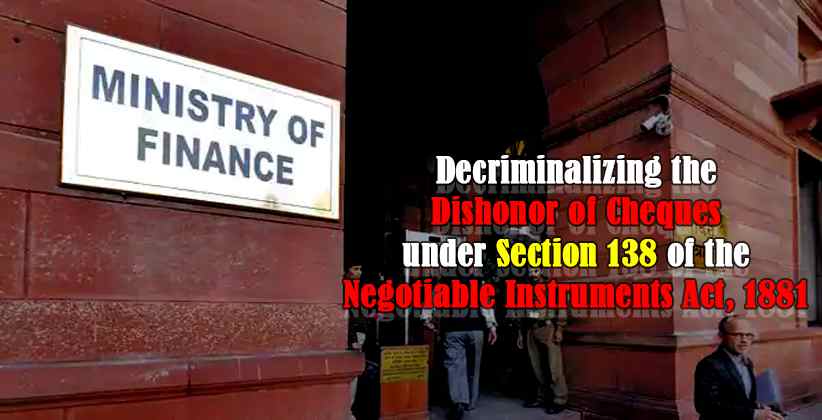
An amendment has been proposed by the Finance Ministry for the amendment of 19 acts. The objective of this amendment is to help overcome the new economic crisis, promote ease of doing business, make the functioning of courts and prison system smooth, decriminalize minor economic offenses including that of cheque bounce, which is currently punishable under Section 138 of the Negotiable Instruments Act, 1881.
The crux of the act is to provide credibility to negotiable instruments and promote their use. With this view in mind, the act has been amended multiple times to ensure that it has widespread attention and reach. The use of cheques is the most common among all the negotiable instruments. This was explicitly the reason for punishing its dishonor in the first place. This step was introduced in 1988 with the view to encourage the culture of using cheques and increasing the credibility of this instrument. Along with punitive measures, laws for speedy trials were also introduced to ensure that the transactions take place smoothly, and justice is dispensed as soon as possible.
The proposed amendment is almost on the opposite extreme as compared to the object of the act. The government claims this will lead to the relief of some amount of economic stress. The fundamental question now has become what will be the consequences of such a move. As opposed to the relief of financial stress, it is highly likely that the credibility of cheques will decrease to a considerable extent. Prima facie, this law seems to bring more problems when compared to relief.
In a society like India, it is essential to have a criminal provision as a deterrent in the minds of people who are used to abuse instruments wit bad intent. Moreover, the lack of penal consequences will inevitably lead to discouragement to the culture of using cheques because it would become tougher to punish the defaulters.
Currently, to recover the amount, a person has two options, initiating a civil suit for recovery and invoking penal proceedings under the Indian Penal Code, 1860. Section 138 of the Act allows for a fine of up to double the amount of the cheque along with the provision of recovery of legal fees. The penal route also involves a lesser court fee as compared to the civil counterpart. This move will primarily result in the victim losing more money out of his pocket.
Since all these cases will now be diverted to civil courts, their functioning will get hampered more than usual. Section 143A of the act allows for immediate compensation of 20% of the cheque amount as interim compensation. This measure will also be laid to rest with the suggested amendment.
What is noteworthy is the fact that a cheque is majorly used as a means of credit through a Post-dated cheque. This institution worked on a very high level of credibility, which will be stripped away. This will cause more problems in the corporate world, along with foreign investors being driven away. If the prosecution of cheques is taken away, the future might not see a reasonable number of transactions using cheques as the instrument.