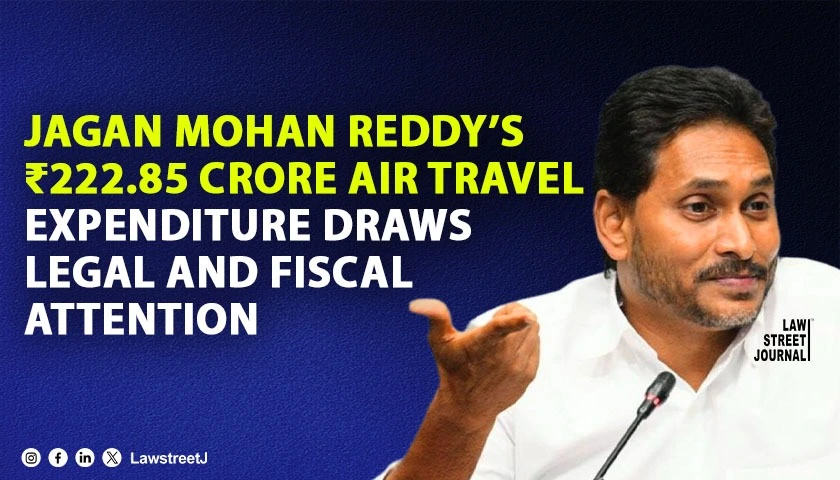
New Delhi: In a disclosure that has stirred debate across administrative and political circles, records from the Andhra Pradesh Aviation Corporation Ltd. (APACL) have revealed that former Chief Minister Y.S. Jagan Mohan Reddy incurred air travel expenses amounting to ₹222.85 crore between May 2019 and May 2024. The expenditure, drawn entirely from the state treasury, has prompted calls for legal scrutiny and fiscal accountability under existing governance frameworks.
Breakdown of Expenditure and Source of Funds
Data obtained through multiple Right to Information (RTI) applications confirms that the bulk of the expenditure was allocated to chartered aircraft and helicopter services used for official travel. Approximately ₹112.50 crore was spent on fixed-wing aircraft, while ₹87.02 crore went toward helicopter operations. An additional ₹23.31 crore covered operational costs such as crew salaries, ground handling, and logistical support.
These expenses were sanctioned and processed through APACL, a state-run entity responsible for managing air travel for government dignitaries. The RTI disclosures indicate that the funds were drawn from the Consolidated Fund of the State, which is governed by the Andhra Pradesh Fiscal Responsibility and Budget Management (FRBM) Act, 2003. This legislation mandates prudent fiscal management and transparency in public spending, especially for discretionary expenditures.
Year-wise data shows a consistent rise in spending: ₹31.43 crore in 2019–20, ₹44 crore in 2020–21, ₹49.45 crore in 2021–22, ₹47.18 crore in 2022–23, and a peak of ₹50.81 crore in 2023–24. These figures have been verified by independent media outlets and legal analysts, confirming the authenticity of the RTI responses.
The controversy intensified when Telugu Desam Party (TDP) leaders, particularly Nara Lokesh, questioned the legitimacy of the expenditure. In response to allegations by YSR Congress Party (YSRCP) supporters that Lokesh had incurred similar travel expenses during his tenure as IT Minister, RTI applications were filed across four departments—Human Resource Development, IT, Electronics and Communication, and Real-Time Governance.
Responses from these departments categorically stated that Nara Lokesh had not claimed any government funds for travel. All expenses were reportedly borne personally, and no reimbursements were processed through departmental budgets. This contrast has led to demands for a forensic audit of APACL’s financial records and a review of procurement practices under guidelines issued by the Comptroller and Auditor General (CAG) of India.
Legal experts point out that under CAG norms, all expenditures from the Consolidated Fund must be justified, documented, and subject to audit. The absence of a formal inquiry by the State Vigilance Commission or the Lokayukta has raised concerns about the enforcement of these norms. Several public interest litigations (PILs) are reportedly being prepared to seek judicial review of the expenditure.
Governance Implications and Public Accountability
While the YSRCP has defended the spending as necessary for administrative outreach, critics argue that the opportunity cost of such expenditure is significant. The ₹222.85 crore could have been redirected toward essential public services such as education, healthcare, and infrastructure development, particularly in underserved districts.
The issue has reignited discussions around the ethics of VIP travel and the need for stricter guidelines on the use of public funds for personal or discretionary purposes. Although the Ministry of Civil Aviation’s protocols emphasize cost-efficiency and accountability, enforcement remains inconsistent across states.
As Andhra Pradesh prepares for its next budget session, opposition parties have signalled that they will table the issue for legislative review. Legal analysts suggest that the matter could lead to amendments in state-level fiscal governance laws, including stronger oversight of aviation-related expenditures.
In the absence of a formal investigation, the debate continues to center on the principles of transparency, legality, and responsible governance. The disclosures have not only highlighted the scale of expenditure but also underscored the importance of institutional checks in safeguarding public resources.