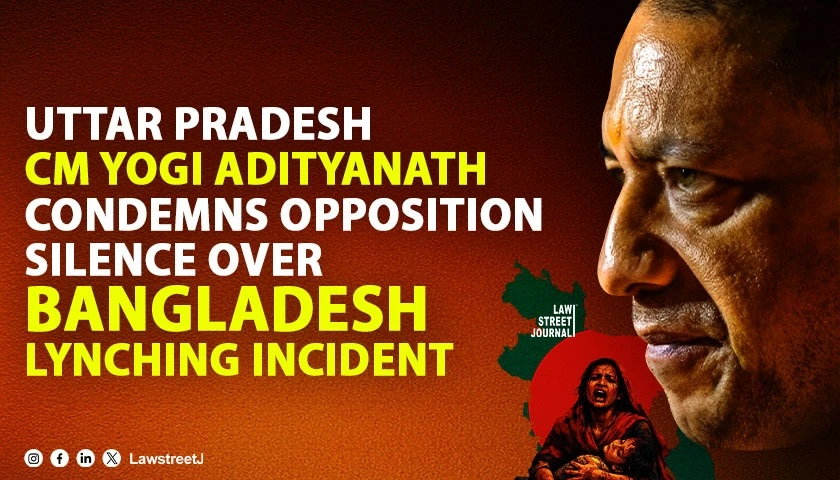
Prayagraj: In a pointed address during the Winter Session of the Uttar Pradesh Legislative Assembly on December 24, 2025, Chief Minister Yogi Adityanath criticised opposition parties for their silence on the alleged lynching of Dipu Chandra Das, a 27-year-old Dalit Hindu youth in Bangladesh. The incident, which occurred on December 18 in the Mymensingh district, has sparked international concern and domestic political debate over selective outrage and minority rights.
Alleged Lynching of Dipu Chandra Das in Bangladesh:
According to reports from Bangladeshi media and international human rights monitors, Dipu Chandra Das was allegedly beaten to death by a mob, and his body was set on fire following accusations of blasphemy. The incident took place in the Mymensingh district, a region that has witnessed sporadic communal tensions in recent years. Das, identified as a member of the Dalit Hindu community, was reportedly accused of making derogatory remarks about religious sentiments on social media, which allegedly led to mob violence.
Bangladesh’s law enforcement agencies have confirmed that an investigation is underway. The country’s Home Ministry has stated that several suspects have been detained for questioning, and forensic teams are examining digital evidence related to the alleged blasphemous post. The Bangladesh Penal Code criminalises blasphemy under Section 295A, which prescribes imprisonment for deliberate and malicious acts intended to outrage religious feelings. However, legal experts in Dhaka have raised concerns about the misuse of blasphemy laws and the lack of due process in cases of mob-led justice.
International human rights organisations, including Amnesty International and Human Rights Watch, have condemned the incident and called for a transparent investigation. The United Nations Office of the High Commissioner for Human Rights (OHCHR) has urged the Bangladeshi government to ensure protection for religious minorities and uphold the rule of law.
CM Adityanath’s Assembly Speech:
During his speech in the Uttar Pradesh Assembly, CM Yogi Adityanath drew a sharp contrast between the vocal support shown by opposition parties for international humanitarian crises, such as the conflict in Gaza, and their silence on the lynching of a Dalit Hindu in Bangladesh. He stated, “You shed tears and hold candle marches for incidents in Gaza, but not a single word emerges when a Dalit Hindu is burned alive in Bangladesh,” referencing the December 18 incident.
Adityanath accused opposition leaders of engaging in vote-bank politics and appeasement, alleging that their selective outrage undermines India’s moral responsibility to speak for persecuted Hindus globally. He called for a resolution in the Assembly to formally condemn the incident and urged the Ministry of External Affairs to raise the issue diplomatically with Bangladesh.
Legal analysts note that while India cannot intervene directly in the internal affairs of a sovereign nation, Article 51 of the Indian Constitution encourages the promotion of international peace and justice. The Ministry of External Affairs has not yet issued an official statement, but sources indicate that diplomatic channels are being used to seek clarity on the investigation and ensure accountability.
Minority Rights and Regional Stability:
The incident has reignited concerns about the safety of religious minorities in Bangladesh, particularly Hindus, who constitute approximately 8.5% of the population, according to the 2022 Bangladesh Bureau of Statistics census. Reports from the Bangladesh Hindu Buddhist Christian Unity Council indicate a rise in targeted violence against minority communities, especially during periods of political instability.
Bangladesh is currently navigating a tense political climate ahead of its general elections scheduled for early 2026. Analysts suggest that communal incidents often escalate during such periods, with minority groups facing increased vulnerability. The lynching of Dipu Chandra Das has prompted protests in parts of India, including West Bengal and Assam, where civil society groups have demanded justice and diplomatic engagement.
Legal experts emphasise the importance of cross-border human rights advocacy and the role of international conventions. Bangladesh is a signatory to the International Covenant on Civil and Political Rights (ICCPR), which mandates protection against arbitrary violence and guarantees freedom of religion. The incident, if confirmed, could constitute a violation of these obligations.
The alleged lynching of Dipu Chandra Das in Bangladesh has triggered a wave of political and legal discourse in India, with Uttar Pradesh Chief Minister Yogi Adityanath’s remarks bringing the issue into sharper national focus. As investigations continue in Bangladesh, the incident underscores the urgent need for regional cooperation on minority rights, legal accountability, and the prevention of mob violence. The Indian government’s response, both diplomatically and legislatively, will be closely watched in the coming weeks.
![Need to develop law, legal education in vernacular languages: CJI [Read Speech]](/secure/uploads/2024/07/lj_1742_Legal_education_in_vernacular_languages_CJI.webp)