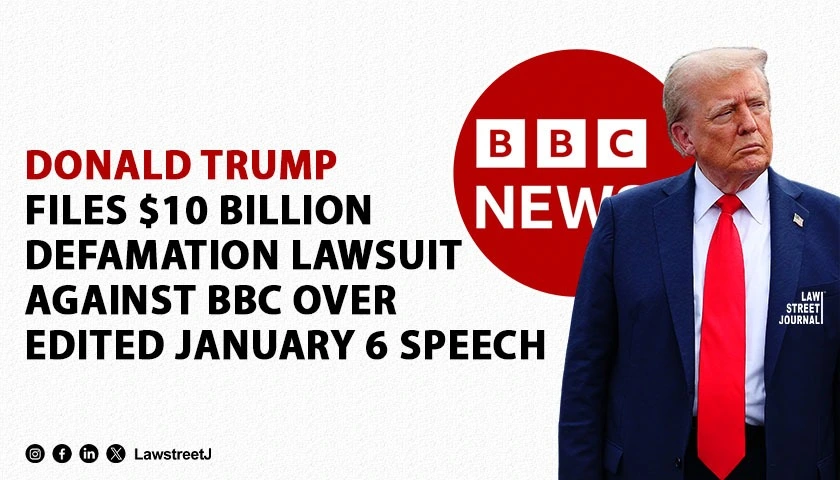
Washington: U.S. President Donald J. Trump has initiated a high-stakes defamation lawsuit against the British Broadcasting Corporation (BBC), seeking $10 billion in damages for what his legal team alleges was the deceptive editing of his January 6, 2021 speech in a BBC documentary. The complaint, filed on December 15, 2025, in the U.S. District Court for the Southern District of Florida, marks a rare international media defamation dispute involving a major public broadcaster.
The lawsuit combines claims of defamation with allegations that the BBC violated Florida’s Deceptive and Unfair Trade Practices Act (FDUTPA). Trump’s attorneys are seeking $5 billion for defamation and $5 billion under Florida’s trade practices laws, asserting that the editing misrepresented his January 6 remarks and caused reputational harm.
Dispute Over BBC Documentary and Editing
The legal action revolves around a Panorama documentary titled Trump: A Second Chance?, which the BBC broadcast in the United Kingdom shortly before the 2024 U.S. presidential election. According to the lawsuit, the documentary spliced together two distinct portions of Trump’s January 6 speech, delivered at the Ellipse in Washington, D.C., on the morning of the Capitol attack.
The complaint alleges that segments featuring Trump’s directive to supporters to “walk down to the Capitol” were placed adjacent to his exhortation to “fight like hell,” creating a misleading impression that he encouraged violent action. The edit allegedly omitted portions of the speech in which Trump urged protesters to remain peaceful.
Trump’s attorneys contend that the composite portrayal was “false, defamatory, deceptive, disparaging, inflammatory, and malicious,” and allege that BBC internal warnings regarding the edited clip were ignored prior to broadcast.
In November 2025, the BBC issued a public apology acknowledging an “error of judgment” in editing the documentary and conceded that the presentation could have created a misleading impression of Trump’s words. However, the broadcaster has maintained that its actions do not meet the legal threshold for defamation and has rejected the basis of the lawsuit.
Jurisdiction and Internal Fallout at the BBC
The controversy reportedly triggered significant internal fallout at the BBC. Director-General Tim Davie and Head of BBC News Deborah Turness resigned amid scrutiny over editorial decision-making and compliance with the BBC’s impartiality guidelines.
Although the documentary was not broadcast in the United States through traditional U.S. television channels, Trump’s legal team argues that jurisdiction in Florida is proper because American viewers could access the content through online platforms such as BritBox and other digital services. The lawsuit further asserts that the BBC’s digital presence and business operations provide sufficient grounds for U.S. court jurisdiction.
Defamation Claim and Legal Requirements
Under U.S. defamation law, a plaintiff must establish:
- A false statement of fact presented as true;
- Publication or dissemination of the statement to a third party;
- Fault amounting to at least negligence by the defendant; and
- Reputational harm resulting from the false statement.
Where the plaintiff is a public figure, as Trump is, the legal standard is higher. He must demonstrate “actual malice,” meaning the defendant knew the statement was false or acted with reckless disregard for its truth or falsity. This standard originates from New York Times Co. v. Sullivan (1964) and remains a cornerstone of U.S. First Amendment jurisprudence.
In addition to defamation, the complaint invokes FDUTPA, which prohibits deceptive practices in trade or commerce. Trump’s legal team argues that the BBC’s editing and presentation of the footage constituted unfair and misleading conduct in violation of the statute. The use of FDUTPA in media-related litigation is relatively uncommon and may face legal challenges regarding its applicability to editorial content.
Legal experts note that media defendants often rely on strong constitutional protections for free speech and press freedom, which could complicate Trump’s claims. The BBC is expected to argue that editorial decisions are protected by broad press safeguards and that even flawed edits do not necessarily amount to actionable defamation absent proof of knowing falsity or reckless disregard.
Furthermore, the BBC may contend that the documentary’s overall context and the substantial truth doctrine—particularly the use of Trump’s own words—undermine claims of a false defamatory narrative. Establishing damages in high-value media defamation cases also requires concrete evidence of specific reputational or financial harm.
Broader Context
The lawsuit adds to a series of legal actions Trump has initiated against media organisations. In 2025, he filed high-profile defamation suits against The New York Times, CBS, ABC, and other outlets, seeking multibillion-dollar damages over coverage he characterized as unfair or misleading. Some of those cases resulted in settlements with major broadcasters.
Notable precedent in this area includes Dominion Voting Systems v. Fox News Network, in which Dominion sought $1.6 billion over election-related reporting. That case highlighted the stringent legal standards governing defamation claims involving public discourse.
Trump’s lawsuit seeks a jury trial and substantial monetary damages and is expected to face rigorous judicial scrutiny in federal court. The BBC has indicated that it does not intend to settle and has stated that the documentary will not be rebroadcast in its original form. The proceedings are likely to involve close examination of editorial processes, internal communications within the BBC, and expert testimony on media ethics and defamation law.