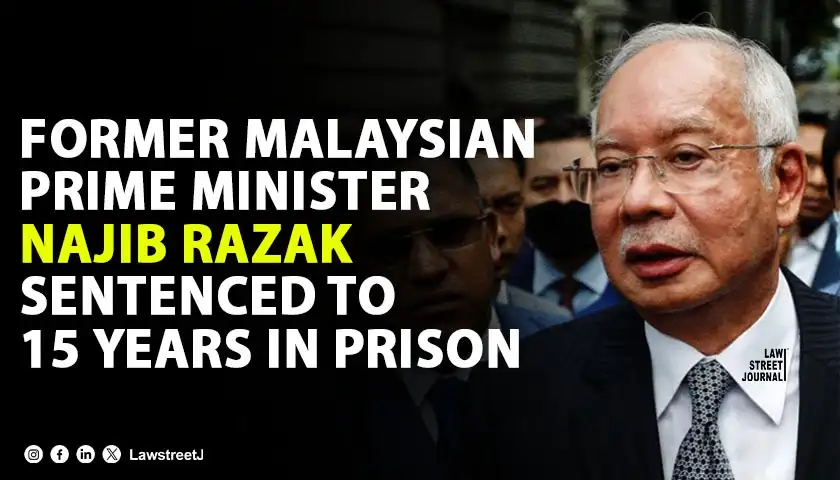
New Delhi: In a landmark ruling marking a pivotal moment in Malaysia’s judicial history, the High Court has sentenced former Prime Minister Najib Razak to 15 years’ imprisonment and imposed a fine of RM11.4 billion after convicting him on multiple charges related to the 1Malaysia Development Berhad (1MDB) scandal.
Verdict and Sentencing Details
Justice Datuk Collin Lawrence Sequerah, presiding over the High Court in Putrajaya, delivered the verdict on December 26, 2025, concluding a trial that spanned over seven years. Najib was found guilty on four counts of abuse of power and 21 counts of money laundering involving RM2.3 billion in misappropriated funds linked to 1MDB.
- Abuse of Power Charges: Najib was sentenced to 15 years’ imprisonment for each of the four counts, to run concurrently.
- Money Laundering Charges: He was sentenced to five years’ imprisonment for each of the 21 counts, also to run concurrently.
- Financial Penalty: The court imposed a total fine of RM11.4 billion. In default of payment, Najib faces an additional 40 years’ imprisonment.
The judge clarified that the new sentence will commence only after Najib completes his current 12-year prison term arising from his previous conviction in the SRC International case, another 1MDB-linked matter.
Legal Proceedings and Case Background
The 1MDB case is among the most significant corruption trials in Malaysia’s history. The charges stem from Najib’s alleged role in the misappropriation of billions of ringgit from 1MDB, a state investment fund established in 2009 during his tenure as Prime Minister. Although the fund was intended to promote economic development, it became the centre of a global financial scandal.
The prosecution presented extensive evidence, including financial records, witness testimonies, and forensic audits, tracing RM2.3 billion in illicit transfers to Najib’s personal accounts. The defence argued that Najib was misled by financial advisers and lacked direct knowledge of the transactions. However, the court found the evidence sufficient to establish criminal intent and abuse of authority.
Justice Sequerah emphasised the gravity of the offences, noting that the scale of financial misconduct had severely undermined public trust in government institutions. He observed that the court must send a clear message that abuse of public office for personal gain will not be tolerated.
The case was prosecuted by the Attorney General’s Chambers, with Datuk Seri Gopal Sri Ram appearing as lead prosecutor. The defence team was led by Tan Sri Muhammad Shafee Abdullah.
Implications and Next Steps
Najib’s conviction and sentencing carry significant legal and political implications. As the first former Malaysian Prime Minister to be convicted and imprisoned for corruption, the ruling sets a precedent for accountability at the highest levels of government. The RM11.4 billion fine is among the largest ever imposed in Malaysian judicial history.
Legal analysts note that recovery of the full amount may involve asset seizures and international cooperation, given the global reach of the 1MDB scandal. Najib retains the right to appeal the verdict before the Court of Appeal and, subsequently, the Federal Court. His legal team has indicated that an appeal will be filed, citing procedural irregularities and disputing the interpretation of financial evidence.
Meanwhile, the Malaysian Anti-Corruption Commission (MACC) has reiterated its commitment to pursuing other individuals and entities implicated in the broader 1MDB investigation. Several related cases remain pending, including those involving foreign financial institutions and intermediaries.
The sentencing comes amid renewed efforts by the Malaysian government to restore public confidence and strengthen anti-corruption mechanisms. The Ministry of Finance has reaffirmed its intention to recover misappropriated funds and enhance transparency in state-linked investments.