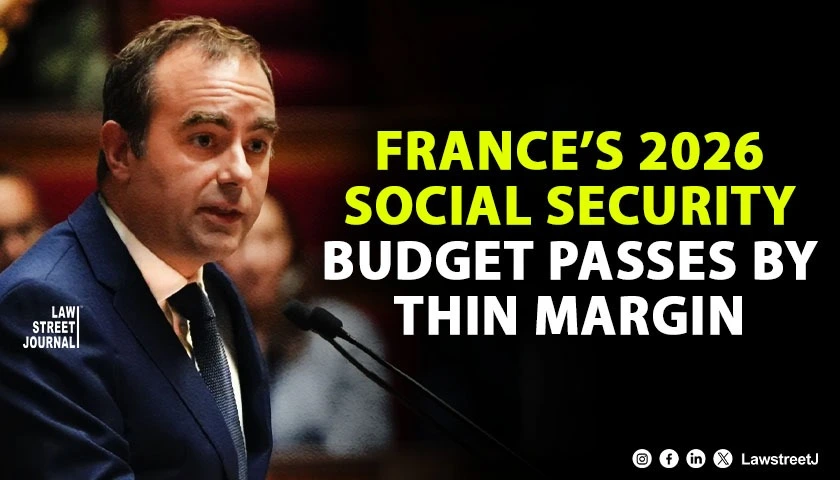
France: In a tense and closely watched vote, France’s National Assembly approved the 2026 social security budget late Tuesday evening, offering Prime Minister Sébastien Lecornu a temporary reprieve amid growing political fragmentation. The bill—central to the government’s fiscal roadmap—passed by a margin of just 13 votes, underscoring both the fragility of Lecornu’s minority coalition and the complex negotiations required to secure legislative support.
Legal Framework and Budgetary Provisions
The social security budget, formally known as the Projet de loi de financement de la sécurité sociale (PLFSS), is a constitutionally mandated annual bill under Article L.O.111-3 of the French Social Security Code. It governs the financial operations of France’s welfare system—including healthcare, pensions, disability provisions, and family benefits.
For the 2026 fiscal year, the PLFSS outlines €640 billion in expenditures with a projected deficit of €30.6 billion. Key provisions include:
- Suspension of the 2023 pension reform, which had raised the retirement age from 62 to 64—a measure introduced to gain support from left-wing lawmakers, particularly the Socialist Party.
- A €5.2 billion increase in hospital funding, targeting emergency services and elderly-care facilities.
- Expansion of mental-health coverage, including teleconsultation reimbursements and youth therapy programs.
- Tighter controls on pharmaceutical reimbursements to reduce fraud and optimize spending.
The budget also aligns with France’s obligations under the European Union’s Stability and Growth Pact, which requires member states to maintain deficits below 3% of GDP. France’s current deficit stands at 4.4%, prompting scrutiny from Brussels and international credit agencies.
Prime Minister Lecornu, appointed in November following Élisabeth Borne’s resignation, faced his first major legislative test with the PLFSS vote. The government, lacking an absolute majority in the 577-seat National Assembly, relied heavily on cross-party negotiations to secure passage:
- Socialist deputies backed the bill after the pension-reform suspension was confirmed.
- Centrist and conservative lawmakers, including members of Les Républicains, opposed the budget, citing excessive concessions and fiscal imprudence as key concerns.
- The National Rally (RN), led by Marine Le Pen, voted against the bill and reiterated calls for snap elections, arguing that the government lacked democratic legitimacy.
The final vote count stood at 287 in favor, 274 against, and 16 abstentions. The narrow margin reflects deep ideological divides and signals potential instability ahead of the upcoming state-budget vote. Lecornu chose not to invoke Article 49-1 of the French Constitution—which allows the government to tie a bill to a vote of confidence—and instead relied on standard parliamentary procedure, a move interpreted as an effort to preserve institutional decorum amid rising tensions.
Legal Implications and Forward Outlook
The passage of the PLFSS averts immediate constitutional risks. Failure to approve the budget could have triggered Article 12 of the Constitution, enabling President Emmanuel Macron to dissolve the Assembly and call early elections. The approval also ensures continuity in funding for France’s social programs, which serve more than 67 million citizens.
However, legal analysts warn that the suspension of the pension reform may face judicial scrutiny. The Constitutional Council—France’s highest authority on legislative compliance—could be petitioned to assess whether the reversal conflicts with prior fiscal commitments or undermines long-term sustainability.
Financial markets responded cautiously. The CAC 40 index closed marginally higher, while bond yields remained stable, though analysts noted persistent concerns about long-term fiscal pressures. Credit-rating agencies, including Moody’s and Fitch, have placed France’s outlook under observation, citing political uncertainty and structural deficits.
In a post-vote statement, Lecornu emphasized the importance of compromise:
“This budget is not just numbers; it’s a commitment to the French people. We must govern with responsibility and dialogue.”
The bill now proceeds to the Senate, where further amendments may be proposed. While the Senate’s role is consultative, its feedback could influence future negotiations and shape the final version of the state budget.
France’s approval of the 2026 social security budget marks a critical juncture for Prime Minister Sébastien Lecornu’s administration. While the vote secures short-term stability, it also exposes the delicate balance of power within a fragmented legislature. With broader fiscal reforms pending and political opposition mounting, the path ahead remains complex and closely monitored both in Paris and across the European Union.