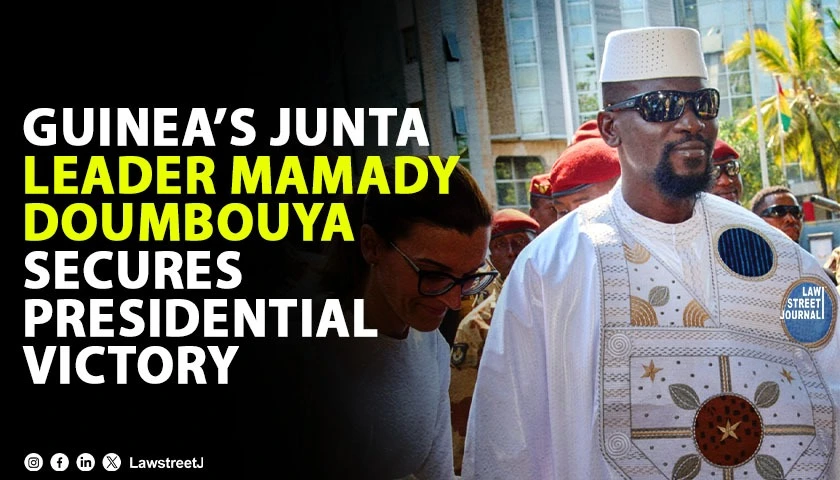
New Delhi: Gen. Mamadi Doumbouya has been declared the winner of Guinea’s December 2025 presidential election, securing 86.72% of the vote, according to provisional results released by the General Directorate of Elections. The outcome marks a formal transition from military to civilian rule following Doumbouya’s 2021 coup.
Provisional Results Confirm Doumbouya’s Landslide Win
On December 30, 2025, Guinea’s General Directorate of Elections announced provisional results from the presidential election held on December 28. Gen. Mamadi Doumbouya, the country’s interim leader since the 2021 coup, won 86.72% of the vote, securing an absolute majority and avoiding a runoff. The election featured eight candidates, though several prominent opposition figures were barred from contesting or remained in exile, significantly narrowing the competitive field.
The Supreme Court of Guinea has eight days from the announcement to validate the results, as stipulated under Article 94 of the Electoral Code, which governs the legal framework for presidential elections in the Republic of Guinea.
Doumbouya cast his vote in Conakry alongside his wife, Lauriane Doumbouya, in a public display of civic participation. The General Directorate confirmed a voter turnout of approximately 61%, though independent observers have yet to verify this figure.
From Coup to Civilian Rule
Mamady Doumbouya first came to power in September 2021, leading a military coup that ousted then-President Alpha Condé. Following the coup, Doumbouya suspended the Constitution, dissolved the National Assembly, and established the National Committee of Reconciliation and Development (CNRD) as the ruling body.
Under international pressure, including from the Economic Community of West African States (ECOWAS), Doumbouya committed to a transition timeline culminating in elections by the end of 2025. The December vote was the first presidential election since the coup and was intended to restore constitutional order.
The legal framework for the election was reinstated in early 2025 through Ordinance No. 2025/01/CNRD, which reactivated the 2010 Constitution and the Electoral Code. However, critics have raised concerns over the exclusion of opposition leaders, including Cellou Dalein Diallo and Sidya Touré, both of whom were barred from running due to unresolved legal proceedings and alleged threats to national stability.
International observers from the African Union (AU) and the United Nations Office for West Africa and the Sahel (UNOWAS) monitored the election but have not yet released a comprehensive assessment of its fairness. Preliminary statements noted a peaceful voting process, though concerns remain regarding media restrictions, limited campaign freedoms, and judicial impartiality.
Implications and Next Steps in Guinea’s Political Transition
The Supreme Court of Guinea, led by Chief Justice Mamadou Sylla, is expected to review the provisional results and address any legal challenges filed by candidates or civil society groups. As of December 31, no formal petitions have been submitted, though opposition figures have publicly questioned the legitimacy of the vote.
If validated, Doumbouya will be sworn in under Article 95 of the Electoral Code, which mandates inauguration within 15 days of final result certification. His administration will be tasked with reconstituting the National Assembly, reforming the judiciary, and implementing economic recovery plans in a country rich in bauxite and iron ore but burdened by high unemployment and infrastructure deficits.
The international community, including ECOWAS, the African Union, and the European Union, has urged Guinea to uphold democratic principles and ensure inclusive governance. ECOWAS Chairperson Bola Tinubu issued a statement calling for “a transparent post-election process and national reconciliation.”
Legal analysts note that Doumbouya’s presidency will be closely scrutinized for adherence to constitutional norms, particularly regarding press freedom, judicial independence, and human rights protections, which were curtailed during the transitional period.