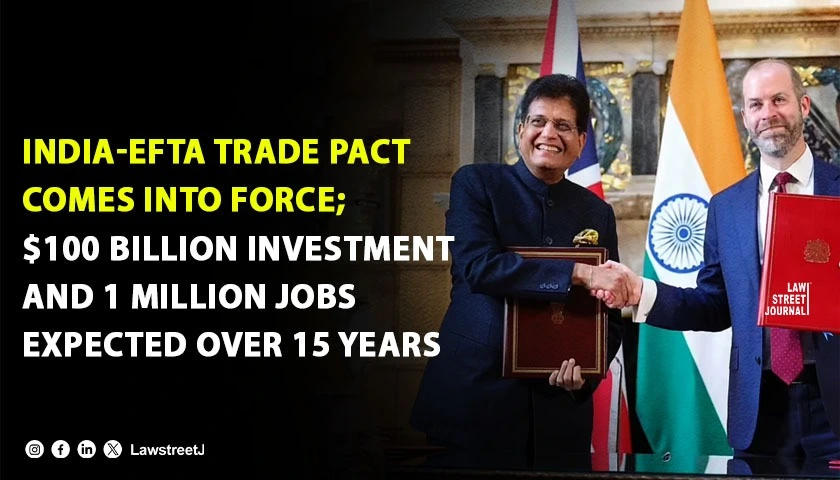
New Delhi: The Trade and Economic Partnership Agreement (TEPA) between India and the European Free Trade Association (EFTA) officially came into effect on October 1, 2025, marking a significant milestone in India’s international trade and investment landscape. The agreement, signed on March 10, 2024, in New Delhi, is the first Free Trade Agreement (FTA) between India and the four EFTA member states—Switzerland, Norway, Iceland, and Liechtenstein—and includes a binding commitment of $100 billion in investments and the creation of one million direct jobs over the next 15 years.
Strategic Investment Commitments and Sectoral Impact
Under the TEPA framework, EFTA nations have pledged to invest $100 billion in India, targeting key sectors such as renewable energy, manufacturing, information technology, education, and audiovisual services. The agreement includes Mutual Recognition Agreements (MRAs) in professional services, covering fields such as nursing, chartered accountancy, and architecture, which are expected to facilitate cross-border professional mobility and service delivery.
The pact also enhances market access by eliminating tariffs on a wide range of goods. EFTA countries will cover 92.2% of tariff lines, accounting for 99.6% of India’s exports, while India will reciprocate by covering 82.7% of tariff lines, representing 95.3% of EFTA’s exports. Sensitive sectors such as dairy, soya, coal, and agriculture have been protected under the agreement, ensuring that domestic interests are safeguarded.
Legal provisions within TEPA include enforceable clauses on investment protection, intellectual property rights, and dispute resolution mechanisms, aligning with international standards and ensuring legal certainty for investors. The agreement also incorporates sustainability and technology cooperation, with a focus on green growth and innovation.
Employment Generation and Economic Reform Linkages
TEPA is projected to generate one million direct jobs in India over the next 15 years, according to official estimates from the Ministry of Commerce and Industry. These jobs are expected to emerge primarily in manufacturing, services, and infrastructure development, driven by foreign capital inflows and expanded export opportunities.
The agreement complements India’s ongoing economic reform initiatives, including the Make in India campaign, simplified regulatory frameworks, and liberalised Foreign Direct Investment (FDI) norms. These reforms have contributed to India’s rise as one of the fastest-growing major economies, with a GDP growth rate of 6.8% in FY 2024–25, according to the Reserve Bank of India.
Legal experts note that TEPA’s binding investment and employment commitments are unprecedented in India’s FTA history. The pact includes monitoring and review mechanisms to ensure compliance and transparency, with periodic assessments scheduled between Indian and EFTA representatives.
Geopolitical Significance and Future Outlook
The India-EFTA TEPA is viewed as a strategic move to deepen economic ties with developed European economies outside the European Union. Switzerland, the largest EFTA economy, has historically maintained strong bilateral trade relations with India, and TEPA is expected to further strengthen this partnership.
The agreement also positions India as a preferred investment destination amid global economic shifts and supply-chain diversification. With geopolitical tensions influencing trade realignments, India’s stable macroeconomic environment and reform-driven governance have attracted increased interest from developed nations.
From a legal standpoint, TEPA sets a precedent for future FTAs by embedding quantifiable investment and employment targets—a feature not commonly found in traditional trade agreements. The pact’s implementation will be overseen by a Joint Committee empowered to resolve disputes and recommend amendments, ensuring adaptability to evolving economic conditions.
As of December 2025, TEPA is fully operational, and investment flows are expected to begin in early 2026, following the ratification of implementation protocols by all member states. The Ministry of Commerce and Industry has announced plans to establish a dedicated TEPA Facilitation Cell to assist stakeholders and monitor progress.