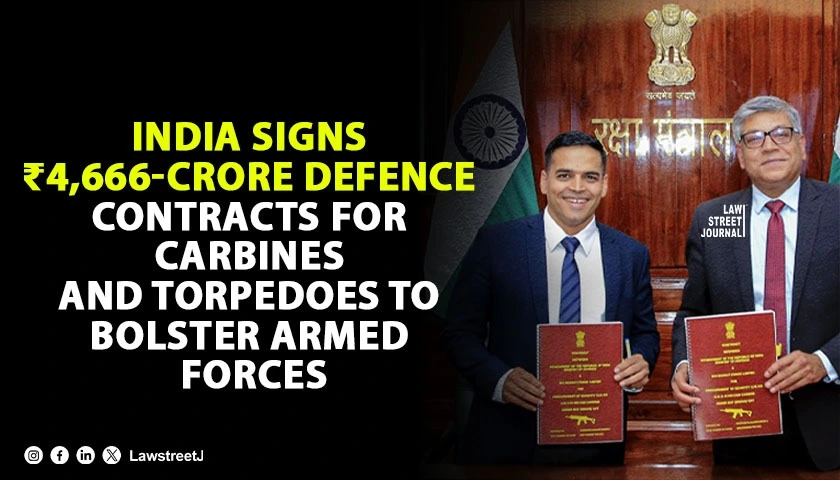
New Delhi: On December 30, 2025, the Ministry of Defence formalized two major procurement contracts totaling ₹4,666 crore for Close Quarter Battle Carbines and Heavyweight Torpedoes, marking a significant stride in India’s defence modernisation and indigenisation efforts.
Strategic Procurement to Enhance Combat Readiness
The Ministry of Defence (MoD), Government of India, signed two high-value contracts on December 30, 2025, aimed at strengthening the operational capabilities of the Indian Armed Forces. The contracts were executed in the presence of Defence Secretary Rajesh Kumar Singh at South Block, New Delhi, and form part of the government’s ongoing initiative under the Aatmanirbhar Bharat Abhiyan to reduce dependence on foreign military imports.
The first contract, valued at ₹2,770 crore, involves the procurement of over 4.25 lakh Close Quarter Battle (CQB) Carbines for the Indian Army and the Indian Navy. These carbines will be supplied by Bharat Forge Ltd and PLR Systems Pvt Ltd, both Indian defence manufacturers. The carbines are intended to replace ageing legacy systems and equip soldiers with modern, lightweight, and high-lethality weapons suitable for close-combat scenarios.
The second contract, worth ₹1,956 crore, was signed with WASS Submarine Systems, Italy, for the supply of 48 Heavyweight Torpedoes. These torpedoes are designed for deployment on Kalvari Class submarines, enhancing India’s underwater warfare capabilities. The procurement aligns with India’s strategic maritime defence posture in the Indo-Pacific region.
Legal Framework and Procurement Process
Both contracts were executed under the Defence Acquisition Procedure (DAP) 2020, which governs capital acquisitions for the Indian Armed Forces. The DAP emphasises transparency, indigenous manufacturing, and timely delivery. The CQB Carbine contract falls under the Buy and Make (Indian) category, ensuring that the bulk of manufacturing and assembly occurs within India, with technology transfer provisions where applicable.
Bharat Forge and PLR Systems, the selected vendors for the carbines, are registered under the Ministry of Defence’s approved vendor list and have met all technical and financial criteria stipulated in the tender. The procurement process involved competitive bidding, field trials, and compliance with the General Financial Rules (GFR) 2017, ensuring legal and procedural integrity.
The torpedo contract with WASS Submarine Systems was finalised under the Buy (Global) category, as the required technology is not currently available indigenously. However, the MoD has mandated offset obligations under the Defence Offset Guidelines 2020, requiring the foreign vendor to invest a portion of the contract value back into India’s defence ecosystem through technology partnerships or local sourcing.
Operational Impact and Indigenous Push
The CQB Carbines are expected to be delivered in phased batches over the next 24 months, with initial units prioritised for frontline infantry and naval boarding teams. The carbines feature a modular design, enhanced ergonomics, and compatibility with modern optics and accessories. Their deployment is anticipated to significantly improve close-range combat effectiveness, particularly in counter-insurgency and urban warfare operations.
The Heavyweight Torpedoes from WASS are slated for integration with the Indian Navy’s Kalvari Class submarines, which are part of Project 75. These torpedoes offer advanced guidance systems, high payload capacity, and deep-water engagement capabilities. Their induction will enhance India’s deterrence posture and submarine fleet lethality.
Both procurements reflect the government’s dual focus on modernising the armed forces and promoting indigenous defence manufacturing. The CQB Carbine contract, in particular, marks a milestone in India’s efforts to build a self-reliant defence industrial base. Bharat Forge and PLR Systems have committed to setting up additional production lines and training programmes to meet delivery timelines and quality standards.
The ₹4,666-crore contracts signed by the Ministry of Defence on December 30, 2025, represent a legally sound and strategically significant investment in India’s defence preparedness. By adhering to established procurement laws and promoting domestic manufacturing, the government has reinforced its commitment to national security and industrial self-reliance. The timely execution and future deployment of these systems will play a crucial role in enhancing the operational capabilities of the Indian Armed Forces.


![SC Asks States to Extend Ex-Military Reservation to Disabled Out-Boarded Cadets [Read Order]](/secure/uploads/2026/08/lj_2165_ChatGPT_Image_Aug_8,_2026,_02_26_46_AM.webp)