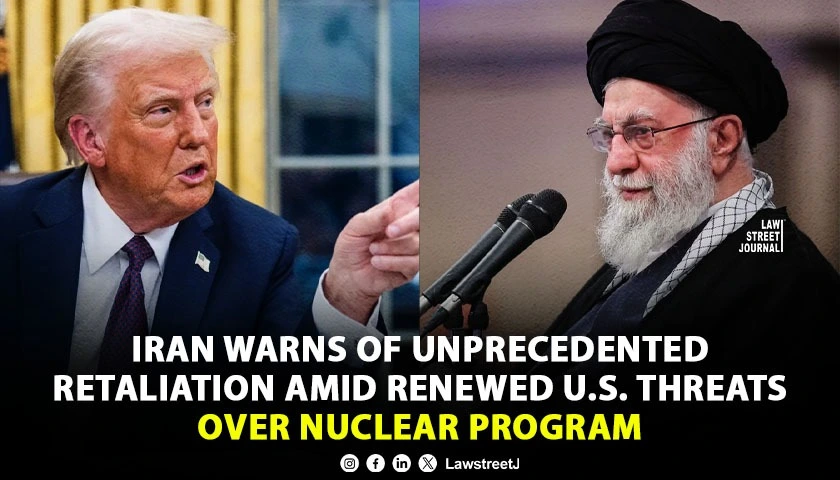
New Delhi: U.S. President Donald Trump reignited tensions with Iran by publicly demanding that Tehran dismantle its nuclear weapons development programmes. In a post on social media, Trump warned that a “massive armada,” led by the USS Abraham Lincoln, was en route to Iran, stating that unless Iran agrees to a new nuclear deal, “the next attack will be far worse.” This marks a significant escalation following the U.S. withdrawal from the Joint Comprehensive Plan of Action (JCPOA) in 2018, which had previously placed limits on Iran’s nuclear activities. Trump’s latest remarks suggest a return to coercive diplomacy, with military force used as leverage. The President emphasised urgency, stating, “Time is running out; it is truly of the essence.”
The Pentagon has not officially confirmed the deployment details, but defence analysts have reported increased naval activity in the Persian Gulf, consistent with Trump’s statements.
Iran’s Response: Legal and Diplomatic Rebuttal at the United Nations
In response, Iran’s Permanent Mission to the United Nations issued a formal statement on the social media platform X, warning that any attack would provoke a response “like never before.” The statement referenced historical U.S. military engagements, noting:
“The last time the U.S. blundered into wars in Afghanistan and Iraq, it squandered over $7 trillion and lost more than 7,000 American lives.”
Iran emphasised its willingness to engage in dialogue, provided it is based on “mutual respect and interests.” However, the mission reiterated that Iran would defend itself forcefully if provoked. Foreign Minister Abbas Araghchi echoed this stance, stating that Iran remains committed to a peaceful resolution but will not tolerate threats to its sovereignty.
Under international law, particularly Article 51 of the UN Charter, Iran retains the right to self-defence if subjected to an armed attack. The Iranian statement appears to invoke this legal framework, signalling that any military aggression would be met with lawful retaliation.
Geopolitical and Economic Implications
The renewed confrontation has triggered regional and global concern. Germany’s Chancellor Friedrich Merz commented that the Iranian government’s “days are numbered,” reflecting growing European unease. Meanwhile, Iran’s currency has plummeted, reaching a record low of 1.6 million rials per U.S. dollar amid ongoing domestic protests and economic instability.
Analysts warn that further escalation could disrupt global oil markets, given Iran’s strategic position in the Strait of Hormuz, through which nearly 20% of global petroleum supplies pass.
The International Atomic Energy Agency (IAEA) has not confirmed any recent violations by Iran but continues to monitor the situation. The U.S. has not presented new evidence of nuclear weaponisation, relying instead on strategic pressure.
Legal Summary
- U.S. Position: Trump’s threat is not backed by a new UN Security Council resolution. Any military action without such authorisation may contravene international law.
- Iran’s Position: Invokes self-defence rights under Article 51 of the UN Charter.
- Diplomatic Status: No formal negotiations have resumed. Iran remains open to dialogue, but no third-party mediation has been announced.
The situation remains volatile. Both nations have invoked legal and historical precedents to justify their positions. The international community is watching closely, with potential implications for regional stability, global energy markets, and diplomatic norms.

.webp)