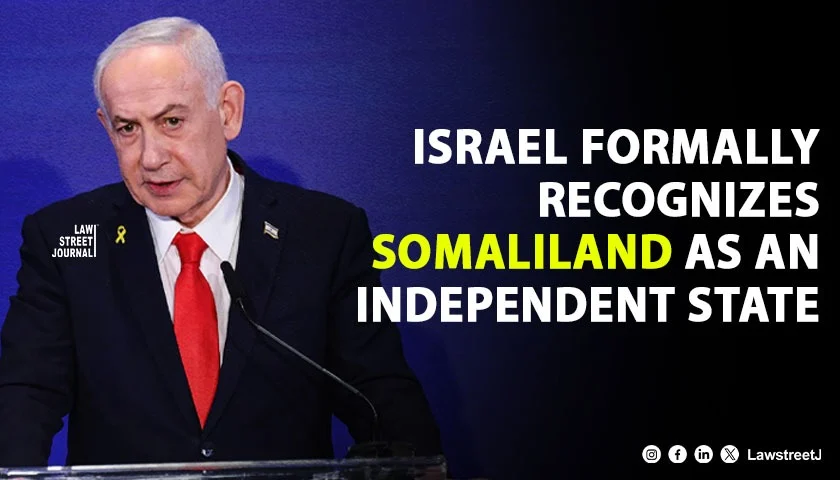
New Delhi: On December 26, 2025, Israel became the first country to officially recognize the Republic of Somaliland as an independent state, ending over three decades of diplomatic ambiguity. The move carries significant legal, geopolitical, and regional implications.
Diplomatic Breakthrough:
In a landmark development, Prime Minister Benjamin Netanyahu and Foreign Minister Gideon Sa’ar signed Israel’s declaration recognizing the Republic of Somaliland as an independent nation. The signing ceremony, held in Jerusalem, was attended virtually by Somaliland President Abdirahman Mohamed Abdullahi, who also signed the declaration on behalf of his government.

The recognition follows Somaliland’s unilateral declaration of independence from Somalia in 1991, after the collapse of the Siad Barre regime. Despite establishing its own government, currency, and security apparatus, Somaliland remained unrecognized by any UN member state until Israel’s announcement.
According to the Israel Government Press Office, the recognition forms part of a broader diplomatic initiative aimed at expanding ties across Africa and the Red Sea region. The declaration also includes provisions for establishing full diplomatic relations, including the opening of embassies and bilateral cooperation in trade, security, and technology.
The legal ramifications of Israel’s recognition are significant. Under international law, recognition of statehood is a sovereign act, and Israel’s move does not require approval from multilateral bodies such as the United Nations. However, it challenges the African Union’s long-standing position that Somaliland is part of Somalia’s territorial integrity.
Somalia’s government, based in Mogadishu, has condemned the recognition, calling it a violation of its sovereignty and territorial unity. In a statement released on December 26, Somalia’s Ministry of Foreign Affairs urged the international community to reject Israel’s decision and reaffirm support for Somalia’s territorial claims.
Legal experts note that Somaliland meets several criteria for statehood under the Montevideo Convention, including a permanent population, a defined territory, a government, and the capacity to enter into relations with other states. However, the lack of widespread recognition has historically limited its participation in international organizations such as the United Nations, World Bank, and African Union.
Israel’s recognition could set a precedent for other countries to follow, particularly those with strategic interests in the Horn of Africa. Somaliland’s geographic location along the Gulf of Aden makes it a critical node for maritime security and trade routes, especially in light of regional instability in Yemen and the Red Sea corridor.
Strategic and Regional Reactions:
The timing of the recognition aligns with Israel’s broader diplomatic outreach under the Abraham Accords framework, which has facilitated normalization agreements with several Arab states since 2020. Somaliland’s leadership has expressed interest in joining the Accords, signaling potential cooperation in counterterrorism, infrastructure development, and energy projects.

Regional powers have responded with caution. Ethiopia and the United Arab Emirates, both of which maintain informal ties with Somaliland, have not issued formal statements but are reportedly monitoring the situation closely. Egypt and Djibouti, which support Somalia’s territorial claims, have expressed concern over the potential destabilization of regional alliances.
The United States has not yet commented officially, though analysts suggest Washington may take a measured approach, balancing its support for Somalia’s federal government with its strategic interests in the Horn of Africa.
Israel’s recognition also opens the door for legal and diplomatic negotiations on bilateral treaties, trade agreements, and consular services. The Israeli Ministry of Foreign Affairs confirmed that a joint committee will be established to oversee the implementation of diplomatic protocols, including visa arrangements, investment frameworks, and cultural exchanges.
Israel’s recognition of Somaliland as an independent state marks a pivotal moment in African and Middle Eastern diplomacy. While the move is legally valid under international norms, it introduces complex geopolitical dynamics that will require careful navigation by regional and global actors. As Somaliland steps onto the international stage with its first formal recognition, the coming months will be critical in shaping its diplomatic trajectory and legal standing within the global community.