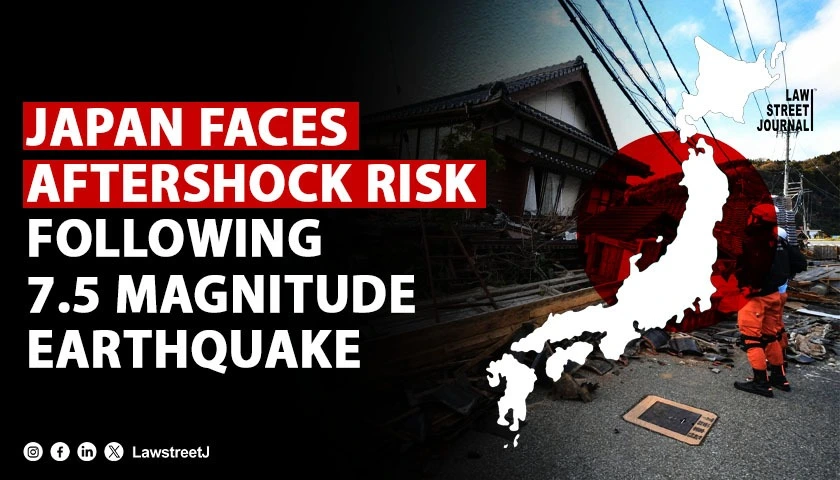
Japan: Japan is assessing the aftermath of a 7.5 magnitude earthquake that struck off its northeastern coast late on December 8, 2025. The strong tremor prompted a tsunami warning, caused injuries to at least 33 people, and triggered large-scale evacuations across several coastal communities. While authorities lifted the tsunami alert within hours, officials continue to warn of possible aftershocks and a slight increase in the risk of a stronger seismic event in the coming days.
Seismic Impact and Government Emergency Response
The earthquake occurred at approximately 11:15 p.m. JST in the Pacific Ocean, about 80 kilometers off the Aomori Prefecture coast in northern Honshu. The Japan Meteorological Agency (JMA) reported a magnitude of 7.5, followed by a 5.1 magnitude aftershock early on December 9. Strong shaking was felt across Aomori, Hachinohe, and surrounding areas, with reports of infrastructure damage and disruptions to local services.
The Fire and Disaster Management Agency confirmed that 33 individuals sustained injuries, including one serious case. Most injuries were attributed to falling debris and collapsed interior structures. In response, Prime Minister Sanae Takaichi activated the government’s emergency task force to oversee rescue coordination, damage evaluation, and support for affected communities. Addressing lawmakers during a parliamentary session on December 9, she emphasized the government’s focus on safeguarding lives and urged the public to remain alert to aftershock advisories.
As a precautionary measure, approximately 90,000 residents were evacuated from coastal areas shortly after the quake. The JMA issued a tsunami warning, and a small wave was recorded at a northern port. Although the warning was lifted within hours, authorities have maintained heightened monitoring of seismic activity and coastal conditions. Rail services in parts of northern Honshu experienced temporary suspension, and some highways were closed for inspection. Airports in the region reported minor disruptions but resumed operations after safety assessments. Local governments have set up evacuation centers equipped with essential supplies for displaced residents.
Japan’s disaster response system operates under the Disaster Countermeasures Basic Act (Act No. 223 of 1961), which outlines the responsibilities of national, prefectural, and municipal authorities during emergencies. Under this law, the Cabinet Office and local governments are empowered to establish emergency headquarters, issue evacuation orders, and mobilize disaster relief personnel.
In this event, the JMA issued a Level 1 Megaquake Advisory, its highest alert category, activating additional legal and operational protocols under the Earthquake Disaster Management Guidelines. These protocols mandate inspections of essential infrastructure, including transportation systems, energy grids, and communication networks. They also require mandatory checks of nuclear power facilities to ensure compliance with seismic resilience standards.
Local authorities have begun conducting structural assessments of buildings in accordance with the Building Standards Act. The Ministry of Land, Infrastructure, Transport and Tourism (MLIT) is overseeing inspections across affected regions, focusing on older structures and public buildings. Schools, hospitals, and government facilities are undergoing seismic safety evaluations to ensure adherence to updated resistance guidelines.
The Self-Defense Forces have been placed on standby to assist with rescue and recovery operations if required. Prefectural governments have activated disaster management centers to coordinate logistics, distribute emergency supplies, and support residents in evacuation shelters.
Scientific Assessment and Forward Outlook on Seismic Activity
The JMA has warned that aftershocks are likely and that the possibility of a magnitude 8-class earthquake has slightly increased along Japan’s northeastern coastline, spanning from Chiba to Hokkaido. This region lies within a major subduction zone responsible for significant seismic activity, including the 2011 Tōhoku earthquake and tsunami, which resulted in nearly 20,000 fatalities and triggered the Fukushima Daiichi nuclear crisis.
Authorities have confirmed that no nuclear abnormalities were detected following the December 8 earthquake. Still, precautionary inspections are underway at all nuclear facilities as part of Japan’s standard protocol. The Nuclear Regulation Authority is monitoring plant systems and reviewing seismic sensor data to ensure operational safety.
The United States Geological Survey (USGS) supported the JMA’s findings, noting the quake’s depth at approximately 35 kilometers. Experts from the National Research Institute for Earth Science and Disaster Resilience (NIED) stated that the seismic activity aligns with plate subduction patterns typical of the region, where the Pacific Plate descends beneath the North American Plate.
Public agencies have urged residents in affected prefectures to remain prepared for potential aftershocks. The Ministry of Internal Affairs and Communications has activated its disaster information network to deliver real-time alerts through mobile devices, broadcast channels, and municipal loudspeaker systems. Emergency response teams have advised residents to secure household items, maintain access to essential supplies, and follow updates from local authorities.
Meteorological and geological agencies will continue monitoring seismic data, ocean conditions, and fault movement trends. Preparations remain active at local disaster prevention centers, and community response teams are assisting residents with temporary shelter arrangements and essential services.