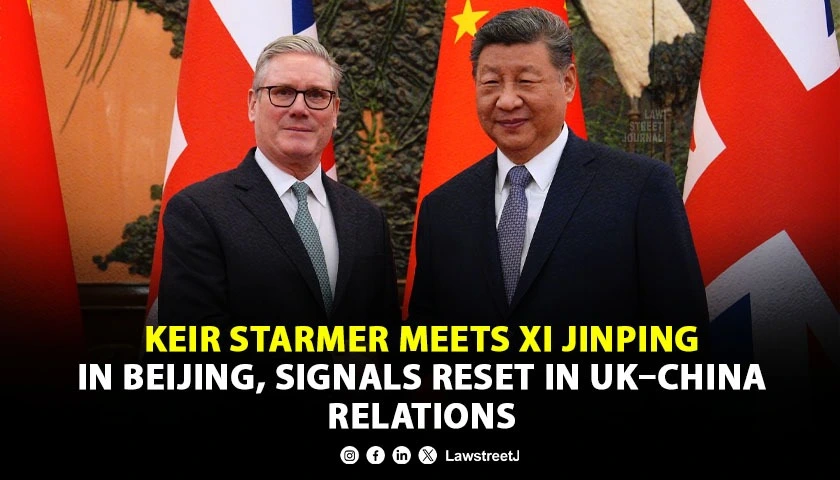
New Delhi: UK Prime Minister Keir Starmer met with Chinese President Xi Jinping at the Great Hall of the People in Beijing, marking the first official visit by a British Prime Minister to China since Theresa May’s 2018 trip. The summit, which lasted approximately 40 minutes, was followed by a working lunch and additional meetings with Premier Li Qiang. The visit comes amid a backdrop of strained bilateral relations since 2020, driven by concerns over national security, human rights, and economic transparency. Starmer’s delegation included over 60 British business and cultural leaders, notably representatives from HSBC, signalling a strong economic focus.
Starmer emphasised the need for a “mature relationship” with China, stating that engagement with the world’s second-largest economy is a pragmatic necessity. While acknowledging security risks, he stressed that economic isolation was not a viable strategy.
Economic Objectives: Trade, Investment, and Market Access
The UK government, under Starmer’s Labour leadership, has faced domestic economic stagnation and is seeking foreign investment to stimulate growth. China remains the UK’s third-largest trading partner, with bilateral trade valued at £93.4 billion in 2025, according to the UK Office for National Statistics. Key economic goals of the visit include:
- Reopening stalled trade dialogues and investment channels
- Expanding market access for British financial services, education, and green technology
- Encouraging Chinese investment in UK infrastructure and clean energy sectors
The Chinese side expressed interest in deepening economic ties, with President Xi Jinping reaffirming China’s commitment to mutual cooperation and respect for sovereignty. Legal analysts note that any new agreements will be subject to UK parliamentary scrutiny, particularly with respect to data protection, intellectual property rights, and compliance with international trade law. The UK’s National Security and Investment Act, 2021 remains a key legal framework governing foreign investments, especially in sensitive sectors.
Geopolitical Implications and Legal Considerations
Starmer’s visit occurs amid growing tensions between the UK and the United States, particularly following recent remarks by President Donald Trump regarding unilateral territorial claims. This has prompted the UK to diversify its diplomatic engagements, with China and Japan emerging as strategic focal points. Legal experts highlight several implications:
- Human rights concerns, including China’s policies in Xinjiang and Hong Kong, remain contentious. The UK Parliament has previously declared China’s actions in Xinjiang to constitute genocide—a designation that complicates bilateral diplomacy.
- Technology and cybersecurity remain under scrutiny. The UK’s 2020 decision to ban Huawei from its 5G infrastructure continues to influence trust levels.
- Export controls and sanctions: The UK maintains targeted sanctions on Chinese entities under its Global Human Rights Sanctions Regime, which may affect future trade negotiations.
Despite these challenges, Starmer’s administration is pursuing a balanced approach, aiming to engage economically while upholding legal and ethical standards. The visit is also seen as a precursor to broader Asia-Pacific engagement, with a follow-up trip to Japan scheduled for early February.
Prime Minister Keir Starmer’s diplomatic outreach to China represents a calculated effort to rebuild trust, stimulate economic growth, and navigate complex geopolitical dynamics. While legal and ethical concerns persist, the visit underscores the UK’s intent to reassert its global economic relevance through strategic partnerships. The outcomes of this engagement will be closely monitored by legal analysts, business leaders, and international observers in the months ahead.

![What is Keir Starmers stance on Kashmir issue ? [Watch Video]](/secure/uploads/2024/07/lj_7459_WhatsApp_Image_2024-07-09_at_11.13.54_AM.webp)