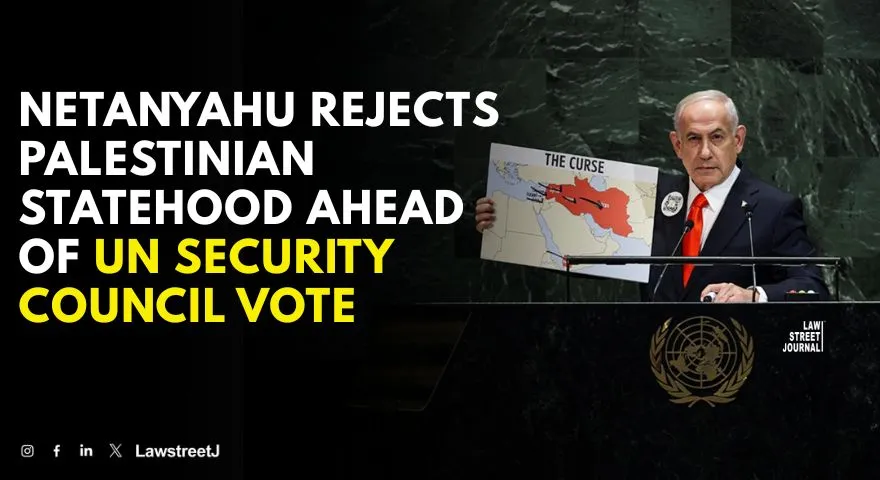
Israel: Israeli Prime Minister Benjamin Netanyahu has reiterated his government’s firm opposition to the creation of a Palestinian state, issuing the statement one day before the United Nations Security Council is scheduled to vote on a U.S.-backed draft resolution related to Gaza’s stabilization and future governance. The vote, set for November 17, 2025, has drawn international attention due to language referencing potential Palestinian statehood within a broader diplomatic framework.
During a cabinet meeting on November 16, 2025, Netanyahu declared that his administration’s stance had not shifted on the question of Palestinian statehood. Netanyahu said, “Our opposition to a Palestinian state in any territory has not changed. Gaza will be demilitarized, and Hamas will be disarmed, the easy way or the hard way.”
His statement followed the circulation of a U.S.-drafted resolution at the UN Security Council that outlines a ceasefire structure, proposes an international security mission for Gaza, and references the possibility of future Palestinian statehood. Israeli officials have stated that any arrangement including the prospect of independence could compromise Israeli national security, particularly in light of recent hostilities involving Hamas. The Israeli government maintains that establishing Palestinian statehood at this stage could create an entity capable of threatening Israel’s borders. Officials have argued that Hamas could exploit such developments and that long-standing security risks remain unresolved.
Legal Context and Diplomatic Elements of the UN Resolution
The draft resolution presented by the United States forms part of a post-ceasefire diplomatic effort following the latest conflict between Israel and Hamas. Although the full text has not been released publicly, diplomatic sources indicate that the proposal includes a temporary international stabilization force for Gaza as well as a transitional administrative mechanism to oversee reconstruction and security arrangements.
The resolution does not directly seek to admit Palestine as a full UN member, but it includes wording that acknowledges the possibility of statehood as part of a long-term political process. This provision has prompted objections from several Security Council members and regional governments. Russia, China, and multiple Arab states have expressed reservations about the precedent the resolution could set and its implications for regional sovereignty.
Under international law, the criteria for statehood, as outlined in the Montevideo Convention of 1933, include a permanent population, defined territory, functioning government, and the capacity to engage in relations with other states. The Palestinian Authority asserts that it fulfills these conditions. More than 130 UN member states recognize Palestine as a state, but full UN membership requires approval from the Security Council—an initiative the United States has historically vetoed.
The proposed American resolution instead seeks to set up a framework that could evolve into statehood, subject to compliance with international obligations and future negotiations. U.S. officials involved in drafting the measure have described it as part of a broader stabilization plan for Gaza, emphasizing that the final outcome would depend on political developments.
If approved, the international force referenced in the draft would require authorization under Chapter VII of the UN Charter, which provides the legal basis for security operations responding to threats to international peace. This would involve a clear mandate specifying rules of engagement, responsibilities, and coordination mechanisms with local authorities.
Regional and International Reactions
Netanyahu’s remarks have contributed to heightened diplomatic tensions ahead of the Security Council vote. Palestinian groups, including Hamas, have rejected the U.S. proposal, arguing that it imposes an external administrative framework on Gaza and fails to support Palestinian claims to self-determination.
The European Union has urged all parties to reduce tensions and reiterated support for negotiations based on established UN resolutions, including Security Council Resolution 242 (1967) and Resolution 2334 (2016). These resolutions affirm the principle of a two-state solution and call for an end to settlement expansion in areas considered occupied under international law.
Governments in the Middle East have issued varied responses. Several Arab states have raised concerns about the implications of an international force in Gaza and about the language concerning potential statehood. Regional actors have also emphasized the need for a comprehensive political process rather than interim arrangements.
Legal analysts note that advancing Palestinian statehood within the UN framework requires navigating multiple factors, including Israel’s security requirements, divisions between Palestinian factions, and the influence of external states such as Iran, the United States, and Gulf nations.
Diplomats familiar with Security Council discussions have stated that several members are considering amendments to the text to address security, governance, and humanitarian issues.
The Security Council will vote on the resolution on November 17, 2025. To pass, the measure requires at least nine affirmative votes and no vetoes from the five permanent members—China, France, Russia, the United Kingdom, and the United States. Because multiple permanent members have expressed reservations, the vote remains uncertain.
Negotiations among member states continued through the evening of November 16, with several delegations indicating that last-minute adjustments could determine the final outcome. Amendments under consideration relate to the authority of the proposed stabilization force and the language concerning future political arrangements for Gaza and the Palestinian territories.
Netanyahu’s reaffirmed opposition to Palestinian statehood underscores Israel’s position as the Security Council prepares to deliberate the resolution. The result of the vote will influence the next phase of diplomatic efforts surrounding Gaza and the Israeli-Palestinian conflict.