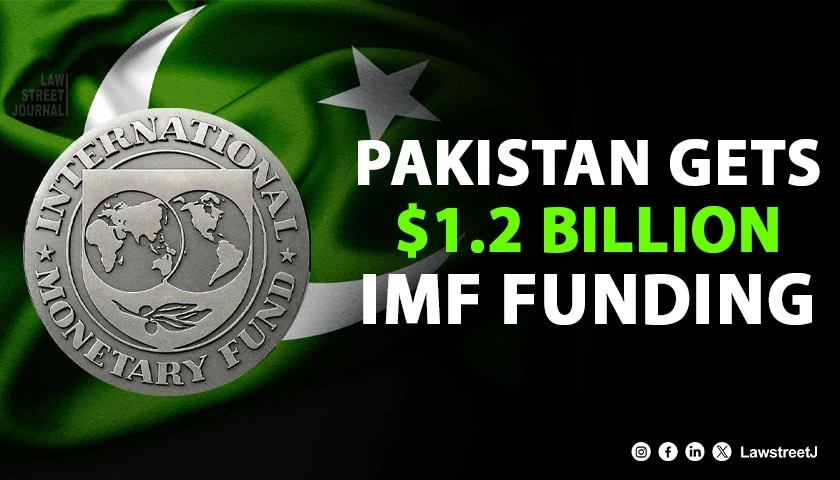
New Delhi: Pakistan has received a major financial boost as the International Monetary Fund (IMF) approved a $1.2 billion loan tranche on December 9, 2025. The decision marks a critical step in the country’s ongoing economic stabilization efforts and its commitments toward climate resilience. With this release, Pakistan’s total receipts under the IMF’s Extended Fund Facility (EFF) and Resilience and Sustainability Facility (RSF) have reached $3.3 billion.
Breakdown of IMF Package and Legal Commitments
The IMF Executive Board met in Washington on December 8 to review Pakistan’s progress under both programs. The approval followed the second review of the 37-month Extended Fund Facility, initiated in September 2024, and the first review of the RSF, aimed at climate-focused reforms. Under the newly cleared package, approximately $1 billion is being released through the EFF to support macroeconomic stabilization, while $200 million comes through the RSF for climate adaptation initiatives. The EFF, with an overall value of $7 billion, is designed to disburse funds in phases as Pakistan meets specific reform milestones. The RSF, a newer component of the IMF toolkit, offers concessional financing to vulnerable economies undertaking climate-related policy actions.
These disbursements are grounded in Pakistan’s commitments outlined in the Letter of Intent and the Memorandum of Economic and Financial Policies, which include legal obligations covering fiscal consolidation, monetary tightening, transparency measures, and structural reforms. These documents define the reform benchmarks Pakistan must meet, with the IMF placing particular emphasis on anti-corruption steps, improvements in public financial management, and the privatization of state-owned enterprises.
IMF Deputy Managing Director Nigel Clarke noted that Pakistan’s reform implementation has helped maintain macroeconomic stability despite global price instability and lingering impacts from the 2022 floods, one of the worst climate disasters in the country’s history. The IMF now projects Pakistan’s GDP growth to reach 3.2% by June 2026, up from the estimated 3.0% for FY 2024–25. Inflation is expected to decline sharply, with an average of 6.3% forecast for FY 2025–26, well below the 23.4% recorded in the prior fiscal year.
Key reform areas highlighted by the IMF include:
- Fiscal discipline to contain deficits
- Improved tax collection, particularly broadening the revenue base
- Targeted social protection spending
- Implementation of public financial management reforms
- Strengthening procurement laws to enhance transparency
The government has committed to publishing audit findings and expanding the authority of the Auditor General of Pakistan, in line with IMF transparency requirements. Privatization continues to be a core component of the reform agenda. The IMF urged Pakistan to accelerate the sale or restructuring of loss-making state-owned enterprises, especially in the energy and transportation sectors, noting that these entities create significant fiscal strain and discourage private investment.
Pakistan Leverages RSF for Long-Term Stability
The $200 million RSF disbursement underscores Pakistan’s shift toward addressing climate vulnerabilities. The country—highly exposed to floods, heatwaves, and environmental degradation—has pledged to direct RSF-backed financing into:
- Renewable energy expansion
- Flood-mitigation infrastructure
- Sustainable agriculture practices
Pakistan’s legal structure for climate policy is anchored in instruments such as the National Climate Change Policy and the Climate Change Act, 2017, which guide the government’s adaptation and resilience planning.
Alongside climate commitments, the IMF placed strong emphasis on governance. The Fund welcomed a recently released fraud and corruption assessment report, commissioned by the government and conducted by an independent panel. The document identifies institutional weaknesses and proposes amendments to strengthen anti-corruption bodies, oversight mechanisms, and judicial processes.
Prime Minister Shehbaz Sharif described the IMF’s approval as proof that Pakistan is “implementing the necessary steps for economic stability and growth.” The statement credited Finance Minister Muhammad Aurangzeb and Chief of Army Staff Gen. Asim Munir for maintaining reform momentum and ensuring coordination between institutions involved in the stabilization program. The government maintains that the latest disbursement will ease external financing pressures and support ongoing reforms in taxation, energy pricing, and public-sector restructuring. Officials also emphasized that part of the funding, particularly through the RSF, will be directed toward climate-resilient infrastructure and long-term sustainability measures.
The IMF’s $1.2 billion approval represents a significant step forward in Pakistan’s economic recovery efforts. With a total of $3.3 billion now released under the EFF and RSF, Pakistan is positioned to advance its fiscal consolidation plans, implement structural reforms, and expand climate resilience initiatives. The program’s legal and institutional requirements—from anti-corruption safeguards to energy-sector restructuring—provide the framework for Pakistan’s policy direction in the coming months. While challenges persist, the government’s commitments under the IMF agreements are expected to shape the country’s economic and climate policy trajectory through 2026.