


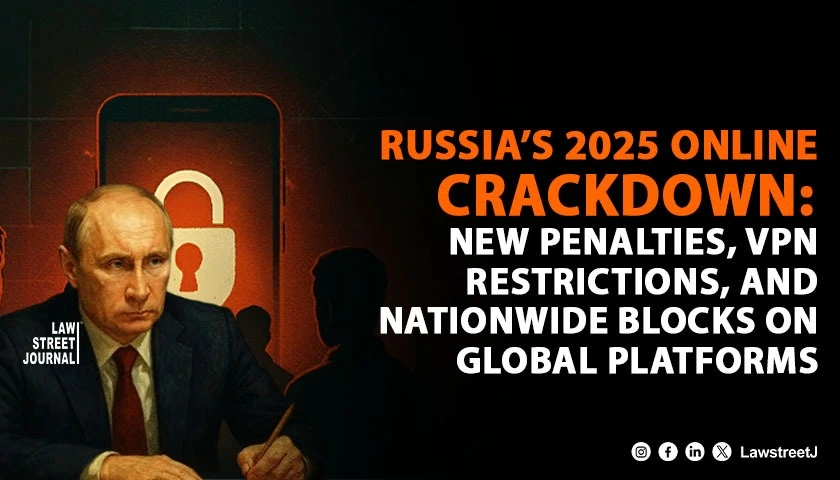
Russia: Russia has enacted a series of new provisions in 2025 tightening state authority over digital communications, internet access, and social-media platforms. In July 2025, the State Duma approved a law introducing penalties for individuals who knowingly search for or access materials listed as extremist, including when using Virtual Private Networks (VPNs). Under the measure, violations attract fines of up to 5,000 roubles (approximately US$64). The official register of prohibited content, maintained by authorities, spans more than 500 pages and includes organisations previously designated as extremist by Russian regulators.
Human-rights monitors have documented a sustained rise in prosecutions under laws governing online speech. In 2024, at least 78 people were charged with disseminating what authorities classify as “fake news,” and as of early 2025, roughly 130 individuals remained in detention on these charges. Most cases fall under broadly worded provisions of the criminal code that prohibit actions interpreted as discrediting the Russian armed forces or circulating false information about state institutions.
The 2025 developments build upon post-2022 legislation introduced after the conflict in Ukraine, which imposed tighter restrictions on criticism of military operations, government actions, and activities linked to organisations deemed “undesirable.” With the new law extending criminal liability to online searches, legal exposure now encompasses both public and private digital activity.
VPN Restrictions and Expansion of Platform Bans
Since March 2024, Russian law has prohibited the advertising, promotion, or distribution of information about tools that enable users to bypass state-mandated internet restrictions. This includes lists, guides, and technical reviews of functioning VPNs. According to digital-rights groups, the number of online resources blocked for sharing VPN-related information nearly doubled in 2025 compared with the previous year.
Although some policy analysts predicted a complete nationwide ban on VPNs, authorities stated in early 2025 that no blanket prohibition had been introduced. However, the legal framework places pressure on service providers to comply with Russian regulatory requirements, including data-access and content-removal obligations. Providers that do not meet these conditions risk being blocked, and individuals may face penalties for seeking or sharing information on how to access restricted services.
In late 2025, regulators widened enforcement by blocking several international communication and social-media platforms. Roskomnadzor announced a nationwide restriction on Apple’s FaceTime service, stating that such applications were being misused for activities linked to terrorism, recruitment, fraud, and other criminal conduct. This followed earlier restrictions on platforms such as WhatsApp, Telegram, and various social-media, gaming, and video-sharing services.
Under Russian law, any platform offering messaging or communication functions must register as an “organiser of information distribution” and provide authorities with user data and decryption capabilities. Services that cannot comply may be blocked. Several global platforms have indicated that compliance is technically or legally unfeasible, resulting in withdrawal or nationwide blocking. These actions have further reduced domestic access to global communication tools.
Legal Basis, Enforcement, and Broader Implications
The July 2025 statute imposing liability for searching extremist materials extends earlier amendments to the criminal code, including Article 280.3 (discrediting the armed forces) and Article 207.3 (publication of information deemed false about state bodies). These provisions enable enforcement against individuals accessing, posting, or distributing prohibited information online.
The March 2024 law restricting VPN promotion added another regulatory layer, criminalising activities that facilitate circumvention of state-mandated internet blocks. By limiting the visibility and availability of VPN services and related information, authorities have significantly reduced avenues for anonymous or unrestricted access to foreign platforms.
The blocking of communication services and social-media platforms stems from regulatory rules requiring technology companies to register with the state, comply with data-sharing obligations, and adhere to content-removal directives. Non-compliance triggers nationwide restrictions executed by Roskomnadzor. These rules apply to both domestic and foreign services operating within Russia’s information ecosystem.
Reports from independent rights organisations in 2025 indicate that enforcement of these laws has accelerated. Human Rights Watch noted that 78 individuals were charged under “fake news” provisions in 2024 and that around 130 people remained detained as of early 2025. Extending liability to online searches reflects a broader expansion of enforcement practices, placing routine internet activity within the reach of criminal prosecution.
Collectively, the measures introduced across 2024 and 2025 constitute a comprehensive regulatory system governing digital communication in Russia. The combination of restrictions on VPN-related resources, new penalties tied to extremist-content searches, and expanded bans on communication platforms has reshaped the country’s digital ecosystem. Access to global platforms has become significantly limited, while compliance obligations for service providers have grown. The regulatory approach relies on broadly worded statutes that grant wide discretion to enforcement agencies, allowing application across a wide spectrum of online behaviour — from posting content to accessing external platforms or conducting private searches. This framework now defines the operational environment for individuals and companies navigating Russia’s digital-communications landscape.