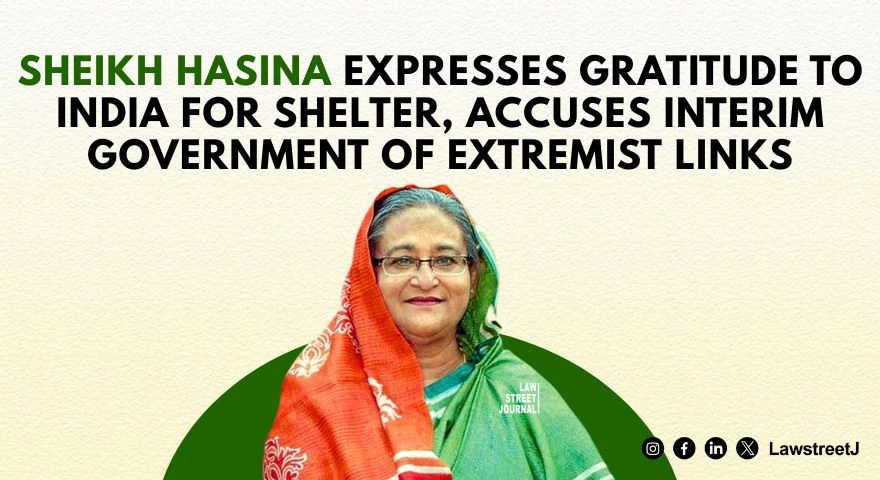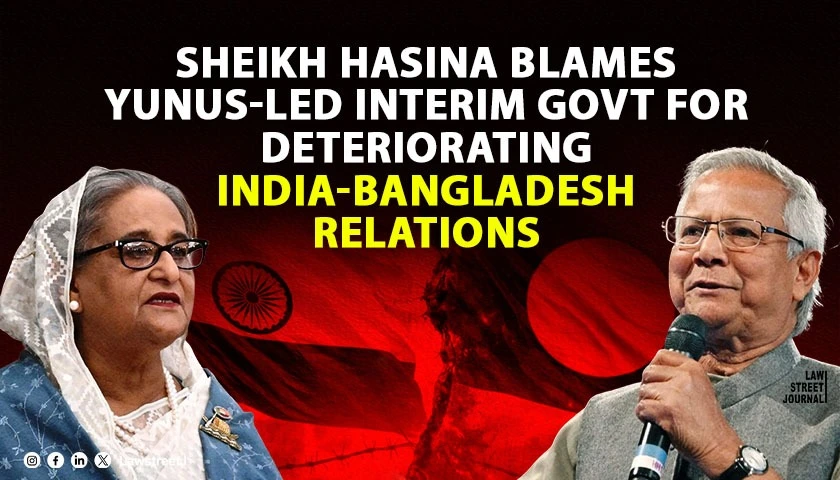
Bangladesh: Former Prime Minister Sheikh Hasina has publicly criticised the Muhammad Yunus-led interim government for deteriorating bilateral relations with India, citing hostile rhetoric and a failure to protect minorities as key concerns.
Hostile Rhetoric and Minority Persecution
On December 22, 2025, former Bangladesh Prime Minister Sheikh Hasina issued a formal statement attributing the recent strain in India–Bangladesh relations to the conduct of the interim government led by Chief Adviser Muhammad Yunus. In an email interview with ANI, Hasina stated, “The strain you are witnessing is entirely of Yunus’ making. His government issues hostile statements against India and has failed to protect religious minorities.”
The diplomatic tension follows a series of incidents, including the lynching of a Hindu man and threats against Indian diplomatic missions in Dhaka. These developments have prompted concern from the Indian government, which has reportedly increased security measures around its consular offices in Bangladesh. Hasina emphasised that the interim administration’s rhetoric and actions have undermined the historically cooperative relationship between the two nations. She cited the government’s failure to curb religious extremism and protect minority communities as violations of Bangladesh’s constitutional obligations under Articles 27 and 41, which guarantee equality before the law and freedom of religion.
Governance Breakdown and Tribunal Verdict
The current political unrest in Bangladesh stems from the July–August 2024 uprising, which led to Hasina’s ouster and the establishment of the interim government. The International Crimes Tribunal (ICT) of Bangladesh later found Hasina guilty of crimes against humanity linked to the suppression of protesters during that period. The verdict has been contested by Hasina, who claims political motivations behind the charges and has refused to return to Bangladesh, citing threats to her life.
Under the interim government, reports have surfaced of convicted extremists being released from prison, and discussions have emerged around lifting the ban on Jamaat-e-Islami, a party previously barred for its alleged links to war crimes and extremist activities. These developments have raised legal and constitutional questions regarding the interim government’s adherence to Bangladesh’s Penal Code and the Anti-Terrorism Act, 2009.
Hasina’s criticism also touches on the interim government’s alleged inability to maintain law and order, which she claims has led to a “multiplication of lawlessness.” This assertion aligns with recent data from the Bangladesh Police, which recorded a 27% increase in politically motivated violence between September and November 2025 compared to the same period in 2024.
India’s Strategic Concerns and Bilateral Stability
India has maintained a cautious stance amid the unfolding crisis. Official sources from the Ministry of External Affairs (MEA) have expressed concern over the safety of Indian nationals and diplomatic staff in Bangladesh. The MEA has also reiterated its commitment to regional stability and respect for democratic processes.
The bilateral relationship between India and Bangladesh has historically been anchored in cooperation on trade, counter-terrorism, and water-sharing agreements. However, recent developments have disrupted ongoing negotiations on the Teesta River Agreement and cross-border energy projects, according to diplomatic sources familiar with the matter.
Legal experts have pointed out that the interim government’s actions may violate provisions of the 1974 India–Bangladesh Treaty of Friendship, Cooperation and Peace, which obligates both nations to maintain mutual respect and refrain from hostile propaganda. The treaty remains a cornerstone of bilateral diplomacy, and any deviation from its principles could invite international scrutiny.
Hasina’s remarks have reignited debate over the legitimacy and accountability of interim governments in transitional democracies. While the Bangladesh Constitution permits the formation of caretaker administrations under Article 58B, critics argue that the current setup lacks transparency and judicial oversight.
As Bangladesh navigates a volatile political landscape, the implications of Sheikh Hasina’s accusations against the interim government extend beyond domestic governance. The deterioration of India–Bangladesh relations, rising extremism, and legal controversies surrounding minority protection and political violence have created a complex matrix of challenges. The international community continues to monitor the situation, with regional stability and constitutional integrity hanging in the balance.

![CJI cites Bangladesh to highlight importance of liberty [Read Speech]](/secure/uploads/2024/08/lj_1548_CJI_Bangladesh.webp)