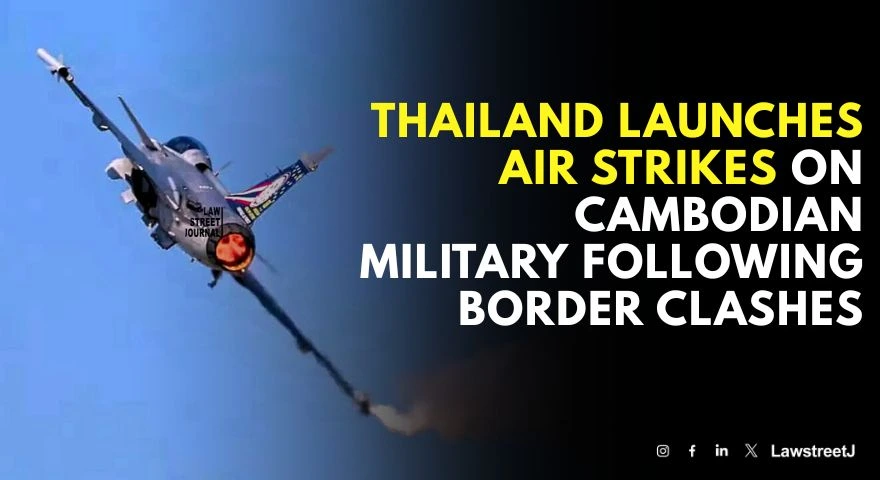
Thailand: On December 8, 2025, the Royal Thai Army confirmed that it had carried out air strikes on Cambodian military positions along the long-contested border near Thailand’s Sisaket province. The aerial operations followed armed confrontations earlier in the morning between Thai and Cambodian forces, during which one Thai soldier was killed and four others sustained injuries. Cambodian authorities reported that the air strikes resulted in the deaths of four civilians. The incident marks a significant escalation in tensions that have persisted since July 2025, when five days of fighting between the two nations left 43 people dead and displaced an estimated 300,000 residents on both sides of the border. Although the conflict was halted by a U.S.-brokered ceasefire in October 2025, mediated personally by President Donald Trump, conditions on the ground have remained unstable.
According to Royal Thai Army spokesperson Major General Winthai Suvaree, the air strikes were launched in response to what Thailand described as an escalation by Cambodian forces. He stated that Cambodian troops allegedly fired into Thai territory using “supporting fire weapons,” prompting Thai units to deploy aircraft to “strike military targets in several areas” to prevent further attacks. Cambodian officials, however, rejected Thailand’s claims and maintained that their forces had not initiated the confrontation. They accused Thailand of violating the terms of the ceasefire agreement and escalating the conflict without provocation. Both governments have exchanged formal communications expressing concern, while international actors have urged restraint to prevent further deterioration of the security situation.
The border area near the Ta Muen Thom temple has long been a flashpoint due to overlapping territorial claims and unresolved demarcation issues. Local authorities on both sides have increased troop deployments, and evacuation orders have been issued for residents in high-risk zones. As of December 8, 2025, neither side has announced a new ceasefire or de-escalation mechanism. Military units remain on heightened alert, and ground conditions continue to fluctuate as diplomatic discussions proceed.
Legal Framework and Ceasefire Violations
The renewed confrontations have prompted legal scrutiny regarding potential breaches of bilateral agreements and international law. The 2000 Memorandum of Understanding (MoU) between Thailand and Cambodia, which outlines procedures for border management and military coordination, prohibits unilateral armed action without prior consultation. Article 5 of the MoU specifically mandates that disputes in the border region must be addressed through peaceful negotiation and established bilateral mechanisms. Analysts have noted that Thailand’s use of air strikes could be interpreted as a violation of these obligations.
Further legal considerations arise from both countries’ commitments under the 2008 ASEAN Charter, which requires member states to resolve disputes through peaceful means and discourages the use of force. As the Charter is legally binding, actions involving armed engagement may raise questions about compliance with regional norms and obligations.
International humanitarian law, including provisions under the Geneva Conventions, also applies to the conduct of military operations. These laws require a clear distinction between military targets and civilian populations. The four civilian deaths reported by Cambodia could therefore become an issue in any potential legal proceedings or third-party investigations concerning proportionality and targeting. In response to the air strikes, the Cambodian Ministry of Foreign Affairs has filed a formal complaint with the International Court of Justice (ICJ), alleging violations of territorial sovereignty and failures to protect civilian lives. Should the ICJ choose to admit the case, it could issue provisional measures aimed at reducing hostilities, securing humanitarian access, or monitoring compliance with international obligations. However, such legal processes typically involve extended timelines, limiting their immediate impact on battlefield dynamics.
The October 2025 ceasefire, facilitated by the United States, also included provisions for de-escalation and information-sharing intended to prevent sudden outbreaks of violence. The recent confrontation raises questions about adherence to those commitments and the effectiveness of the monitoring mechanisms put in place. Neither government has publicly released documentation regarding ceasefire verification or shared intelligence related to the alleged exchange of fire preceding the air strikes.
Diplomatic Reactions and Regional Implications
The escalation has drawn swift reactions from regional and international actors. The United States Department of State issued a statement calling for an “immediate cessation of hostilities” and reaffirming its commitment to the October 2025 ceasefire framework. Washington has remained engaged in the region since brokering that agreement and continues to urge both sides to return to established channels of communication.
ASEAN’s Secretary-General has proposed convening an emergency summit to address the crisis, citing the need to prevent destabilization within Southeast Asia. Although the organization’s ability to intervene is limited by its non-interference principle, it has historically facilitated dialogue between member states facing territorial disputes. China, which maintains economic and strategic relations with both Thailand and Cambodia, has urged restraint but has not offered to mediate directly. Beijing’s position reflects its broader approach to regional conflicts—emphasizing stability while avoiding involvement in bilateral sovereignty issues unless formally requested.
The United Nations Office for the Coordination of Humanitarian Affairs (OCHA) has expressed concern over civilian casualties and the potential for renewed displacement. OCHA called on both governments to ensure humanitarian access to affected communities, particularly those located near active military zones. The agency cited the displacement during the July 2025 clashes as a warning of the humanitarian risks posed by renewed conflict.
As of the evening of December 8, 2025, diplomatic channels remain active but strained. No new ceasefire agreement has been finalized, and cross-border engagements have not been formally halted. Observers emphasize that the situation remains fluid and that the next steps taken by both governments will be critical in determining whether the conflict escalates further or returns to diplomatic management.