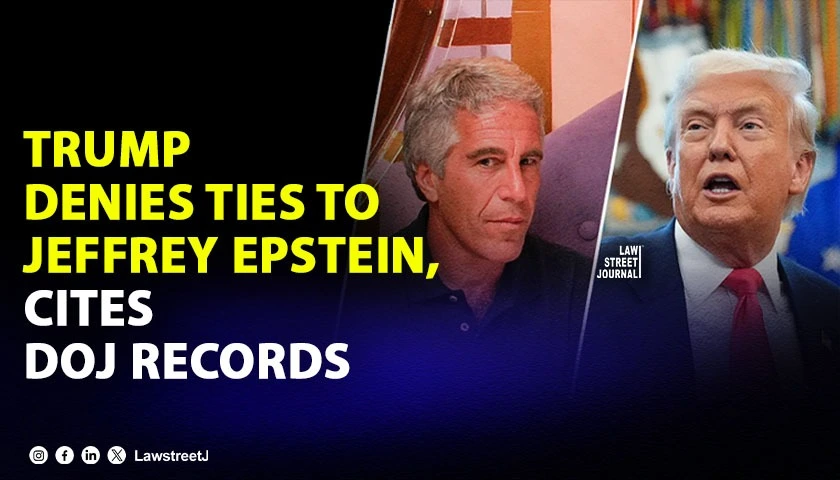
United States: On February 2, 2026, U.S. President Donald Trump issued a statement on Truth Social denying any association with Jeffrey Epstein, the financier convicted of sex offences who died in federal custody in 2019. Trump asserted that newly released records of the Department of Justice (DOJ) revealed a conspiracy between Epstein and author Michael Wolff aimed at damaging his presidency. He emphasised that he never visited Epstein’s private island, which has been central to allegations of trafficking and abuse.
The DOJ has been releasing millions of pages of Epstein-related files under the Epstein Files Transparency Act, passed in late 2025. The latest tranche includes correspondence, financial records, and digital evidence recovered from Epstein’s devices. While Trump cited these disclosures in support of his claims, he did not refer to any specific documents. The DOJ confirmed that Trump’s name appears in the files but stated that no evidence directly links him to Epstein’s criminal activities.
Legal Dimensions and Defamation Threats
Trump’s remarks carried legal implications as he threatened lawsuits against Wolff and unnamed political opponents. Under U.S. defamation law, public figures must establish that false statements were made with “actual malice.” If litigation is pursued, the case would likely test the limits of defamation law in the context of political reporting. Wolff, known for publishing books critical of Trump’s presidency, has not yet responded to the allegations. Legal analysts note that any claim would hinge on whether Wolff knowingly published false assertions regarding Trump’s alleged ties to Epstein.
The DOJ’s disclosures have also intensified debates on accountability. Advocacy groups have criticised the absence of a definitive “client list” in the released materials, while federal officials maintain that disclosures are being made in compliance with transparency requirements without compromising ongoing investigations.
Political Fallout and Broader Context
The Epstein case remains among the most closely scrutinised criminal investigations in recent U.S. history. Epstein’s death in 2019 triggered widespread demands for transparency, ultimately leading to congressional mandates for disclosure of his files. The DOJ has acknowledged that the records reference several high-profile individuals across politics, business, and entertainment, though no charges have been brought against Trump.
Photographs from the 1990s and early 2000s show Trump and Epstein together at social events, fueling speculation about their relationship. Trump has acknowledged knowing Epstein socially but maintains that their association ended well before Epstein’s arrest. He has also accused Democrats and their donors of visiting Epstein’s island, though he has provided no corroborating evidence.
The release of DOJ records has reignited public debate over Epstein’s network and its political ramifications. Trump’s denial, coupled with allegations of a conspiracy involving Wolff, highlights the intersection of law, politics, and public perception. While Trump has threatened legal action, no verified evidence has directly linked him to Epstein’s crimes. The ongoing disclosures are expected to continue shaping legal scrutiny and political discourse in the months ahead.