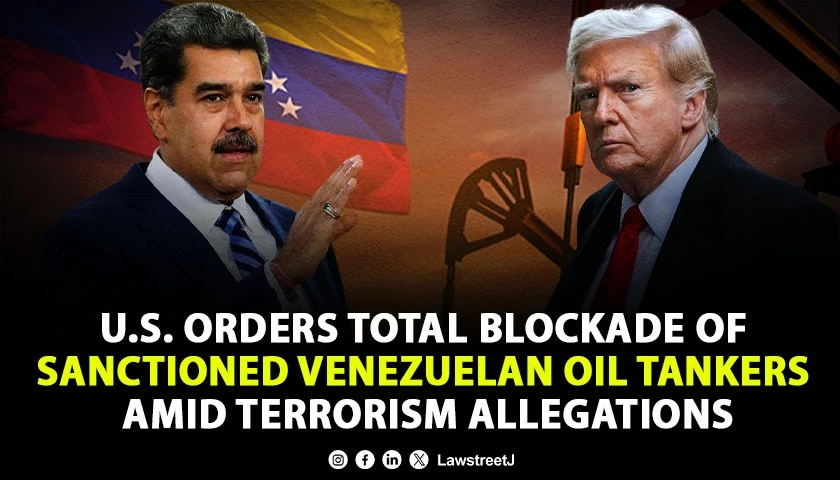
New Delhi: In a significant escalation of U.S. foreign policy toward Venezuela, President Donald Trump has ordered a “total and complete blockade” of all sanctioned oil tankers entering or leaving the South American nation. The directive, issued on December 16 via Truth Social, follows the designation of Nicolás Maduro’s government as a “foreign terrorist organization” and comes amid heightened geopolitical tensions and military buildup in the Caribbean region.
Legal Designation and Justification
The U.S. government’s decision to classify Venezuela’s administration under President Nicolás Maduro as a foreign terrorist organization (FTO) marks a pivotal legal shift in bilateral relations. Under Section 219 of the Immigration and Nationality Act, an FTO designation requires evidence of involvement in terrorist activity that threatens U.S. nationals or national security. President Trump’s statement cited “terrorism, drug smuggling, human trafficking, murder, and kidnapping” as grounds for the designation. He further alleged that Venezuela had “stolen oil, land, and other assets” from the United States, justifying the blockade as a national security measure.
The blockade specifically targets vessels already under U.S. sanctions, meaning ships affiliated with entities previously blacklisted by the Treasury Department’s Office of Foreign Assets Control (OFAC). These include PDVSA (Petróleos de Venezuela, S.A.), Venezuela’s state-owned oil company, which has been under U.S. sanctions since January 2019. The blockade does not extend to non-sanctioned vessels; however, enforcement is expected to be stringent, with U.S. naval forces deployed to monitor maritime traffic.
The announcement follows the U.S. Navy’s recent seizure of a sanctioned oil tanker off Venezuela’s coast, an operation reportedly involving coordination with the Departments of Defense and Homeland Security. Satellite imagery released by Planet Labs confirms the presence of a large U.S. naval armada in the Caribbean, described by President Trump as “the largest ever assembled in the history of South America.”
The blockade is expected to disrupt Venezuela’s oil exports, which remain a critical source of revenue for the Maduro government. According to OPEC data, Venezuela produced approximately 700,000 barrels per day as of November 2025, with exports primarily directed to China, India, and Turkey. The blockade could complicate shipping logistics for these countries, particularly if secondary sanctions are imposed on entities that violate the directive.
Legal experts note that while the U.S. has jurisdiction over its own sanctions enforcement, the extraterritorial application of such measures—especially those affecting third-party nations—could invite challenges under international maritime law. The United Nations Convention on the Law of the Sea (UNCLOS), to which the U.S. is not a party but generally adheres, restricts interference with freedom of navigation unless authorized by the UN Security Council or justified under the right of self-defense.
Venezuela’s Response and Diplomatic Fallout
In an official statement, Venezuela’s Ministry of Foreign Affairs “categorically rejected” the U.S. blockade, calling it a “grotesque threat” and a violation of international law. The Maduro administration accused Washington of attempting to destabilize the country and undermine its sovereignty through economic coercion and military intimidation.
The diplomatic fallout has extended to regional allies. Cuba and Bolivia have condemned the blockade, while Brazil and Colombia have maintained neutrality. The European Union has called for restraint and urged both sides to resolve the dispute through dialogue.
Meanwhile, energy analysts predict limited immediate impact on global oil prices due to Venezuela’s relatively small share of global supply. However, the blockade could exacerbate regional tensions in Latin America and complicate future negotiations on sanctions relief or humanitarian assistance.
The U.S. blockade of sanctioned Venezuelan oil tankers represents a legally complex and geopolitically charged maneuver. Grounded in terrorism allegations and asset-recovery claims, the directive intensifies pressure on the Maduro regime while raising serious questions about international law, regional stability, and global energy markets. As enforcement begins, global stakeholders will closely monitor the legal ramifications and diplomatic consequences of this unprecedented action.