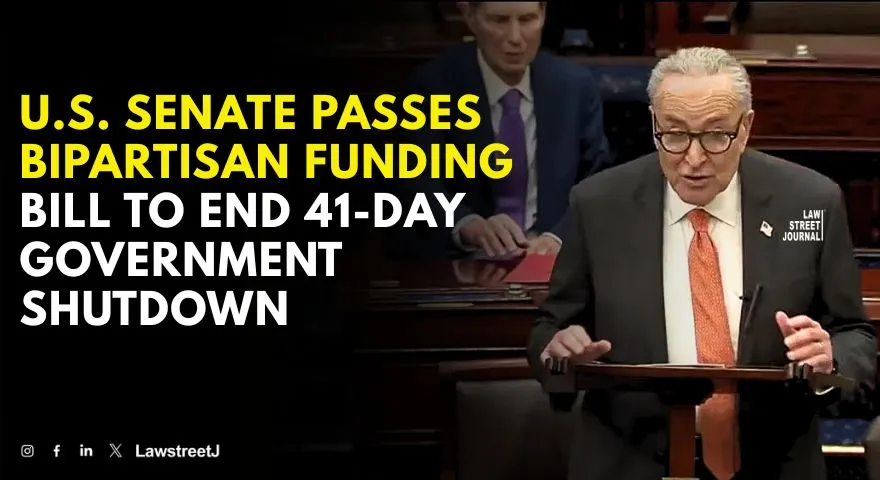
United States: The U.S. Senate on 10 November 2025 approved a bipartisan funding bill designed to end the 41-day partial government shutdown — the longest in American history. The package combines a short-term continuing resolution with three full-year appropriations bills and now heads to the House of Representatives for final action before being sent to President Donald Trump.
After weeks of stalled negotiations, the Senate voted late Monday to advance the measure, one day after eight Democratic senators joined Republicans in a key procedural vote that cleared the filibuster hurdle. The agreement emerged after a series of talks aimed at restoring federal operations and securing commitments on later votes related to healthcare and federal worker protections.
The legislation includes a continuing resolution extending government funding through 30 January 2026, along with three annual appropriations bills for departments such as Health and Human Services, Veterans Affairs, and Transportation. It also reinstates furloughed federal workers and sets out the terms of the bipartisan compromise reached in recent days. Senate Majority Leader Mitch McConnell said the bill “restores stability to federal operations and reflects a shared commitment to responsible governance.” The shutdown disrupted services across the country, delaying SNAP benefits, slowing passport processing, and affecting federal court operations during the six-week closure.
Next Steps in the House and Constitutional Process
With Senate approval complete, the bill moves to the House, where Speaker Mike Johnson has signaled a vote as early as Wednesday, 12 November. In guidance circulated by GOP Whip Tom Emmer, lawmakers were told to return to Washington for votes beginning at 4 p.m. ET. The House will first take up procedural motions before moving to final passage.
The bill’s format follows the requirements of the Congressional Budget Act of 1974, which outlines how appropriations must move through both chambers before a measure can become law. The continuing resolution provides temporary funding while the three annual bills take effect, allowing agencies to resume standard operations. Once the House passes the bill, it will be formally enrolled and delivered to the president under Article I, Section 7 of the Constitution.
President Trump has endorsed the bipartisan agreement, saying it “reflects the will of the American people and ensures continuity of essential services.” His signature would officially bring the shutdown to a close.
The shutdown began on 30 September 2025, when Congress failed to pass appropriations ahead of the new fiscal year. With no spending authority in place, federal agencies were required to halt non-essential activities under the Antideficiency Act (31 U.S.C. § 1341). As a result, more than 800,000 federal employees were either furloughed or required to work without pay.
The effects were felt nationwide. SNAP benefits for more than 40 million recipients were interrupted. Immigration courts postponed hearings. Federal grants and regulatory work slowed and stopped across numerous agencies. Several federal employee unions filed legal challenges alleging violations of labor laws and due process protections.
The new bill guarantees back pay for furloughed workers, consistent with the Government Employee Fair Treatment Act of 2019. It also reiterates agencies’ responsibilities under the Administrative Procedure Act to restart paused rulemaking and adjudications once the government reopens.
Legal analysts point out that while the legislation brings the shutdown to an end, it reopens discussions about structural changes to prevent future funding lapses. Proposals now circulating include automatic continuing resolutions that would take effect during budget impasses and enhanced requirements to meet annual spending deadlines.
The Senate’s approval of the bipartisan bill marks a turning point after a 41-day shutdown that strained federal services and tested long-standing budget procedures. With the House preparing for a vote and the president indicating support, the process of restoring full government operations is close to completion. The legislation resolves the immediate funding crisis while placing renewed attention on the legal and procedural frameworks that govern federal budgeting.