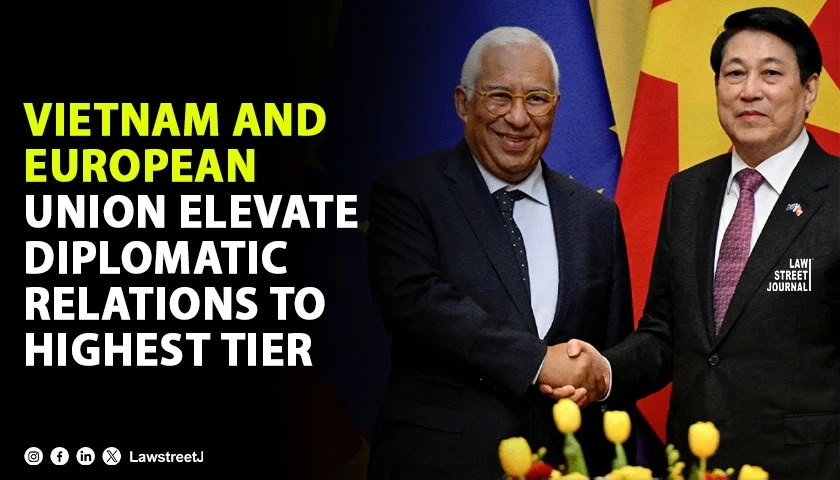
New Delhi: The Socialist Republic of Vietnam and the European Union (EU) have officially upgraded their diplomatic relationship to the highest level, marking a significant development in international relations. The announcement was made during a high-level meeting in Hanoi between Vietnamese President Luong Cuong and European Council President António Costa, where both parties signed a joint declaration outlining expanded cooperation across trade, technology, defence, and sustainable development.
This diplomatic elevation places the EU alongside China, the United States, and Russia in Vietnam’s top-tier foreign relations framework. The move has been described by Vietnamese officials as a “historical milestone,” reflecting Vietnam’s strategic intent to diversify its partnerships amid shifting global dynamics. The EU, in turn, reaffirmed its commitment to deepening engagement in Southeast Asia through its Indo-Pacific strategy.
Legal Framework and Economic Instruments Supporting the Upgrade
The diplomatic upgrade builds upon existing legal agreements, notably the EU-Vietnam Free Trade Agreement (EVFTA) and the EU-Vietnam Investment Protection Agreement (EVIPA). The EVFTA, which entered into force on August 1, 2020, is a comprehensive trade pact that eliminates nearly 99% of tariffs over time and enhances market access for both sides. It is legally binding under international trade law and includes enforceable provisions on labour rights, environmental protection, and intellectual property.
The EVIPA, signed in 2019 and ratified by several EU member states, provides legal safeguards for investors, including dispute-resolution mechanisms governed by UNCITRAL arbitration rules. These instruments remain central to the economic dimension of the upgraded relationship.
In addition to trade and investment, the joint declaration outlines cooperation in the following areas:
- Critical minerals and rare earths: Vietnam, which holds one of the world’s largest reserves of rare earth elements, will collaborate with the EU on sustainable extraction and supply-chain integration. This aligns with the EU’s Critical Raw Materials Act, adopted in 2023.
- Semiconductor development: The EU will support Vietnam’s ambitions to become a regional hub for chip manufacturing, subject to compliance with EU export-control regulations and Vietnam’s Law on Investment (2020 revision).
- Telecommunications and cybersecurity: The EU expressed interest in assisting Vietnam with the deployment of “trusted” 5G networks. This cooperation must adhere to Vietnam’s Law on Cybersecurity (2018), which mandates data localisation and restricts foreign control over critical infrastructure.
Geopolitical Context and Strategic Implications
The timing of the diplomatic upgrade is geopolitically significant. It follows the reappointment of General Secretary To Lam as head of the Communist Party of Vietnam, ensuring continuity in foreign policy. The move also comes amid rising tensions in the South China Sea and increasing protectionist measures by the United States, prompting Vietnam to seek diversified strategic partnerships.
For the EU, the upgrade complements its Global Gateway strategy, launched in 2021 to counter China’s Belt and Road Initiative through sustainable infrastructure investments. Vietnam’s strategic location and economic growth—projected at 6.2% GDP growth in 2025 according to the Asian Development Bank—make it a key partner in the EU’s Indo-Pacific engagement.
The EU is currently Vietnam’s fifth-largest trading partner, with bilateral trade reaching €52 billion in 2025, up from €45 billion in 2023. EU foreign direct investment (FDI) in Vietnam totalled €7.4 billion in 2025, concentrated in manufacturing, renewable energy, and digital services. Defence cooperation, while not formalised through a treaty, is expected to expand under existing EU frameworks such as the European Peace Facility, which allows for non-lethal support to partner countries. Any transfer of defence technology will be subject to EU dual-use export controls and Vietnam’s Law on National Defense (2018).
The elevation of Vietnam-EU diplomatic ties to the highest level marks a legally grounded and strategically calculated expansion of bilateral relations. Anchored in binding trade and investment agreements, the upgrade signals a mutual intent to deepen cooperation in critical sectors while navigating complex geopolitical challenges. As both parties move forward, the partnership is expected to shape regional dynamics and reinforce Vietnam’s role as a pivotal actor in the Indo-Pacific.