38.6c New Delhi, India, Friday, May 15, 2026
Top Stories Supreme Court
Political NEWS Legislative Corner Celebstreet International Videos
Subscribe Contact Us
close
Judiciary

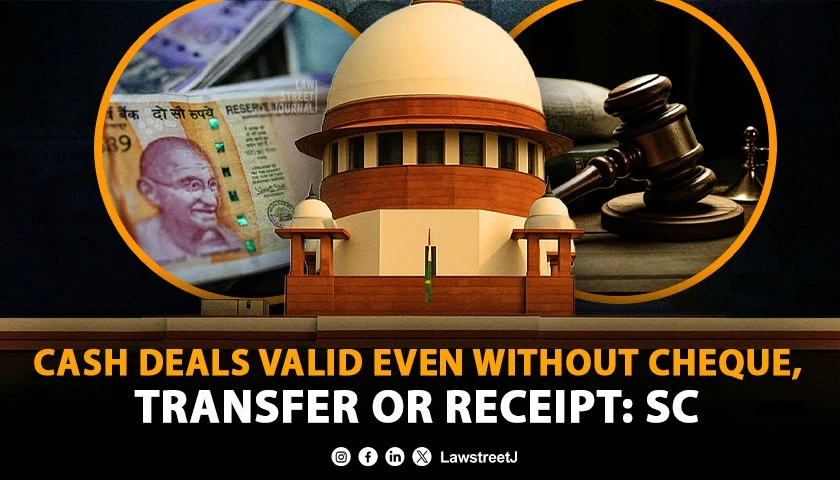
Absence of cheque, bank transfer or receipt won't always negate cash transaction: SC [Read Order]

By Jhanak Sharma      08 September, 2025 02:43 PM      0 Comments
Absence of cheque bank transfer or receipt wont always negate cash transaction SC

NEW DELHI: The Supreme Court has said it is not always that the absence of cheque, bank transfer or receipt won't always negate cash transaction, as it is not uncommon that in money transactions, there is a component of cash also involved.

"Just because a person is not able to prove the transfer through official modes i.e., through any negotiable instrument or bank transaction, it would not lead to the conclusion that such amount was not paid through cash, especially when there was a categorical statement to this effect," a bench of Justices Ahsanuddin Amanullah and Vipul M Pancholi said.

In an order, the court emphasised, a person who gives cash obviously would not be having any documentary proof per se.

"Sometimes there may be an occasion where even for a cash transaction, a receipt is taken, but absence of the same would not negate and disprove the stand that the cash transaction also took place between the parties,'' the bench said.

An appeal was filed by Georegekutty Chacko, who contended that though his suit for recovery of an amount pursuant to a promissory note has been upheld but the amount to be recovered, i e, Rs 35,29,680 has been reduced to Rs 22,00,000 only by the High Court.  

Allowing the appeal, the court held the bifurcation made by the High Court was clearly erroneous and therefore, unsustainable.

The appellant submitted that the obligation to pay the amount by the respondent, M N Saji was pursuant to a promissory note in which clearly the respondent had accepted that he had received Rs 30,80,000 from him.

The appellant filed the suit for recovery of the amount, which was allowed by the Trial Court.

The Trial Court decreed the suit for Rs 35,29,680. However, the High Court modified the order and reduced the decretal amount to Rs 22,00,000.

The appellant's counsel submitted that once the promissory note has been accepted by both the courts and also by the respondent, the amount clearly specified in such promissory note could not have been unilaterally reduced.  

He contended the course taken by the High Court with regard to there being proof of only Rs 22,00,000 having been paid by the appellant to the respondent is erroneous for the reason that the clear cut stand was that Rs 22,00,000 was given through various instruments/bank transactions whereas the remaining was given by cash.  

The appellant also submitted to reject the cash amount, that too, only on the ground that it was an oral statement, is not correct, for the reason that the document i.e., the promissory note, as a whole has to be taken, especially when there was no complaint by the respondent that the promissory note, though signed by him, contained incorrect fact and/or there was any manipulation.

"Having considered the matter and going through the material on record, we find that a case for interference has been made out,'' the bench said.

The court pointed out when the appellant has taken a specific stand that he has paid Rs 30,80,000 to the respondent pursuant to a promissory note, which incidentally has been upheld and not disbelieved, the onus would be on the respondent to dispel such fact.

It also noted there was a categorical statement by the appellant before the court concerned.

The bench also found, moreover, the initial presumption of legally enforceable debt comes from the Negotiable Instruments Act also and thus the onus is on the respondent to prove that no such amount was given.

"Only because documentary proof was not available, we find such a view taken to be erroneous,'' the bench said.

The court set aside the High Court's order.

[Read Order]

Disclaimer: This content is produced and published by LawStreet Journal Media for informational purposes only and does not constitute legal advice. The views expressed are independent of any legal practice of the individuals involved.



Share this article:

About:

Jhanak is a lawyer by profession and legal journalist by passion. She graduated at the top of her cl...Read more

Follow:
FacebookTwitterLinkedinInstagram


Leave a feedback about this
Related Posts
View All

Another CBI Officer Investigating Rakesh Asthana Moves SC Against Transfer, Makes Startling Revelations Another CBI Officer Investigating Rakesh Asthana Moves SC Against Transfer, Makes Startling Revelations

After A.K. Bassi, another CBI officer who was investigating corruption allegations against Special Director Rakesh Asthana moved the Supreme Court.

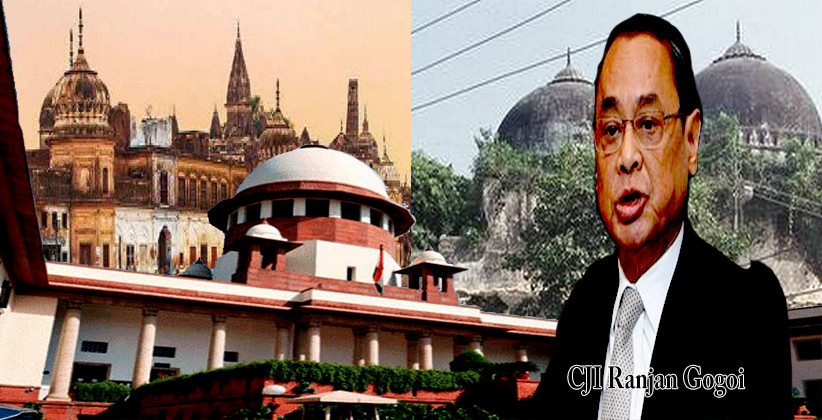
Ayodhya verdict: SC rules in favour of Ram Lalla, Sunni Waqf Board gets alternate land Ayodhya verdict: SC rules in favour of Ram Lalla, Sunni Waqf Board gets alternate land

SC bench led by CJI Ranjan Gogoi has allotted the dispute site to Ram Janmabhoomi Nyas, while directing the government to allot an alternate 5 acre land within Ayodhya to Sunni Waqf Board to build a mosque.

Supreme Court: Money Spent On Judiciary Less Than 1% In All States Except Delhi Supreme Court: Money Spent On Judiciary Less Than 1% In All States Except Delhi

The court guided all states to document their response to the commission's report within four weeks. If any of the states fail to file a response, it will be presumed that they have no objections to the recommendations made by the commission, the court said.

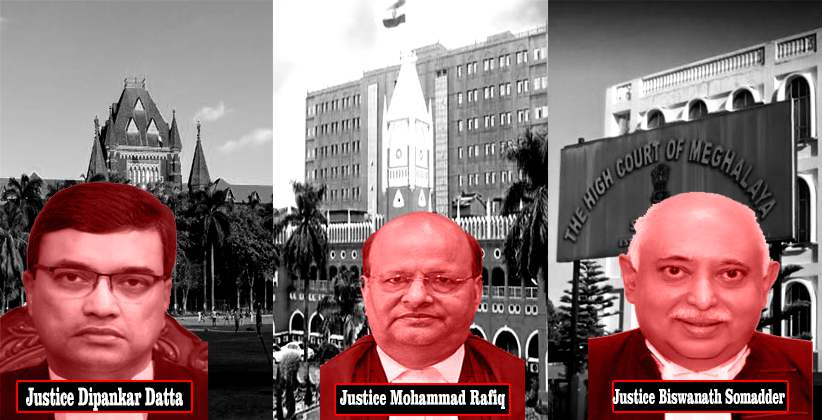
Supreme Court Top Panel Names Chief Justices for Bombay, Orissa and Meghalaya High Courts Supreme Court Top Panel Names Chief Justices for Bombay, Orissa and Meghalaya High Courts

On April 18, 2020, the Supreme Court Collegium recommended new Chief Justices for three High Courts. Justice Dipankar Datta was proposed as Chief Justice of the Bombay High Court, succeeding Justice B.P. Dharmadhikari. Justice Biswanath Somadder was nominated as Chief Justice of Meghalaya High Court, while Justice Mohammad Rafiq was recommended for transfer as Chief Justice of Orissa High Court.

TRENDING NEWS

no-offence-under-sc-st-act-if-alleged-casteist-abuse-occurred-inside-private-house-sc
Trending Judiciary
No Offence Under SC/ST Act If Alleged Casteist Abuse Occurred Inside Private House: SC [Read Judgment]

Supreme Court rules SC/ST Act offence is not made out if alleged casteist abuse occurred inside a private house without public view.

14 May, 2026 03:16 PM
madras-hc-bars-tiruppattur-mla-from-floor-test-over-disputed-one-vote-victory
Trending Judiciary
Madras HC Bars Tiruppattur MLA From Floor Test Over Disputed One-Vote Victory [Read Order]

Madras High Court restrains Tiruppattur MLA from floor test participation over disputed one-vote victory and alleged electoral irregularities.

14 May, 2026 03:24 PM

TOP STORIES

delhi-hc-refers-to-larger-bench-issue-on-stage-of-hearing-accused-under-section-223-bnss-before-cognizance
Trending Judiciary
Delhi HC Refers to Larger Bench Issue on Stage of Hearing Accused Under Section 223 BNSS Before Cognizance [Read Judgment]

Delhi High Court refers to Larger Bench issue on when accused must be heard under Section 223 BNSS before taking cognizance.

09 May, 2026 10:25 AM
hymen-intact-does-not-mean-no-penetration-delhi-high-court-upholds-pocso-conviction-of-tenant-who-raped-six-year-old-girl
Trending Judiciary
‘Hymen Intact Does Not Mean No Penetration’: Delhi High Court Upholds POCSO Conviction of Tenant Who Raped Six-Year-Old Girl [Read Order]

Delhi High Court upheld a tenant’s POCSO conviction for raping a six-year-old girl, holding that an intact hymen does not negate penetration.

09 May, 2026 12:42 PM
consumer-commission-directs-bus-operator-to-pay-50000-compensation-after-barat-reaches-wedding-destination-at-3-am-due-to-breakdown
Trending Judiciary
Consumer Commission Directs Bus Operator to Pay ₹50,000 Compensation After Barat Reaches Wedding Destination at 3 AM Due to Breakdown [Read Order]

Delhi Consumer Commission ordered a bus operator to pay ₹50,000 compensation after a Barat reached the wedding venue at 3 AM due to breakdown.

09 May, 2026 01:56 PM
sabarimala-reference-day-13-can-faith-justify-civil-death-and-genital-cutting-of-children-sc-bench-examines-religions-reach-over-the-body
Trending Judiciary
Sabarimala Reference Day 13: “Can Faith Justify Civil Death and Genital Cutting of Children?”: SC Bench Examines Religion’s Reach Over the Body

SC’s nine-judge bench examined whether religious practices violating dignity, bodily autonomy and conscience can claim protection under Article 26.

09 May, 2026 02:25 PM

ADVERTISEMENT


Join Group

Signup for Our Newsletter

Get Exclusive access to members only content by email