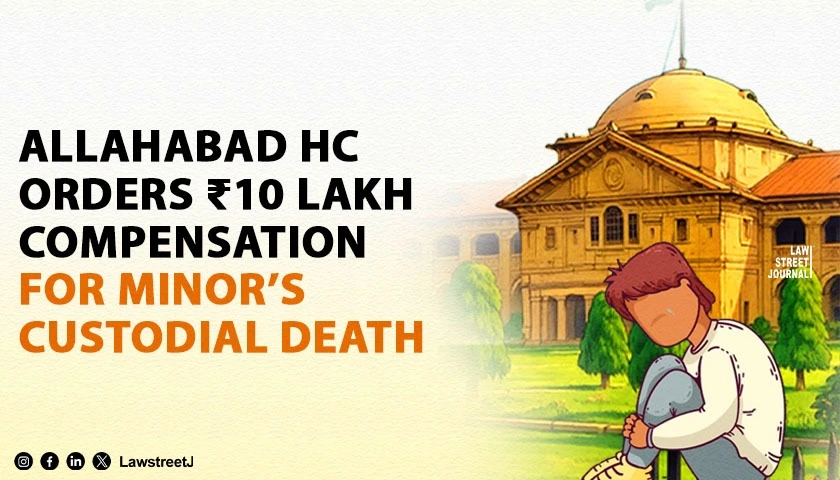
Prayagraj: The Allahabad High Court (Lucknow Bench) has awarded ₹10 lakh compensation to the family of a minor who died in custody at the District Prison, Pilibhit, holding the State absolutely liable for the unnatural death of a prisoner in its custody. The Division Bench comprising Justice Shekhar B. Saraf and Justice Manjive Shukla allowed the writ petition filed under Article 226 of the Constitution and directed payment of compensation within three weeks.
The writ petition was filed by Prema Devi, whose minor son, Sukhvinder, died on February 20, 2024, while lodged in jail. He had earlier been accused in Case No. 742/2016 under Sections 363, 366 and 376 of the IPC and Sections 3/4 of the POCSO Act at P.S. Puranpur, District Pilibhit. After having undergone imprisonment for about three years and ten months, he was released on bail on February 12, 2022. Subsequently, upon his failure to appear before the trial court, he was arrested on February 7, 2024, and detained in prison.
On February 20, 2024, the petitioner was informed that her son had died in custody. A panchnama and post-mortem examination were conducted, which indicated death due to “asphyxia as a result of ante-mortem hanging.” The inquest report submitted by the Judicial Magistrate under Section 176 of the CrPC (corresponding to Section 196 of the BNSS) concluded that the deceased had committed suicide and that no external injuries indicative of custodial violence were found.
The National Human Rights Commission had, by order dated October 10, 2024, recommended payment of ₹3 lakh as compensation to the next of kin. Though the State approved the compensation, the amount was not disbursed, citing verification of legal heirs and budgetary allocation.
Before the High Court, the petitioner alleged custodial torture and illegal monetary demands by prison officials, contending a violation of Articles 14 and 21 of the Constitution. Reliance was placed on decisions including Nilabati Behera v. State of Orissa, D.K. Basu v. State of West Bengal, and Re-Inhuman Conditions in 1382 Prisons to argue that compensation in public law is an established remedy for custodial deaths.
The State contended that the death was a case of suicide and not attributable to negligence or misconduct. It further submitted that compensation of ₹3 lakh had already been approved pursuant to the NHRC’s recommendation and would be disbursed upon completion of procedural formalities.
The Court, however, held that once a person dies in custody, the State bears an absolute and non-delegable duty to account for the circumstances of the death. Relying on Supreme Court jurisprudence, the Bench observed that even a suicide in custody amounts to an “unnatural death” for which the State is liable unless it conclusively demonstrates death due to natural causes. The Court underscored that Article 21 does not stand suspended within prison walls and that custodial death strikes at the core of constitutional governance.
Rejecting the State’s explanation as insufficient to displace the presumption of liability, the Court held that the death of the petitioner’s son constituted a violation of fundamental rights. It reiterated that constitutional courts are empowered to award monetary compensation as a public law remedy independent of civil or criminal proceedings.
On the quantum of compensation, the Bench noted that courts in recent years have awarded ₹10 lakh in custodial death cases. While referring to the categorisation adopted by the Meghalaya High Court in Suo Motu Custodial Violence (2023), the Court observed that the said judgment had been stayed by the Supreme Court on the issue of age-based categorisation and therefore could not be relied upon as binding precedent. Nevertheless, considering prevailing judicial trends and the facts of the case, the Court awarded ₹10 lakh to the legal heirs.
The Court further directed the State Government to frame guidelines for compensation in custodial death cases by adopting rational parameters akin to the multiplier method under the Motor Vehicles Act, 1988, based on age, income, and dependants.
The writ petition was accordingly allowed.
Case Details:
- Case Title: Prema Devi v. State of U.P. through Principal Secretary, Home Department, Lucknow & Ors.
- Court: Allahabad High Court, Lucknow Bench
- Case No.: WRIT - C No. 579 of 2025
- Reserved on: February 11, 2026
- Pronounced on: February 20, 2026
- Bench: Justice Shekhar B. Saraf and Justice Manjive Shukla
Appearance:
- Counsel for Petitioner(s): Rama Kant Dixit, Uday Kumar

!["No Loudspeakers For Azan, No Fundamental Right To Create Noise," Says Allahabad HC To Two Mosques [Read Judgment]](/secure/uploads/2020/01/lj_4995_Allahabad_HC_AZAN.jpg)