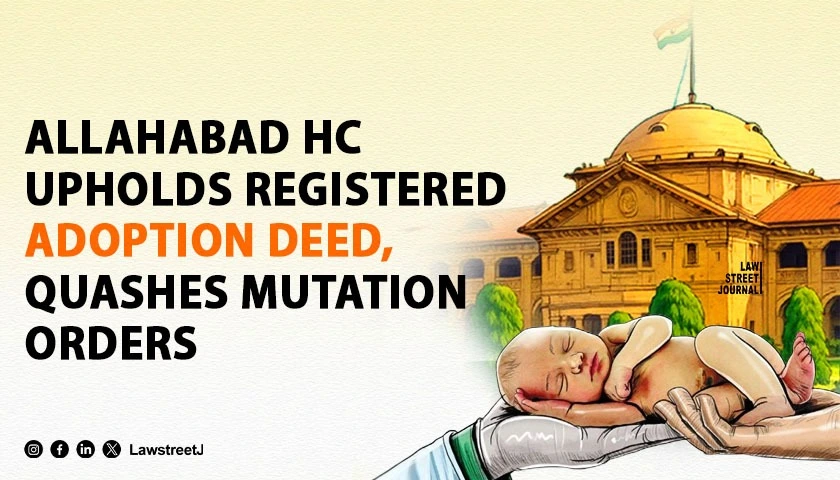
Prayagraj: In a significant judgment, the High Court of Judicature at Allahabad, Lucknow Bench, in Ram Kumar v. Narain and Others, set aside the orders passed by the revisional and appellate authorities, reaffirming the statutory presumption attached to a registered adoption deed under Section 16 of the Hindu Adoption and Maintenance Act, 1956. The judgment, delivered by Hon’ble Justice Irshad Ali, addressed a dispute concerning the mutation of agricultural land following the death of the adoptive father.
The petitioner, Ram Kumar, was adopted by his uncle, Ram Asrey, through a duly executed and registered adoption deed dated 8 February 1982, when the petitioner was four years old. Following Ram Asrey’s death, a mutation application was filed in favour of the petitioner. The application was initially allowed by the Naib Tehsildar on 18 August 1992, as the original adoption deed was proved along with the testimony of the natural mother, marginal witnesses, the Village Pradhan, and the priest who performed the adoption rituals.
However, the Sub-Divisional Officer, Kaiserganj, allowed the appeal filed by the respondent (brother of the deceased) on 17 September 1993, setting aside the mutation order and directing that the names of the deceased’s brothers, Samay Deen and Narain, be recorded. This decision was subsequently upheld by the Commissioner, Faizabad Division, who dismissed the revisions on 8 December 1999. Both the appellate and revisional authorities expressed suspicion regarding the adoption deed, despite the respondents having never challenged it in any statutory proceeding.
The High Court criticised the lower authorities for ignoring the legal presumption attached to a registered adoption deed. The Court observed that the Commissioner, Faizabad Division, “by completely ignoring the presumption attached to the registered adoption deed in terms of Section 16 of the Hindu Adoption and Maintenance Act, and also by ignoring the illegality, irregularity, and perversity committed by the appellate court, dismissed all three revisions by passing a common order dated 8.12.1999.”
The Court further held that, “If there was any grievance against the duly registered adoption deed, the respondents ought to have instituted appropriate statutory proceedings challenging the same. In the absence of such challenge, the findings recorded by the appellate and revisional courts, based on mere assumptions of doubt, are perverse in nature and unsustainable in the eyes of law.”
Emphasising the necessity of reasoned conclusions, the Court stated, “No reasons have been recorded for coming to the conclusion that the adoption deed is suspicious in nature. Reasons are the heartbeat of any conclusion, and without reasons, an order becomes lifeless. Therefore, the non-recording of reasons in arriving at the conclusion that the adoption deed is suspicious renders the order wholly illegal and devoid of merit.”
Relying on Section 16 of the Hindu Adoption and Maintenance Act, the Court reiterated the mandatory statutory presumption, observing, “The Court shall presume that the adoption has been made in compliance with the provisions of this Act unless and until it is disproved.” Since “the respondent has utterly failed to challenge the said evidence or disprove the aforesaid adoption,” the Court held that the suspicion cast by the lower authorities was wholly unjustified.
The Court also relied on Supreme Court precedents, including Laxmibai (Dead) through LRs v. Bhagwantbuva (Dead) through LRs and Others and Mst. Deu and Others v. Laxmi Narayan and Others, to reiterate that once a registered adoption deed is produced, the burden shifts to the person challenging its validity.
Concluding that the impugned orders were passed in total disregard of settled legal principles, the Court held that they were liable to be set aside. Accordingly, the impugned orders dated 8 December 1996 and 8 May 2000 were quashed, and the writ petition was allowed.
Case Details:
Case: WRIT-C No. 1001378 of 2000
Counsel for Petitioner(s): R.P. Pandey, G.P. Pandey, Rajeev Kumar Tripathi
Counsel for Respondent(s): C.S.C.; Dharmendra Singh Gaur; K.N. Shukla; Rahul Mishra; Shiv Kumar Mishra (for legal heirs of respondent no.1); Divesh Mishra (Standing Counsel for respondent nos. 4, 5 and 6)
Bench: Hon’ble Justice Irshad Ali
Date of Order: 2 December 2025

!["No Loudspeakers For Azan, No Fundamental Right To Create Noise," Says Allahabad HC To Two Mosques [Read Judgment]](/secure/uploads/2020/01/lj_4995_Allahabad_HC_AZAN.jpg)