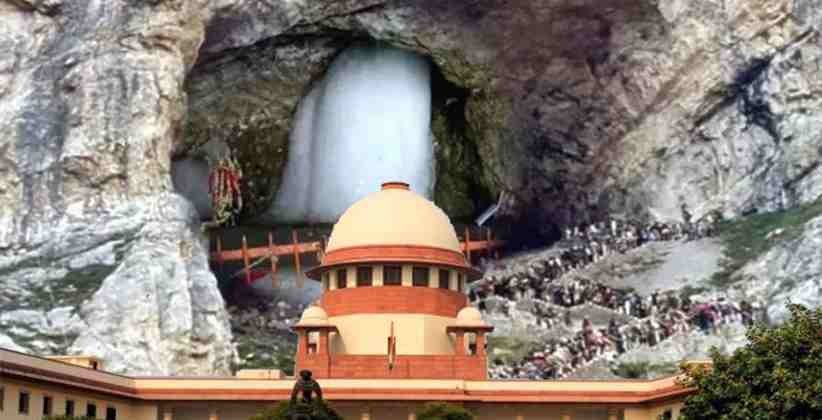
The Supreme Court on July 13 refused to put the brakes on this years Amarnath Yatra in Jammu and Kashmir, proposed to be held amid the coronavirus pandemic, saying it is a subject matter under the domain of the Executive and that the courts cannot take over these powers under the rubric of judicial review.
A three-judge Bench of Justices D.Y. Chandrachud, Indu Malhotra, and K.M. Joseph dismissed the petition filed by Shri Amarnath Barfani Langars Organisation, which had sought a directive to the Centre, the Union Territory of Jammu and Kashmir and Shri Amarnathji Shrine Board to restrict access of the general public, devotees, and pilgrims to the annual pilgrimage for 2020 given the Covid-19 outbreak.
The plea filed through Advocate-on-Record Amit Pai urged the Court to issue directions to ensure that proper arrangements to be made instead for live darshan through the Internet and electronic media to satiate the religious sentiments of devotees. The petitioners said the issue as to whether Amarnath Yatra 2020 should or should not be held is a matter that must be left to the competence of the local administration.
Any decision that is arrived at has to be based on law and relevant statutory provisions holding the field. Entertaining a writ petition under Article 32 (enforcement of fundamental right) at this stage would necessarily involve this Court taking over an executive function of oversight over the local administration. We decline to exercise the jurisdiction under Article 32 to take over these powers under the rubric of judicial review. The principle of separation of powers requires that administrative decisions must be taken where they are entrusted, namely by the executive arm of the state, Justice Chandrachud said.
Senior advocate Devadatt Kamat, appearing for the petitioner, relied on the guidelines issued on June 29 under the Disaster Management Act, 2005, by the Union home ministry to point out that religious functions and other large congregations have been barred from the range of activities permissible outside containment zones. Kamat, to buttress his case, cited the Supreme Court's order in the Jagannath Puri Yatra case. However, the Court was quick to point out that the State of Odisha was also before the Court in that case. Further, the Court asked,
In its order, the bench said the decision on whether a pilgrimage should be permitted and, if it is permitted, the safeguards which should be observed, are matters which fall within the domain of the executive. In arriving at a decision, the administrative authorities must bear in mind statutory provisions governing the field and policies and administrative circulars issued in pursuance of statutory provisions. An assessment of the situation will be based on ground realities, the bench said.
This assessment lies in the domain of the administrative functions of the state, the bench said.
Justice Chandrachud mentioned that it is the court must step in where the decision-making process is flawed by a failure to observe statutory or constitutional requirements or where a decision is contrary to law or the failure to make a decision results in a breach of statutory duty or a fundamental right.
Once a decision is taken, its validity can be tested on procedural and substantive grounds including proportionality and manifest arbitrariness. The power to decide on whether a pilgrimage should take place in a given situation lies with the executive arm of the state.
The court will step in where the parameters for judicial review, as explained earlier, arise. The petitioners are at liberty to provide such inputs as they may be advised to furnish having regard to their experience of assisting in the pilgrimage in the past we decline to entertain the petition under Article 32 of the Constitution. The petition stands dismissed, the court said in the order.