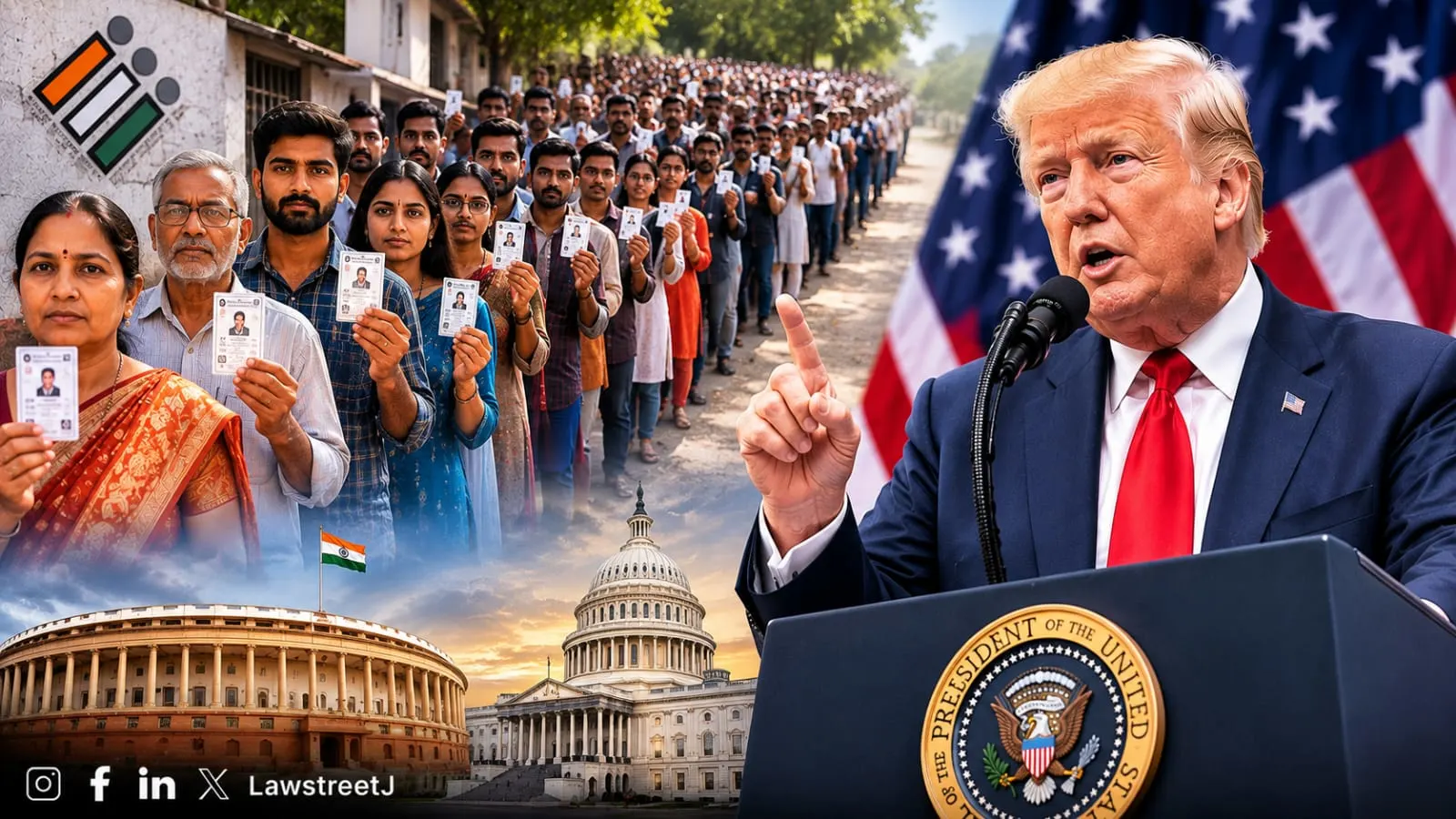
India has the distinction of being the largest democracy in the world. Elections are the most important and integral part of politics in a democratic system of governance. While politics is the art and practice of dealing with political power, the election is a process of legitimizing such power. Democracy and free and fair elections are inseparable twins. Democracy can indeed function only upon this faith that elections are free and fair and not rigged and manipulated. Elections at present, however, are not being held in ideal conditions because of the enormous amount of money required to be spent and the large muscle power needed for winning the elections.
The election process in our country is the progenitor of political corruption. The major defects which come in the path of the electoral system in India are money power, muscle power, criminalization of politics, poll violence, booth capturing, communalism, casteism, non-serious and independent candidates, etc.
Electioneering is an expensive affair in every democratic polity which plays a more vital role in India. Money power plays a destructive role in our electoral system, affecting seriously the working of periodic elections. It leads to all-around corruption and contributes mainly to the generation of black money. The adoption of a mixed economy with a large amount of control, regulation, licenses, permits, and quotas in free India provided enormous opportunities for political corruption and resulted in an unethical nexus between the electoral politics and the business sector of the country. This nexus seems to continue even today with more disastrous consequences of an overflow of black money into the corridors of political parties despite the liberalized economy induced to the political system of the country. Only those people can participate in elections as candidates who have a lot of money because todays vote is not merely a means of public opinion but is being purchased.
India elections have historically faced problems of payment of bribes and other illegal inducements to influence the voters. Sometimes, even top politicians have been caught on camera offering cash and other doles to voters to buy their votes. Vote-buying is such a common form of electoral malpractice in India that it has become a key feature of election culture. Vote-buying constrains economic development through the under-provision of public goods such as education, public health, and infrastructure. Further, since low-income individuals are the primary targets of vote-buying, it may also undercut their political voice. Money allows wealthy individuals or interests to influence electoral politics in their favor, thereby entrenching their wealth and creating a reinforcing cycle in which inequality and public policies interlock.
Freedom of choice is called the essence of a democratic election. In all democratic countries, the election of a particular person of their choice among the other candidates for discharging certain duties is the natural right of an individual. Corrupt electoral practices make a mockery of holding free and fair elections and weaken democratic structures. Corrupt practices and offenses related to the election are those which interfere in the free exercise to vote and include bribery, undue influence, etc.
Electoral offenses have been enumerated under the Indian Penal Code of 1860 and the Representation of the People Act of 1951.
Chapter IX-A of the Indian Penal Code enlists the offenses relating to elections. Sections 123 (1) of the Representation of the People Act and Sections 171-B and 171-C of the Indian Penal Code defines bribery as a corrupt practice as well as an electoral offense.
Section 171-B states that whoever gives gratification with the object of inducing a person to exercise any electoral right or of rewarding any person for having exercised any such right or accepts any gratification for exercising any such right, commits an offense of bribery.
Section 171-C provides that, whoever voluntarily interferes or attempts to interfere with the free exercise of any electoral right, commits the offense of undue influence at an election. Whoever threatens a candidate with injury of any kind or induces or attempts to induce a candidate or voter to believe that he, or any person in whom he is interested, will become, or will be rendered an object of divine displeasure or spiritual censure, also commits the offense of undue influence of elections.
Section 171-E prescribes the punishment for bribery with imprisonment for a term that may extend to one year or with a fine or with both. Section 171-F prescribes the punishment for undue influence with imprisonment which may also extend to one year, or with a fine, or with both.
Section 123 of the Representation of the People Act, 1951 stipulates corrupt practices relating to the Acts such as bribery, exercising undue influence, appeal to vote on the ground of religion, caste, community, language, etc., promote oblique attempt to promote feelings of enmity or hatred between classes of citizens, publication of false statements, hiring or procuring vehicles for the conveyance of election, expenditure in contravention to Section 177 of the Representation of the People Act, obtaining any assistance for the furtherance for the prospect of that candidates election from governmental officials and booth capturing shall be deemed to interfere with the free exercise of electoral rights.
The prevalence of provisions penalizing electoral offenses hardly serves as a deterrent for candidates to stop indulging in electoral malpractices.
In a bid to put a stop to such offenses, Advocate Ashwini Kumar Upadhyay had filed a Public Interest Litigation (PIL) that sought to make electoral offenses, including bribery, false statement, and undue influence cognizable.
Supreme Court Advocate Ashwini Upadhyay stated that the candidates often used bribes in a bid to influence election results and the democracy would be in peril and culminate into plutocracy in the absence of stringent laws against such offenders.
Mr. Upadhyay submitted that the Election Commission had seized about Rs, 1000 crore in cash during various polls between 2014 and 2018, indicating the extent to which illegal money has been playing a role in electoral politics.
Influence of big money is converting democracy into plutocracy. Excess election costs are not only the motivation but also justification for political corruption, creating a green pasture for systematic corruption. Unregulated electioneering is not only a source of black money but also creates demand and motivation for hoarding of black money, the petition said.
The petition stated that in states such as Andhra Pradesh, Telangana, Karnataka, Tamil Nadu, and Goa, and the Northeast, a candidate for an Assemble Poll has been spending between Rs. 10 crores. In Lok Sabha elections, the petition said, the amount varies between Rs. 40 crores and Rs. 100 crores. Under existing laws, the maximum a candidate can spend for Assembly Polls is Rs.20 lakhs in small states like Goa and Manipur and Rs. 28 crores in larger states like Uttar Pradesh and Bihar. In Lok Sabha elections, the maximum a candidate can spend is Rs. 70 lakhs in the larger states and Rs. 54 lakhs in the smaller states.
The change in law has become necessary as there have been increasing incidents of bribery being detected in all elections, from local body polls to Lok Sabha elections. This is because, currently, bribery is a non-cognizable offense attracting only minimal punishment.
Bribery, undue influence, and impersonation are non-cognizable, with the punishment of one year in jail, or fine, or both. The petition said publishing false statements to affect the outcome of an election was punishable with a fine. Incurring expenditure for promoting the prospects of a candidate was also an offense, but the punishment was a mere Rs. 500/- fine. Similarly, failure to keep election accounts was punished with a fine of Rs. 500/-.
Ashwini Upadhyay cited the Election Commission of Indias recommendation to the government in 2012 that the law is amended to make election bribery, both in cash and in-kind, a cognizable offense. This would have enabled the police to arrest the accused without a warrant and to increase punishment up to two years, the petition read.
Mr. Upadhyay said in his petition that the failure of successive governments to act on the Election Commissions recommendation for harsher punishments since 1992 has resulted in the erosion of public trust in the electoral system.
In 1992, the Election Commission proposed that punishments for these offenses be enhanced to two years [in jail], and these offenses be made cognizable. Since 1992, it has reiterated the proposals many times, but the successive government did nothing to implement them, Mr. Upadhyay said.
Money and muscle powers are the basic evils that pollute and defile the process and motivate participants to resort to malpractices in elections. This leads to the decline of moral values in the arena of electoral politics. Therefore, radical measures- legislative, administrative, and reformatory are needed to stem the root that is eating vitiate of the democratic process. After all, a game can only be fair if the players are honest and true to its spirit.