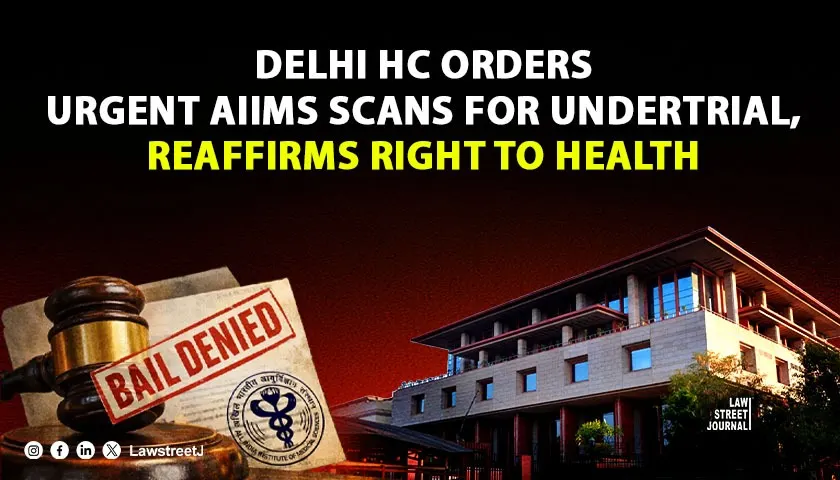
New Delhi: The Delhi High Court has reiterated that incarceration cannot suspend an undertrial’s right to health, directing the Medical Superintendent of AIIMS, New Delhi, to conduct CT Brain and MRI Brain scans on a priority basis for an accused lodged in judicial custody, even as his interim bail plea on medical grounds was dismissed as withdrawn.
The order was passed by Justice Girish Kathpalia on 15 January 2026 in Bail Application No. 155 of 2026, arising out of a murder case in which the prosecution claims recovery of the weapon of offence, the vehicle allegedly used to take the deceased away, and “last seen” evidence against the accused.
Bail Plea Withdrawn Amid Allegations of Concealment
The accused sought interim bail on medical grounds, claiming deterioration due to neurological issues and delayed access to diagnostic facilities, with a CT scan scheduled for 22 January 2026 and an MRI only in May 2026.
The State opposed the plea, pointing out that the accused had concealed an earlier Sessions Court order dated 29 October 2025, which had rejected the extension of medical bail on the ground that the accused failed to commence treatment despite having been granted interim bail earlier. The complainant further alleged that during the earlier bail period, the accused’s family attempted to encroach upon the deceased’s property, leading to a police complaint by the widow.
In light of these submissions, the accused sought permission to withdraw the bail application, which the Court allowed.
Court Intervenes to Protect Medical Rights
Despite dismissing the bail plea, the High Court refused to ignore the medical aspect. Justice Kathpalia observed that while concealment of material facts would ordinarily justify outright rejection, an accused in judicial custody remains entitled to proper medical treatment.
The Court underscored that the right to health flows directly from Article 21 of the Constitution, noting that even a convicted prisoner retains this protection, subject only to procedure established by law. Since the accused was still an undertrial, the obligation of the State was even more pronounced.
Balancing the competing interests of the accused, the prosecution, and the complainant, the Court directed AIIMS to conduct both scans within one week, with the Investigating Officer required to coordinate compliance. The accused is to be taken into custody for the scans and thereafter treated either in jail or in a hospital attached to the prison.
Rooted in Settled Constitutional Jurisprudence
The High Court’s reasoning aligns with a long line of Supreme Court jurisprudence recognising prisoners’ right to health and medical care as an inseparable facet of Article 21:
- Sunil Batra v. Delhi Administration (1978)
The Supreme Court held that prisoners do not shed their fundamental rights at the prison gate, and that cruel, inhuman, or degrading treatment violates Article 21. - Charles Sobhraj v. Superintendent, Central Jail (1978)
The Court ruled that the right to life includes the right to health and medical care even within prison walls. - Parmanand Katara v. Union of India (1989)
It was held that preservation of human life is of paramount importance and that medical treatment cannot be denied on technical or procedural grounds. - State of Andhra Pradesh v. Challa Ramkrishna Reddy (2000)
The Court affirmed that prisoners are entitled to reasonable medical facilities and that the State bears constitutional responsibility for their health. - Inhuman Conditions in 1382 Prisons, In Re (2016)
The Supreme Court explicitly recognised the right to health of prisoners, directing systemic reforms to address overcrowding, inadequate medical staff, and deficient prison healthcare infrastructure.
Case Details:
- Case Number: Bail Application No. 155 of 2026; CRL.M.A. 1320/2026
- Title: Jagarnath Shah @ Lala v. State (NCT of Delhi)
- Counsel for the Petitioner: Mr. Abhishek Rana, Advocate; Mr. Vikas, Advocate
- Counsel for the Respondent/State: Mr. Sanjeev Sabharwal, Additional Public Prosecutor
- Counsel for the Complainant: Mr. Vikram Panwar, Advocate; Mr. Vijay, Advocate
- Court: Delhi High Court
- Judge: Justice Girish Kathpalia
- Date of Order: 15 January 2026

![Delhi High Court Sets Aside Arbitral Tribunal's Award Against NHAI in Highway Project Delay Case [Read Judgment]](/secure/uploads/2023/07/lj_9605_23374c2e-392c-4491-a2fe-f2f12fc5272f.jpg)
![Delhi Court Rejects Stay Request in Defamation Case Against Rajasthan CM Ashok Gehlot [Read Order]](/secure/uploads/2023/08/lj_5208_80de1ddc-d76a-4f7f-b180-408e3ae14fb4.jpg)