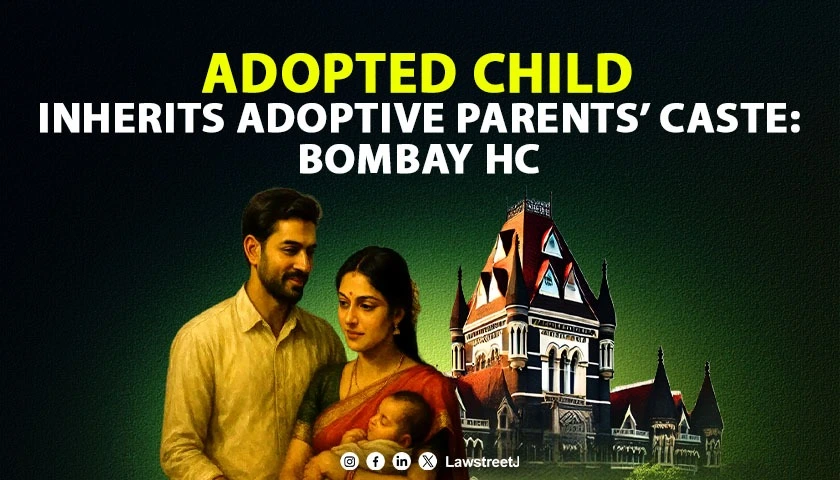
Mumbai: The Bombay High Court has held that where an abandoned child is lawfully adopted and the biological parents are unknown, the caste of the adopted child must be treated as that of the adoptive parents. Denial of caste validity in such circumstances, the Court observed, would defeat the legal effect of adoption and adversely impact the child’s future entitlements.
The ruling was delivered by a Division Bench comprising Justice M. S. Karnik and Justice S. M. Modak, allowing a writ petition filed by Mrs. Geeta Dattatray Achari challenging the cancellation of a caste certificate issued in favour of her adopted son, Om Dattatray Achari.
The case arose from the adoption of Om, an abandoned child whose biological parents and caste were unknown. The petitioner and her husband adopted the child through a valid court process under the Juvenile Justice (Care and Protection of Children) Act, 2000. By an order dated 22 August 2014, the District Court, Pune, declared the petitioner and her husband to be the lawful adoptive parents, directed issuance of a birth certificate recording them as the child’s parents, and imposed conditions relating to the child’s welfare, insurance, and financial security.
The petitioner belongs to the Special Backward Category. On her application, the competent authority issued a caste certificate in favour of the adopted child in 2017. However, following a complaint by an unknown person, the Sub-Divisional Officer cancelled the caste certificate in February 2018, holding that there was no provision under the Maharashtra Scheduled Castes, Scheduled Tribes, De-Notified Tribes (Vimukta Jatis), Nomadic Tribes, Other Backward Classes and Special Backward Category (Regulation of Issuance and Verification of Caste) Certificate Act, 2000, to grant a caste certificate to an adopted child. The appeal was dismissed by the Caste Scrutiny Committee in December 2018, leading to the present writ petition.
Before the High Court, the petitioner argued that once a valid adoption has taken place and the biological parents are unknown, the adopted child must legally acquire the caste of the adoptive parents. Reliance was placed on an earlier Division Bench judgment of the Bombay High Court, as well as on Supreme Court precedents recognising the full legal consequences of adoption. The State defended the impugned orders, contending that the caste legislation does not expressly provide for grant of caste validity to adopted children.
Allowing the petition, the High Court held that while the caste certificate legislation and the rules framed thereunder may not expressly deal with adoption, they cannot be interpreted in isolation from other governing laws. The Court examined the scheme of the Juvenile Justice Act, 2000, under which the adoption was granted, and emphasised that adoption under the Act permanently severs the child’s ties with the biological family and creates a complete legal relationship with the adoptive parents.
The Bench noted that the Juvenile Justice Act defines adoption as a process through which the adopted child becomes the legitimate child of the adoptive parents, with all rights, privileges, and responsibilities attached to that relationship. This legal fiction, the Court observed, cannot be diluted when determining social and legal status such as caste, particularly where biological parentage is unknown.
The Court further held that denying caste validity in such cases would leave the child in a state of uncertainty and undermine the very purpose of adoption laws aimed at rehabilitating abandoned children and integrating them fully into family and society. It found that the authorities had failed to consider the legal effect of adoption and had adopted an unduly narrow interpretation of the caste statute.
Relying on earlier judicial pronouncements and the constitutional obligation to protect the rights of children, the Bench concluded that an adopted child must, for all legal purposes, be treated as the child of the adoptive parents. Consequently, where the adoptive parents belong to a reserved category, the adopted child is entitled to the same status, subject to the validity of the adoption.
Accordingly, the High Court set aside the orders of the Sub-Divisional Officer and the Caste Scrutiny Committee and directed the Scrutiny Committee to issue a caste validity certificate to Om Dattatray Achari as a member of the Special Backward Category within four weeks.


![Husband Can Also Claim Alimony/Maintenance From Wife: Bombay High Court Orders Woman To Pay Alimony To Ex-Husband [Read Order]](/secure/uploads/2022/04/lj_2823_Divorce.jpg)