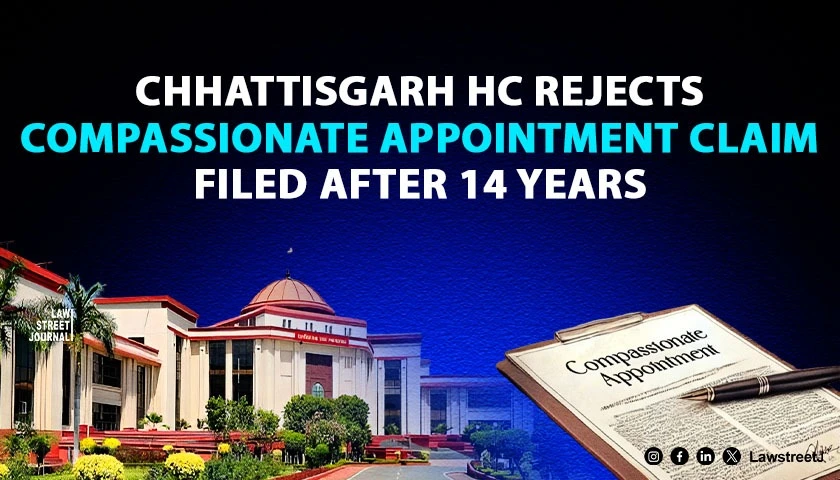
Chhattisgarh: The Chhattisgarh High Court at Bilaspur has dismissed a writ petition seeking compassionate appointment, holding that inordinate delay and laches defeat the very object of compassionate employment, which is intended solely to provide immediate relief to the family of a deceased government employee facing sudden financial distress.
Justice Amitendra Kishore Prasad refused to interfere with the State Government’s decision rejecting the petitioner’s claim, observing that compassionate appointment is neither a vested right nor a mode of inheritance and cannot be revived after the passage of several years merely because a dependent attains majority or due to disputes among legal heirs.
The petitioner’s father, who was working as a Circle Coordinator in the Education Department, died in harness on 19 February 2005. At the time of death, the petitioner was a minor. The petitioner claimed that his mother had informed the authorities about the death and sought compassionate appointment for him but was not guided properly. It was also contended that a dispute between the deceased employee’s two wives led to civil litigation, which delayed the claim.
After attaining majority, the petitioner applied for compassionate appointment in June 2019, nearly 14 years after his father’s death. The application was rejected by the State authorities on the ground of delay. Despite an earlier direction by a Coordinate Bench of the High Court to reconsider the claim, the authorities again rejected it by a reasoned order dated 16 January 2023, holding that the claim was hopelessly time-barred under the applicable policy.
The High Court noted that the compassionate appointment policy of the State of Chhattisgarh prescribes a strict timeline for submitting such applications and that even in exceptional circumstances, the outer limit cannot exceed five years. The Court held that disputes between legal heirs or the attainment of majority do not extend or revive a time-barred claim.
Relying on a consistent line of Supreme Court precedents, including the recent decision in Tinku v. State of Haryana, the Court reiterated that compassionate appointment is an exception to the constitutional mandate of equality in public employment and must be strictly governed by policy. Entertaining stale claims after the crisis period has long passed would undermine Articles 14 and 16 of the Constitution.
Finding no arbitrariness or illegality in the State’s decision, the Court dismissed the writ petition, holding that the petitioner failed to establish any exceptional circumstance warranting relaxation of the prescribed time limits.
Case Details
- Court: High Court of Chhattisgarh, Bilaspur
- Bench: Justice Amitendra Kishore Prasad
- Date of Decision: January 22, 2026
- Case Title: Nijesh Chauhan v. State of Chhattisgarh & Others
- Case Number: WPS No. 2604 of 2023
- Citation: 2026:CGHC:3889
Advocates Appearing:
For the Petitioner: Mr. Sumit Singh Rathore, Advocate
For the Respondents (State): Mr. Arpit Agrawal, Panel Lawyer


![SC sets free man from case under SC/ST Act as offence not committed due to caste [Read Judgment]](/secure/uploads/2024/01/lj_4809_5ccb3cf2-6198-4e45-bb33-bfaa9b67a897.jpg)
![SC to consider forming guidelines on trial for deaf-dumb people [Read Order]](/secure/uploads/2024/04/lj_3160_483df315-842c-414c-9d28-65634ae6e806.webp)