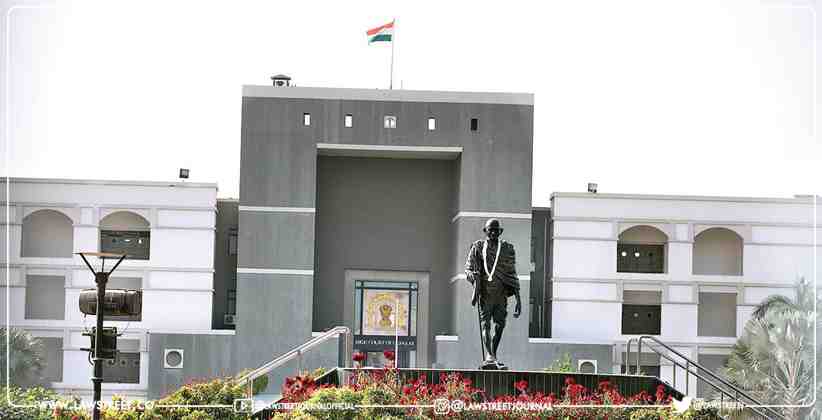
The Bench, led by Justice Rajendra Sareen, was considering a special civil suit challenging the Petitioner's detention order issued in December 2021 under Section 3(2) of Gujarat Prevention of Anti-Social Activities Act , 1985 .
The issue involved in this case is that Whether this case involves a substantial question of law as to the interpretation of the Constitution of India or any order made thereunder ?
Justice Mr. Rajendra M. Sareen Observed that
Unless and until, the material is there to make out a case that the person has become a threat and menace to the Society so as to disturb the whole tempo of the society and that all social apparatus is in peril disturbing public order at the instance of such person, it cannot be said that the detenue is a person within the meaning of section 2(b) of Gujarat Prevention of Anti-Social Activities Act , 1985 Except general statements, there is no material on record which shows that the detenue is acting in such a manner, which is dangerous to the public order.
Learned advocate for the detenue submits that the order of detention impugned in this petition deserves to be quashed and set aside on the ground of registration of the solitary offence/s under Sections 65-AE, 116-B 98(2) and 81 of the Prohibition Act by itself cannot bring the case of the detenue within the purview of definition under section 2(b) of the Act.
Furthermore, learned advocate for the detenue submits that illegal activity likely to be carried out or alleged to have been carried out, as alleged, cannot have any nexus or bearing with the maintenance of public order and at the most, it can be said to be breach of law and order. Furthermore, except statement of witnesses, registration of above FIR/s and Panchnama drawn in pursuance of the investigation, no other relevant and cogent material is on record connecting alleged anti-social activity of the detenue with breach of public order.
On the other hand, an Additional Government pleader for the respondent State supported the detention order issued by the authority, claiming that sufficient material and evidence discovered during the course of the investigation, which was also provided to the detenue, indicate that the detenue is in the habit of engaging in the activity defined under section 2(b) of the Act, and that, based on the facts of the case, the detaining authority acted properly in issuing the detention order.
The Honble court stated that except the general statements, there is no material on record which shows that the detenue is acting in such a manner, which is dangerous to the public order. In this reference the Honble Court placed reliance on the landmark decision of the Supreme Court in Pushker Mukherjee v/ s. State of West Bengal[1], where the difference between 'law and order' and 'public order' has been clearly laid down.
The Court observed as follows :
When two people quarrel and fight and assault each other inside a house or in a street, it may be said that there is disorder but not public disorder. Such cases are dealt with under the powers vested in the executive authorities under the provisions of ordinary criminal law but the culprits cannot be detained on the ground that they were disturbing public order. The contravention of any law always affects order but before it can be said to affect public order, it must affect the community or the public at large. In this connection we must draw a line of demarcation between serious and aggravated forms of disorder which directly affect the community or injure the public interest and the relatively minor breaches of peace of a purely local significance which primarily injure specific individuals and only in a secondary sense public interest. A mere disturbance of law and order leading to disorder is thus not necessarily sufficient for action under the Preventive Detention Act but a disturbance which will affect public order comes within the scope of the Act.
At last the Honble Court ordered that
In view of above, I am inclined to allow this petition, because simplictor registration of FIR/s by itself cannot have any nexus with the breach of maintenance of public order and the authority cannot have recourse under the Act and no other relevant and cogent material exists for invoking power under section 3(2) of the Act. In the result, the present petition is hereby allowed and the impugned order of detention passed by the respondent detaining authority is hereby quashed and set aside. The detenue is ordered to be set at liberty forthwith if not required in any other case
In the current case, the court found that the petitioner had not performed an act that violated section 2(b) of the Act by disrupting society's tempo. The detention order was quashed and set aside by Justice Sareen due to these facts and circumstances.
Case Title: DILIP BHAVANISHANKAR YADAV Versus STATE OF GUJARAT
Case No.: C/SCA/19820/2021
[1] AIR 1970 SC 852