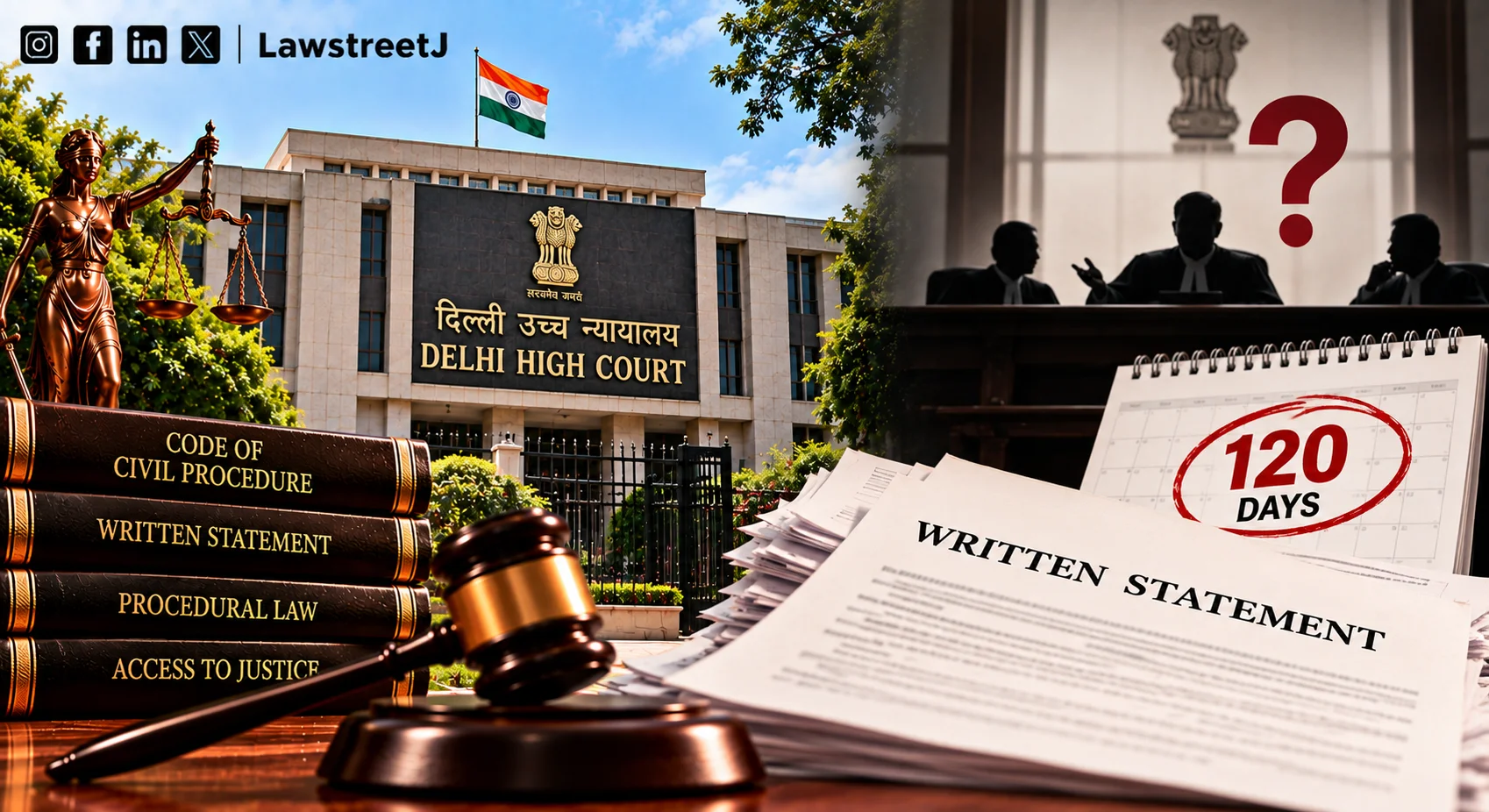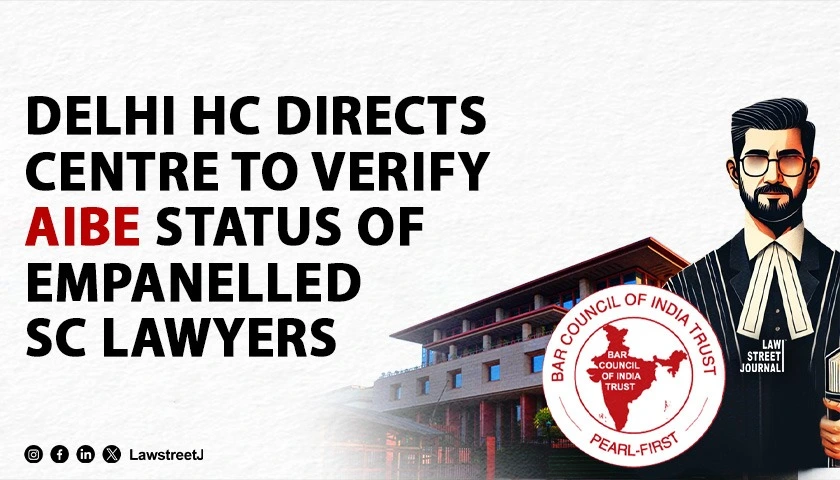
New Delhi: The Delhi High Court on Tuesday granted the Central Government eight weeks to examine allegations that some of the 650 lawyers empanelled to represent it before the Supreme Court have not cleared the All India Bar Examination (AIBE), a mandatory requirement to practise law in India. The Court also reiterated its earlier direction to the Government to frame a comprehensive policy for the empanelment of lawyers to represent the Union of India across various forums, as mandated in a case decided last year.
A Division Bench comprising Chief Justice Devendra Kumar Upadhyaya and Justice Tejas Karia was hearing a public interest litigation (PIL) filed by the First Generation Lawyers Association. The plea challenged the list of 650 empanelled lawyers issued by the Ministry of Law and Justice on November 21, 2025, alleging “serious concerns” regarding irregularities, lack of transparency, and the inclusion of newly enrolled advocates.
The petition contended that several individuals named in the panel were enrolled with State Bar Councils only in 2024 or even 2025, with some allegedly yet to clear the AIBE. The Association argued that appointing such inexperienced lawyers to represent the Union of India before the Supreme Court—particularly in matters involving constitutional interpretation and national policy—“violates constitutional mandates of fairness, equality of opportunity, and accountability under Article 14.”
The Bench specifically directed action on the individual allegations, stating:
“We direct that the grievances raised by the petition in respect of individuals empanelled shall be considered and a decision be taken within eight weeks from today.”
The proceedings also witnessed submissions from Additional Solicitor General (ASG) Chetan Sharma, appearing for the Central Government, who contended that the petitioner organisation and its President, Advocate Rudra Vikram Singh, were using the PIL for campaigning in the upcoming Bar Council of Delhi (BCD) elections. He further alleged misuse of the court process by sharing the virtual conference (VC) link on social media, stating, “There is something sinister.”
Appearing for the petitioner organisation, Advocate Rudra Vikram Singh denied using the PIL as campaign material, stating that the Association was working to safeguard the interests of lawyers, though he acknowledged that he was contemplating contesting the elections.
The Bench observed that posting the Court’s VC link amounted to a violation of the Delhi High Court Electronic Evidence and Video Conferencing Rules, 2025. Following this observation, the Court recorded Mr. Singh’s statement that he would delete all social media posts sharing VC links and confirmed that “the institution of the PIL will not be used as campaign material.”
The Court ultimately directed the Central Government to submit its decision on the allegations within the stipulated eight-week period.
Case Details:
Case Title: First Generation Lawyers Association (FGLA) v. Union of India
Court: High Court of Delhi
Coram: Chief Justice Devendra Kumar Upadhyaya and Justice Tejas Karia
Pronounced on: Tuesday, 06 January 2026
Counsel for Petitioner: Advocate Rudra Vikram Singh, Advocate Ashirvad Kumar Yadav, Advocate Neetu Rani, Advocate Rashmi Mehta, and Advocate Anirudh Tyagi
Counsel for Central Government/Union of India: Additional Solicitor General Chetan Sharma and Central Government Standing Counsel Radhika Dubey

![Delhi High Court Sets Aside Arbitral Tribunal's Award Against NHAI in Highway Project Delay Case [Read Judgment]](/secure/uploads/2023/07/lj_9605_23374c2e-392c-4491-a2fe-f2f12fc5272f.jpg)
![Delhi Court Rejects Stay Request in Defamation Case Against Rajasthan CM Ashok Gehlot [Read Order]](/secure/uploads/2023/08/lj_5208_80de1ddc-d76a-4f7f-b180-408e3ae14fb4.jpg)