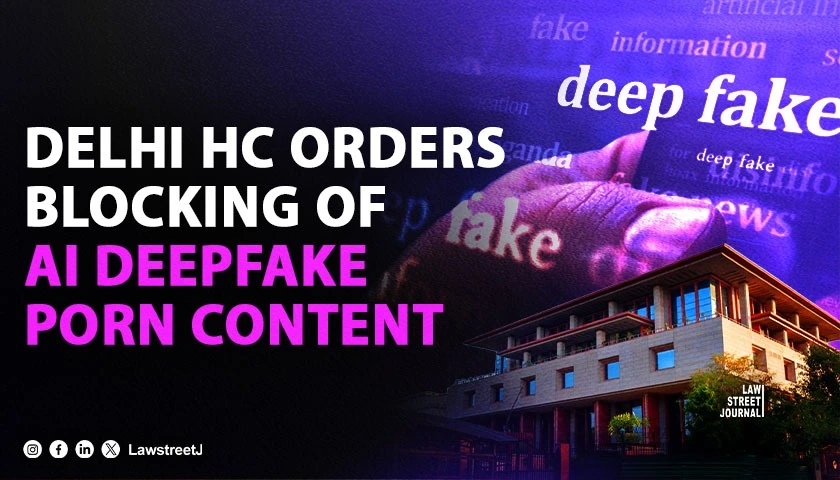
New Delhi: In a significant and strongly worded order addressing the escalating threat of AI-generated deepfake pornography, the Delhi High Court has granted wide-ranging interim relief in a civil suit filed by two digital content creators, directing takedown, de-indexing, disclosure of subscriber information, and government-led blocking of pornographic and morphed content falsely depicting the plaintiffs in sexually explicit positions.
The order was passed on 13 January 2026 by Justice Vikas Mahajan in X and Another v. John Doe and Others [CS(OS) 33/2026], a suit arising out of the non-consensual creation and circulation of AI-generated deepfake videos, morphed images, and manipulated audio-visual material impersonating the plaintiffs.
Plaintiffs’ Identity Directed to Be Masked:
Recognising the gravity and sensitivity of the allegations, the Court directed that the names of the plaintiffs be masked in the judicial record and in all orders uploaded on the Court’s website. The Court accepted the plaintiffs’ submission that public disclosure of their identities would compound the harm caused by the pornographic content.
The Registry was also directed to take on record, in a sealed manner, a pen drive containing the offending material, noting that the suit concerns sexually explicit and compromising content.
Allegations of Deepfake Abuse and Online Sexual Exploitation:
The plaintiffs jointly operate a well-known digital content channel under the brand name “Slayy Point”, with a substantial and quantifiable online presence across major social media platforms. They approached the Court alleging that unknown persons, along with several pornographic websites and online platforms, had digitally manipulated, morphed, and superimposed their likeness onto pornographic videos and images.
It was contended that routine internet searches for the plaintiffs’ names or their digital brand disproportionately surfaced links to the impugned content, causing grave reputational, psychological, and professional harm. Despite prior representations to intermediary platforms, the content continued to remain accessible across websites and search results.
Court Finds Prima Facie Breach of Privacy and Dignity:
On a prima facie perusal of the material handed over in Court, Justice Mahajan observed that the content was “completely defamatory, derogatory, and a patent breach of the plaintiffs’ fundamental right to privacy.” The Court held that the plaintiffs had established a strong prima facie case, that the balance of convenience lay in their favour, and that irreparable injury would be caused if interim protection were not granted.
Ad-Interim Injunction, Takedown and De-Indexing Directions:
Granting ad-interim relief, the Court passed a series of comprehensive directions, including:
- restraining John Doe defendants and third-party pornographic websites from uploading, publishing, sharing, or disseminating any non-consensual explicit images or videos of the plaintiffs;
- directing immediate takedown of specific URLs identified in the plaint, as well as any other URLs hosting identical or substantially similar content;
- directing intermediary platforms to remove the offending content forthwith, if not already done;
- ordering de-indexing of the specified URLs from Google Search results.
The Court further granted liberty to the plaintiffs to notify intermediary platforms of any subsequently discovered URLs, which were directed to be acted upon expeditiously.
MeitY Impleaded, ISPs Directed to Block Websites:
Accepting the submission that effective enforcement required executive involvement, the Court allowed the impleadment of the Ministry of Electronics and Information Technology as a defendant.
The Union of India, through MeitY, was directed to:
- block the pornographic websites identified in the plaint;
- issue appropriate directions to Internet Service Providers to block access to specific web pages hosting the offending content;
- act on further complaints by the plaintiffs regarding newly discovered objectionable websites.
Disclosure of Subscriber Information Ordered:
In another crucial direction, the Court ordered major intermediary platforms to disclose available subscriber information and identifying details of the defendants operating the offending accounts and websites, noting that such disclosure was necessary to enable meaningful enforcement of legal remedies.
Procedural Directions:
The plaint was directed to be registered as a suit. Summons were issued, several defendants accepted service and waived formal notice, and timelines were fixed for filing written statements, replications, and affidavits of admission and denial. The matter has been listed before the Joint Registrar on 23 February 2026, and before the Court on 30 January 2026.
Case Details:
- Case Title: X and Another v. John Doe and Others
- Court: Delhi High Court
- Case Number: CS(OS) 33/2026
- Coram: Justice Vikas Mahajan
- Date of Order: 13 January 2026

![Delhi High Court Sets Aside Arbitral Tribunal's Award Against NHAI in Highway Project Delay Case [Read Judgment]](/secure/uploads/2023/07/lj_9605_23374c2e-392c-4491-a2fe-f2f12fc5272f.jpg)
![Delhi Court Rejects Stay Request in Defamation Case Against Rajasthan CM Ashok Gehlot [Read Order]](/secure/uploads/2023/08/lj_5208_80de1ddc-d76a-4f7f-b180-408e3ae14fb4.jpg)