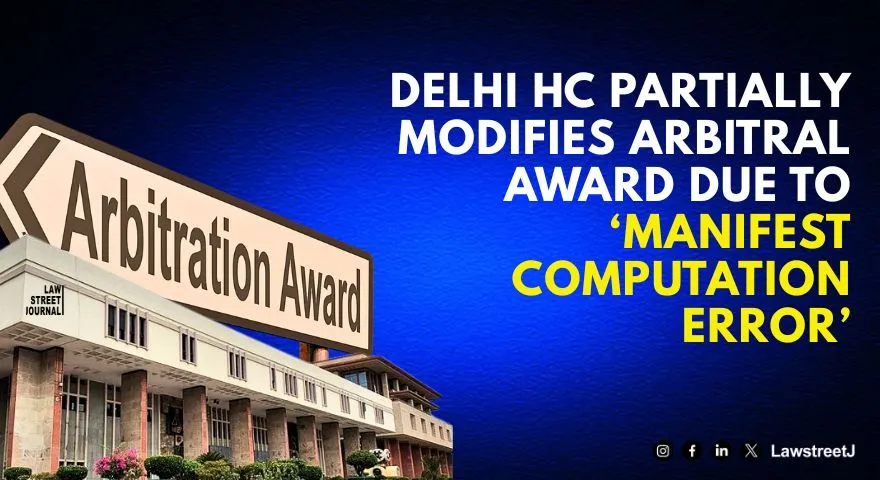
New Delhi: The Delhi High Court, in a significant ruling on the scope of judicial review in arbitration matters, has partially allowed an appeal and modified an arbitral award, citing a “manifest computational error” apparent on the face of the record. The Division Bench comprising Hon’ble Mr. Justice Anil Kshetarpal and Hon’ble Mr. Justice Harish Vaidyanathan Shankar delivered the judgment on November 26, 2025, emphasizing the limited power of courts under Section 37 of the Arbitration and Conciliation Act, 1996 (A&C Act) to correct purely arithmetical mistakes.
The appeal, filed by Jagdish Kaur, challenged the rejection of her Section 34 petition by the District Judge, which had upheld an arbitral award dated June 5, 2020. The core contention raised before the High Court was that the Arbitrator failed to adjust an amount overpaid by the Appellant against the determined value of work executed by Respondent No. 1 (the contractor).
The Arbitrator, in adjudicating the claims, made two crucial and admitted findings: under Issue No. 3, the total amount received by the Claimant (Respondent No. 1) from the Appellant was determined as “Rs. 68,00,000/-”; and under Issue No. 4, the actual value of the work constructed was determined as “Rs. 65,44,049/-”.
The High Court observed that a simple calculation revealed an overpayment of Rs. 2,55,951/- (Rs. 68,00,000 – Rs. 65,44,049) to the Respondent, which was not factored into the final awarded sum. This oversight formed the basis of the challenge. The Court referred to the recent Constitution Bench judgment in Gayatri Balasamy v. ISG Novasoft Technologies Ltd., which recognized a limited power of courts to modify an arbitral award.
The Court held that the inconsistency arose “not from any interpretative exercise or re-appreciation of evidence, but from a manifest error with regard to the computation of the resulting liability that is self-evident upon comparing the numerical findings recorded in the Award.” It further noted that “The Supreme Court has clarified that the statutory power of setting aside an Award necessarily encompasses the lesser power of correction in cases of manifest computational errors.”
Applying this principle, the Court concluded that the error squarely fell within the category of correctable arithmetical mistakes. The judgment stated: “Keeping in view the aforesaid discussion, this Court is of the opinion that the extra payment arising out of the difference between the value of the work done at the subject premises and the Award sum received by Respondent No. 1 should be adjusted.”
Consequently, the Award was modified. The Appellant was held entitled to an adjustment of Rs. 2,55,951/-. The final awarded sum in favour of the Claimant/Respondent No. 1 was reduced from Rs. 7,88,965/- to Rs. 5,33,014/- [Rs. 7,88,965 – Rs. 2,55,951], along with applicable interest.
The Court reiterated the established legal framework, observing that the scope of interference under Section 37 is even narrower than that under Section 34, stating that its “remit is limited to ascertaining whether the Section 34 Court has applied the correct legal standards and whether its interference with, or refusal to interfere with, the Award aligns with the restrictive contours of Section 34.” The appeal was partly allowed to the extent of rectifying the computational mistake.
Case Details:
Title: Jagdish Kaur v. Jasbir Singh Sandhu & Ors.
Case Number: FAO (COMM) 205/2024 and CM APPL. 60557/2024
Coram: Hon’ble Mr. Justice Anil Kshetarpal and Hon’ble Mr. Justice Harish Vaidyanathan Shankar
Judgment Pronounced on: 26.11.2025
Advocates Appearing:
For the Appellant (Jagdish Kaur): Ms. Aastha Dhawan, Adv.
For the Respondents (Jasbir Singh Sandhu & Ors.): Mr. Bipin Kumar Prabhat and Mr. Kislaya Prabhat, Advs.

![Delhi High Court Sets Aside Arbitral Tribunal's Award Against NHAI in Highway Project Delay Case [Read Judgment]](/secure/uploads/2023/07/lj_9605_23374c2e-392c-4491-a2fe-f2f12fc5272f.jpg)
![Delhi Court Rejects Stay Request in Defamation Case Against Rajasthan CM Ashok Gehlot [Read Order]](/secure/uploads/2023/08/lj_5208_80de1ddc-d76a-4f7f-b180-408e3ae14fb4.jpg)