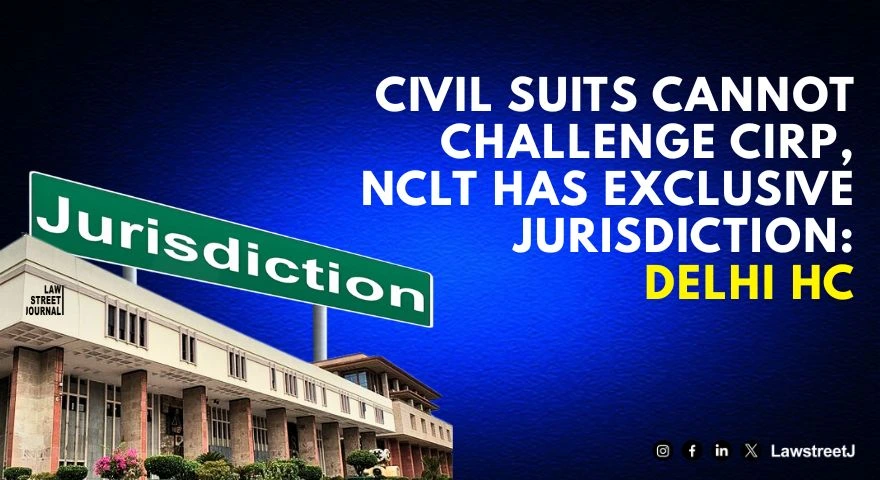
New Delhi: The High Court of Delhi has dismissed a commercial civil suit instituted by a corporate debtor seeking to derail insolvency proceedings initiated against it, holding that challenges to the initiation of the Corporate Insolvency Resolution Process (CIRP) lie exclusively within the jurisdiction of the National Company Law Tribunal (NCLT). Allowing an application under Order VII Rule 11 of the Code of Civil Procedure, 1908, the Court ruled that the suit was expressly barred by Sections 63 and 231 of the Insolvency and Bankruptcy Code, 2016 (IBC).
The ruling was delivered by Justice Purushaindra Kumar Kaurav while deciding a suit filed by Roseland Buildtech Pvt. Ltd., which sought to question the maintainability of a Section 7 application under the IBC filed by the financial creditor. The plaintiff-corporate debtor contended that its loan obligations stood fully discharged, that no legally enforceable debt subsisted, and that the Business Transfer Agreement (BTA) through which the debt was allegedly assigned was fraudulent, forged, void ab initio, and non-binding.
Rejecting these contentions, the High Court held that the substance of the dispute squarely fell within the domain of the NCLT. The Court observed that allegations of fraud, forgery, collusion, fabrication of documents, and malicious initiation of insolvency proceedings are not alien to the insolvency framework and are matters which the NCLT is “institutionally equipped” to adjudicate. It noted that the IBC confers wide powers on the NCLT to address such disputes, including under Sections 60(5)(c), 65, and 75 of the Code, read with the relevant provisions of the NCLT Rules, 2016.
The Court emphasised that Section 60(5)(c) of the IBC grants the NCLT residuary jurisdiction to decide “any question of law or facts arising out of or in relation to insolvency resolution proceedings,” which is deliberately broad in scope. It held that permitting parallel civil suits on issues intrinsically connected with the initiation of CIRP would undermine the legislative scheme of the IBC and frustrate its objective of time-bound insolvency resolution.
Addressing the plaintiff’s argument that serious allegations of fraud could not be adjudicated by the NCLT, the Court clarified that the insolvency forum is fully empowered to conduct fact-finding exercises. It noted that the NCLT Rules permit the examination of witnesses, calling for documents, and even cross-examination where necessary. The Court further pointed out that Section 65 of the IBC specifically enables the NCLT to inquire into and penalise fraudulent or malicious initiation of insolvency proceedings, thereby negating the need for recourse to civil courts.
The High Court held that the bar under Sections 63 and 231 of the IBC operates squarely in the present case, as the reliefs sought in the suit directly impinged upon matters entrusted by statute to the NCLT. It observed that entertaining such a suit would derail insolvency timelines and defeat the core legislative purpose of ensuring speedy and efficient resolution of corporate insolvency.
Consequently, the plaint was rejected under Order VII Rule 11 CPC, and the plaintiff’s application seeking interim injunctive relief was dismissed as infructuous. The judgment reinforces the principle that civil courts cannot be used as alternative forums to challenge or stall insolvency proceedings once the IBC is set in motion.
📌 Case Details
- Case Title: Roseland Buildtech Pvt. Ltd. v. Vihaan 43 Realty Pvt. Ltd. & Ors.
- Case Number: C.S. (COMM.) 812 of 2025
- Court: High Court of Delhi
- Coram: Justice Purushaindra Kumar Kaurav
- Date of Decision: 05 January 2026
Counsel for the Plaintiff:
Mr. Tanmaya Mehta and Mr. Palash Singhai, Advocates
Counsel for Defendant No. 1:
Mr. Darpan Wadhwa, Senior Advocate, with Mr. Amek Vaid, Ms. Chanan Parwani, Mr. Shivam Shukla, Mr. Kaustubh Singh, Ms. Shubhi Agarwal, and Mr. Rajat Sinha, Advocates
Counsel for Defendant No. 5:
Ms. Ekta Kalra Sikri, Mr. Ajay Pal Singh Kullar, and Mr. Prakhar Khanna, Advocates
Counsel for Defendant No. 6:
Ms. Pooja M. Saigal, Senior Advocate, with Mr. Shubham Jain, Advocate

![Delhi High Court Sets Aside Arbitral Tribunal's Award Against NHAI in Highway Project Delay Case [Read Judgment]](/secure/uploads/2023/07/lj_9605_23374c2e-392c-4491-a2fe-f2f12fc5272f.jpg)
![Delhi Court Rejects Stay Request in Defamation Case Against Rajasthan CM Ashok Gehlot [Read Order]](/secure/uploads/2023/08/lj_5208_80de1ddc-d76a-4f7f-b180-408e3ae14fb4.jpg)