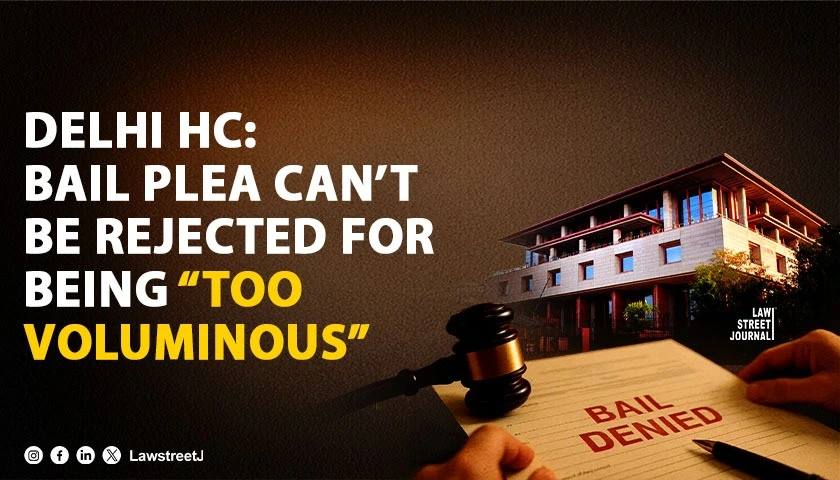
New Delhi: The Delhi High Court has set aside a trial court order which dismissed a bail application solely on the ground that it was “too voluminous and bulky”, holding that such an approach reflects non-application of judicial mind and violates the fundamental principles governing bail jurisprudence and personal liberty.
Justice Swarana Kanta Sharma observed that once a bail application is entertained, notice is issued, and the matter is listed for final arguments, the court is duty-bound to consider the application on merits. Dismissing a bail plea without examining the grounds raised, merely because the application is lengthy or supported by extensive annexures, is impermissible in law.
The Court was dealing with a petition challenging an order passed by the Special POCSO Court at Karkardooma, which had dismissed the petitioner’s second bail application on the sole reasoning that it ran into nearly 500 pages and would consume “precious judicial time”. The High Court noted that the trial court neither considered the merits of the bail plea nor afforded a meaningful opportunity of hearing, despite the matter having been fixed for final arguments and a reply having been filed by the Investigating Officer.
The High Court underscored that the right to be heard, particularly in bail matters, is not a mere procedural formality but a substantive safeguard of personal liberty. It held that the liberty of an accused cannot be made dependent on the perceived bulk of pleadings, the drafting style adopted by counsel, or the docket pressure faced by a court.
Justice Sharma also took note of the petitioner’s contention that a core constitutional issue—namely, the alleged violation of Article 22(1) of the Constitution due to non-communication of grounds of arrest—had been specifically raised in the bail application but was not even adverted to by the trial court. The failure to consider such a constitutional plea, the Court held, amounted to a failure to exercise jurisdiction.
The judgment contains detailed observations on the concept of “precious judicial time”, clarifying that judicial time exists for adjudication and cannot be cited as a reason to refuse consideration of a matter already listed for hearing. The Court observed that dismissing the bail application at that stage did not save judicial time but instead resulted in duplication of proceedings, thereby defeating the very objective cited by the trial court.
Emphasising the role of pleadings and the professional effort of counsel, the High Court held that annexing judgments and documents to assist the court cannot become a ground to non-suit an accused. At best, courts may regulate proceedings by directing concise oral submissions, written synopses, or identification of relevant portions of case law—but outright dismissal of a bail application on the ground of volume is a procedure unknown to law.
Accordingly, the High Court set aside the impugned order and restored the bail application, directing the trial court to decide it afresh on merits after granting an opportunity of hearing to both sides, preferably within ten days. The Court also directed that a copy of the judgment be circulated among all judicial officers in Delhi and forwarded to the Delhi Judicial Academy.
Case Details:
- Court: High Court of Delhi
- Bench: Justice Swarana Kanta Sharma
- Date of Judgment: January 29, 2026
- Case Title: Vijay Gupta v. State (NCT of Delhi)
- Case Number: CRL.M.C. 242 of 2026
Advocates Appearing:
- For the Petitioner:
Mr. Puneet Singh, Mr. Chetan, Mr. Naman Jain, Mr. Shubham Sharma, Advocates - For the Respondent/State:
Mr. Naresh Kumar Chahar, APP, with Ms. Amisha Dahiya, Advocate

![Delhi High Court Sets Aside Arbitral Tribunal's Award Against NHAI in Highway Project Delay Case [Read Judgment]](/secure/uploads/2023/07/lj_9605_23374c2e-392c-4491-a2fe-f2f12fc5272f.jpg)
![Delhi Court Rejects Stay Request in Defamation Case Against Rajasthan CM Ashok Gehlot [Read Order]](/secure/uploads/2023/08/lj_5208_80de1ddc-d76a-4f7f-b180-408e3ae14fb4.jpg)