


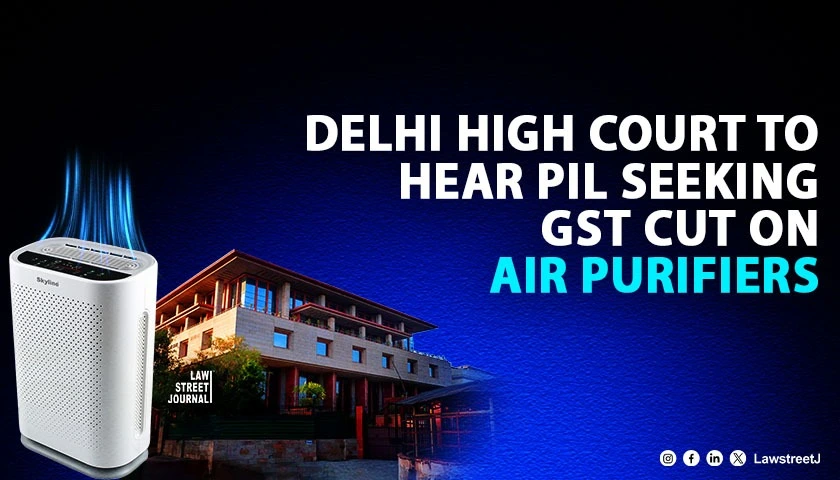
New Delhi: The Delhi High Court has directed the GST Council to convene at the earliest and examine a Public Interest Litigation seeking a declaration that air purifiers be categorised as “medical devices” under the Medical Devices Rules, 2017, with a consequential reduction of the Goods and Services Tax (GST) from 18 percent to 5 percent. The Bench, comprising the Chief Justice and Justice Tushar Rao Gedela, heard detailed submissions on the petition’s legal and policy grounds, highlighting the nexus between fiscal policy, public health, and environmental governance in the context of persistently hazardous air quality in the capital and several urban centres.
The PIL, Kapil Madan v. Union of India & Ors., filed by advocate Kapil Madan with assistance from Gurmukh Singh Arora and Rahul Matharu, challenges the classification of air purifiers under the highest GST slab as arbitrary, irrational, and inconsistent with their functional role in protecting human health. The petitioner submitted that air purifiers mitigate serious health risks arising from prolonged exposure to toxic particulate matter and smog, particularly affecting vulnerable populations such as children, the elderly, and persons with respiratory conditions.
Quoting from the petition, the PIL asserts that the “classification of air purifiers under the 18 percent GST slab lacks a rational basis and violates principles of fiscal justice and public health protection, especially when comparable preventive and therapeutic devices are taxed at the concessional rate of 5 percent.” It emphasised that differential tax treatment without an intelligible nexus to public health objectives offends the constitutional requirement of reasonable classification and administrative fairness.
During the hearing, the Court observed that air purifiers have, in recent years, transitioned from niche luxury products to essential devices in the everyday lives of many residents of Delhi and other pollution-hit cities. The Bench noted that in the face of recurring poor air quality episodes, “when clean air cannot be provided, the high tax burden on devices that ameliorate pollution impact needs urgent re-examination.” The Court underscored that access to pollution-mitigating technology cannot be constrained by punitive fiscal policy, particularly when public health is at stake.
Drawing attention to the statutory regime, the petition highlighted that under the Medical Devices Rules, 2017, air purifiers satisfy criteria typically associated with devices that prevent disease and promote health, aligning them with other items currently eligible for a lower GST rate.
The Union Government, through standing counsel, submitted that classification and taxation fall within the domain of the GST Council, a composite federal forum where the Centre and States jointly decide on rate structures. In response, the Bench directed that the GST Council be requested to convene a meeting expeditiously to consider the petitioner’s contentions, as well as the broader public health implications of retaining an 18 percent tax on air purifiers. The Court emphasised that the matter required policy engagement at the highest level, not merely isolated judicial evaluation.
The High Court also sought responses from the Ministry of Health and Family Welfare and the Central Board of Indirect Taxes and Customs (CBIC) on the legal position regarding classification and any obstacles to the re-classification of air purifiers as medical devices, to enable the GST Council to take an informed decision.
The petition has drawn attention to wider debates in policy and parliamentary forums urging fiscal incentives for pollution-mitigation equipment, including calls from industry and health advocacy groups to bring essential air-quality devices within a lower GST bracket. Reports indicate that sales of air purifiers have surged in recent years, with demand remaining high as seasonal and structural pollution challenges persist, placing greater emphasis on equitable access to these technologies.
The High Court has adjourned the matter for further hearings after the GST Council’s position and government responses are placed on record. The litigation underscores the judiciary’s role in examining the intersection of environmental distress, public health needs, and fiscal policy frameworks.
Case Details:
Kapil Madan v. Union of India & Ors., as on 24 December 2025.
Advocates Appearing:
For the Petitioner: Kapil Madan, Gurmukh Singh Arora, and Rahul Matharu.

![Delhi High Court Sets Aside Arbitral Tribunal's Award Against NHAI in Highway Project Delay Case [Read Judgment]](/secure/uploads/2023/07/lj_9605_23374c2e-392c-4491-a2fe-f2f12fc5272f.jpg)
![Delhi Court Rejects Stay Request in Defamation Case Against Rajasthan CM Ashok Gehlot [Read Order]](/secure/uploads/2023/08/lj_5208_80de1ddc-d76a-4f7f-b180-408e3ae14fb4.jpg)

.jpeg)

