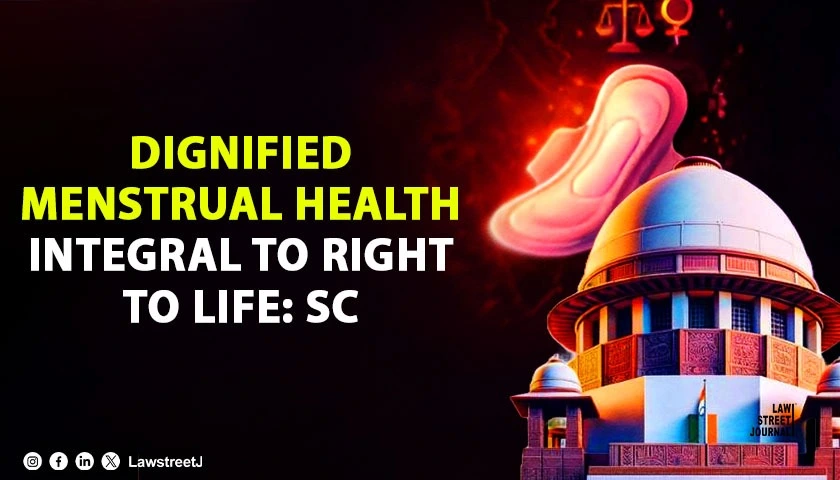
New Delhi: In a landmark judgment that firmly places menstruation within the constitutional framework of rights, the Supreme Court has held that the right to dignified menstrual health forms an intrinsic part of the right to life under Article 21 of the Constitution. The Court ruled that denial of access to menstrual hygiene facilities violates not only dignity and privacy, but also the rights to equality and education guaranteed under Articles 14 and 21A.
The ruling was delivered in Dr. Jaya Thakur v. Government of India, a public interest litigation seeking directions to ensure free sanitary pads for school-going girls, gender-segregated toilets, maintenance staff, and awareness programmes across government and government-aided schools. The Bench comprising Justice J.B. Pardiwala and Justice R. Mahadevan examined menstruation not as a private issue of hygiene but as a structural barrier that continues to exclude girls from equal participation in education and public life.
Menstruation as a Constitutional Concern
The Supreme Court observed that menstruation operates at the intersection of gender, poverty, education and social stigma. It noted that lack of access to sanitary products, private toilets, water and safe disposal mechanisms leads to absenteeism, loss of dignity and, in many cases, complete dropout of adolescent girls from school. Such exclusion, the Court held, is constitutionally impermissible.
Rejecting a formalistic understanding of equality, the Court reiterated that Article 14 mandates a substantive approach. Where biological and social realities place girls at a disadvantage, the State has a positive obligation to adopt affirmative measures. Treating menstruating girls “the same” as others without addressing their specific needs was held to perpetuate inequality rather than remedy it.
Link Between Menstrual Health and Right to Education
The judgment places strong emphasis on the right to education as a meaningful and lived right, not merely a formal guarantee. The Court held that education under Article 21A cannot be reduced to enrolment alone. Regular attendance, participation and dignity in the school environment are essential components of the right.
The absence of menstrual hygiene management facilities was held to directly impede access to education and equality of opportunity. The Court ruled that schools which lack gender-segregated toilets, sanitary products and disposal facilities effectively exclude menstruating students, thereby violating constitutional guarantees.
Importantly, the Court held that menstrual hygiene management must be treated as a mandatory norm under the Right of Children to Free and Compulsory Education Act, 2009, and not as an optional welfare measure dependent on policy discretion.
Dignity, Privacy and Bodily Autonomy
The Supreme Court further held that the right to dignified menstrual health flows from the broader constitutional understanding of dignity and bodily autonomy under Article 21. Managing menstruation safely, privately and without stigma was recognised as an essential facet of living with dignity.
The Court observed that forcing girls to manage menstruation in unsafe or humiliating conditions violates decisional autonomy and privacy. It rejected stigma-driven approaches and underscored the need for awareness programmes involving not only girls but also boys, teachers and communities, so as to dismantle taboos surrounding menstruation.
Alignment With Recent Supreme Court Jurisprudence on Women’s Rights
The judgment aligns with a growing body of Supreme Court jurisprudence that foregrounds women’s dignity, bodily autonomy and substantive equality.
In Justice K.S. Puttaswamy v. Union of India (2017), the Court recognised privacy and bodily autonomy as integral to Article 21. In Indian Young Lawyers Association v. State of Kerala (2018), the Court dismantled exclusionary practices rooted in biological stereotypes. More recently, the Court has repeatedly emphasised that neutrality cannot justify policies that ignore lived gendered realities.
The recognition of menstruation as a constitutional concern marks a continuation of this trajectory, where women’s biological experiences are no longer treated as private inconveniences but as relevant to rights analysis.
Policy Framework and Implementation Gaps
While acknowledging that multiple Union and State governments have introduced schemes for subsidised sanitary products, vending machines, incinerators and awareness initiatives, the Court noted that implementation remains uneven and inconsistent. The problem, the Court observed, lies not in lack of policy but in lack of effective execution and monitoring.
The Supreme Court issued directions calling for coordinated implementation of menstrual hygiene policies, adequate budgetary support, maintenance of sanitation infrastructure, and accountability mechanisms to ensure that facilities actually reach schools and students.
Broader Impact
The judgment has far-reaching implications for education policy, public health governance and gender justice. By placing menstrual health within the framework of fundamental rights, the Court has transformed what was often treated as a welfare issue into a matter of constitutional obligation.
The ruling strengthens the legal basis for demanding gender-sensitive infrastructure in schools and public institutions, and affirms that dignity, equality and education cannot be realised unless the State actively dismantles structural barriers faced by women and girls.
Case Details:
- Case Title: Dr. Jaya Thakur v. Government of India and Others
- Court: Supreme Court of India
- Citation: 2026 INSC 97
- Jurisdiction: Original Civil Jurisdiction
- Writ Petition: W.P. (C) No. 1000 of 2022
- Bench: Justice J.B. Pardiwala and Justice R. Mahadevan
- Date of Judgment: 30 January 2026