38.6c New Delhi, India, Tuesday, May 12, 2026
Top Stories Supreme Court
Political NEWS Legislative Corner Celebstreet International Videos
Subscribe Contact Us
close
Judiciary

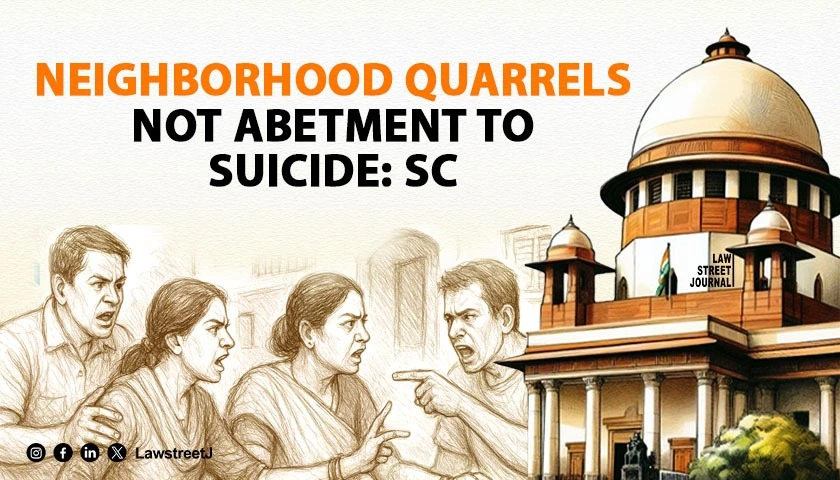
Everyday neighborhood quarrels, heated exchanges can't be taken as abetment to suicide: SC [Read Judgment]

By Jhanak Sharma      11 September, 2025 05:42 PM      0 Comments
Everyday neighborhood quarrels heated exchanges cant be taken as abetment to suicide SC

NEW DELHI: The Supreme Court has acquitted a woman in a case of abetment to suicide of a 25-year-old girl, saying neighbourhood quarrels involving heated exchanges and even physical blows, which occured in everyday life, cannot be treated as instigation in such cases.

A bench of Justices B V Nagarathna and K V Vishwanathan allowed an appeal by Geeta, in a case in which she allegedly abused the victim, living in infront of her house, by calling her "bitch", leading the latter to end her life.

On August 12, 2008, the deceased-Sarika, who used to give tuition classes to children, set herself on fire. She alleged the appellant used to abuse her by calling her bitch when she complained about noise coming from the appellant's home which affected her tuition classes. She died on September 02, 2008.

"Though ‘love thy neighbour’ is the ideal scenario, neighbourhood quarrels are not unknown to societal living. They are as old as community living itself," the bench said.

The court said, for the purpose of examining whether the ingredients of Section 306 are attracted, even if the prosecution case is taken as it, there is definitely evidence on record to show that over a period of few months the neighbours were at loggerheads.

While the victim felt that her tuition classes were being disturbed, the appellant’s family have also had a grievance about the victim and her family scolding the children of the appellant’s household.

"There is no doubt that not only were there heated exchanges, but physical blows were also alleged to have been administered by the appellant’s party,'' the bench said.

However, the appellant stood acquitted for the offence punishable under Section 323.

"Even if we were to assume that physical blows were administered, will that per se constitute abetment to suicide? This court in a case where the accused told the deceased “go and die” and when thereafter, the deceased committed suicide, absolved the accused of the charge under Section 306,'' the bench said.

The court allowed her appeal against the Karnataka High Court's judgment of April 27, 2018.

"We are not able to persuade ourselves to hold that when the appellant’s family and the victim’s family had heated exchanges, there was any intention to abet or to cause any member of either family to take their own life," the bench said.

The court observed, these quarrels occured in everyday life.

"On facts we are not able to conclude that there was an instigation on the part of the appellant to such an extent that the victim was left with no other option but to commit suicide,'' the bench said.

The court emphasised the intention of the accused to aid or to instigate or to abet the victim to commit suicide is a must for attracting Section 306 of the IPC.

In the case, the High Court confirmed her conviction but reduced her sentence from five to three years in jail.

The HC acquitted the woman of the charges under Section Section 3(2)(v) of the SC/ST (Prevention of Atrocities) Act, under which the trial court imposed life imprisonment.

[Read Judgment]

Disclaimer: This content is produced and published by LawStreet Journal Media for informational purposes only and does not constitute legal advice. The views expressed are independent of any legal practice of the individuals involved.



Share this article:

About:

Jhanak is a lawyer by profession and legal journalist by passion. She graduated at the top of her cl...Read more

Follow:
FacebookTwitterLinkedinInstagram


Leave a feedback about this
Related Posts
View All

Another CBI Officer Investigating Rakesh Asthana Moves SC Against Transfer, Makes Startling Revelations Another CBI Officer Investigating Rakesh Asthana Moves SC Against Transfer, Makes Startling Revelations

After A.K. Bassi, another CBI officer who was investigating corruption allegations against Special Director Rakesh Asthana moved the Supreme Court.

Ayodhya verdict: SC rules in favour of Ram Lalla, Sunni Waqf Board gets alternate land Ayodhya verdict: SC rules in favour of Ram Lalla, Sunni Waqf Board gets alternate land

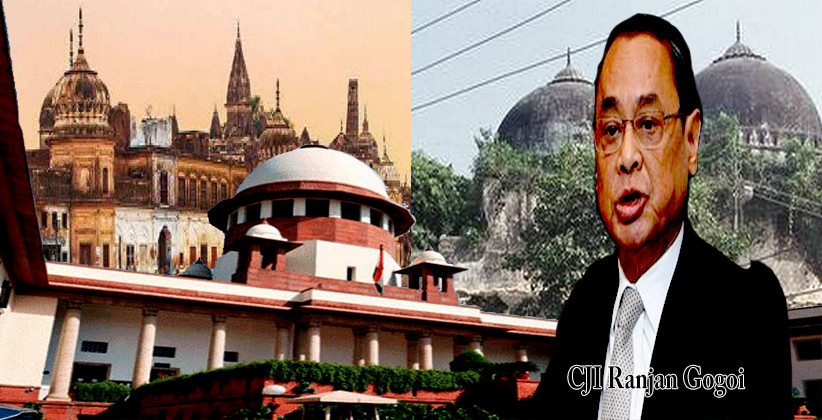
SC bench led by CJI Ranjan Gogoi has allotted the dispute site to Ram Janmabhoomi Nyas, while directing the government to allot an alternate 5 acre land within Ayodhya to Sunni Waqf Board to build a mosque.

Supreme Court: Money Spent On Judiciary Less Than 1% In All States Except Delhi Supreme Court: Money Spent On Judiciary Less Than 1% In All States Except Delhi

The court guided all states to document their response to the commission's report within four weeks. If any of the states fail to file a response, it will be presumed that they have no objections to the recommendations made by the commission, the court said.

Supreme Court Top Panel Names Chief Justices for Bombay, Orissa and Meghalaya High Courts Supreme Court Top Panel Names Chief Justices for Bombay, Orissa and Meghalaya High Courts

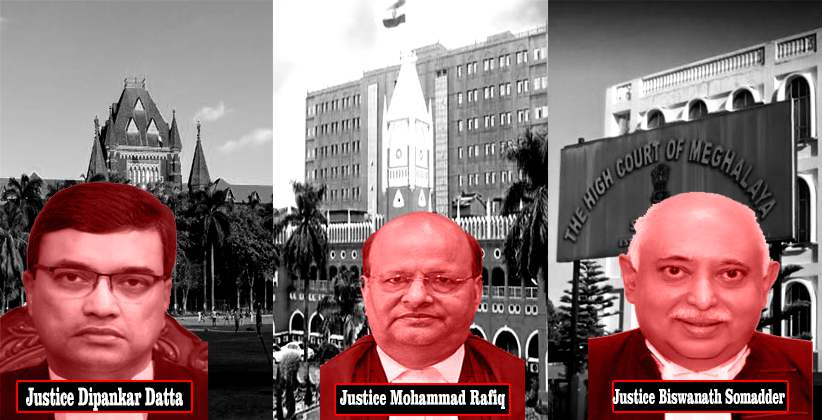
On April 18, 2020, the Supreme Court Collegium recommended new Chief Justices for three High Courts. Justice Dipankar Datta was proposed as Chief Justice of the Bombay High Court, succeeding Justice B.P. Dharmadhikari. Justice Biswanath Somadder was nominated as Chief Justice of Meghalaya High Court, while Justice Mohammad Rafiq was recommended for transfer as Chief Justice of Orissa High Court.

TRENDING NEWS

the-faustian-bargain-judicial-paternalism-legislative-silence-and-the-crisis-of-masculinity-in-indian-matrimonial-law
Trending Vantage Points
The Faustian Bargain: Judicial Paternalism, Legislative Silence, and the Crisis of Masculinity in Indian Matrimonial Law

Senior Advocate Mahalakshmi Pavani critically examines Indian matrimonial law, judicial paternalism, and gender bias, calling for gender-neutral domestic violence laws and equal constitutional protection for men and women alike.

11 May, 2026 11:07 AM
sc-refuses-to-hear-pleas-against-aor-exam-2026-cancellation
Trending Judiciary
SC Refuses To Hear Pleas Against AOR Exam 2026 Cancellation

Supreme Court refuses to hear pleas against cancellation of AOR Exam 2026 and asks aggrieved lawyers to submit representation to the CJI.

11 May, 2026 02:22 PM

TOP STORIES

scba-expresses-deep-concern-and-shock-over-andhra-pradesh-hc-incident-young-advocate-sent-to-judicial-custody-during-hearing
Trending Legal Insiders
SCBA Expresses ‘Deep Concern and Shock’ Over Andhra Pradesh HC Incident; Young Advocate Sent to Judicial Custody During Hearing [Read Resolution]

SCBA expresses shock over Andhra Pradesh HC incident where a young advocate was sent to judicial custody during court proceedings.

06 May, 2026 02:54 PM
bombay-hc-orders-takedown-in-jio-studios-masterchow-dhurandhar-copyright-dispute
Trending Business
Bombay HC Orders Takedown in Jio Studios–MasterChow ‘Dhurandhar’ Copyright Dispute [Read Order]

Bombay High Court disposes Jio Studios’ copyright suit against MasterChow over the ‘Dhurandhar’ ad, issues John Doe takedown order.

06 May, 2026 04:46 PM
pakistan-clears-pm-shehbazs-daughter-and-son-in-law-in-saaf-pani-corruption-case
Trending International
Pakistan Clears PM Shehbaz's Daughter and Son-in-Law in Saaf Pani Corruption Case

Pakistan's Anti-Corruption Establishment has declared Rabia Imran and Ali Imran Yousaf innocent in the Punjab Saaf Pani Company case, finding no evidence against them. The ruling closes a legal saga that began in 2017 under NAB and spanned multiple courts, warrants, and jurisdictional shifts.

06 May, 2026 04:56 PM
nepals-president-signs-constitutional-council-ordinance-clearing-path-for-chief-justice-appointment
Trending International
Nepal's President Signs Constitutional Council Ordinance, Clearing Path for Chief Justice Appointment

Nepal's President Ramchandra Paudel on May 5, 2026, promulgated the Constitutional Council First Amendment Ordinance under Article 114(1) of the Constitution, ending an eight-month institutional deadlock. The ordinance clears the path for appointing a permanent Chief Justice and heads of key constitutional bodies.

06 May, 2026 05:24 PM

ADVERTISEMENT


Join Group

Signup for Our Newsletter

Get Exclusive access to members only content by email