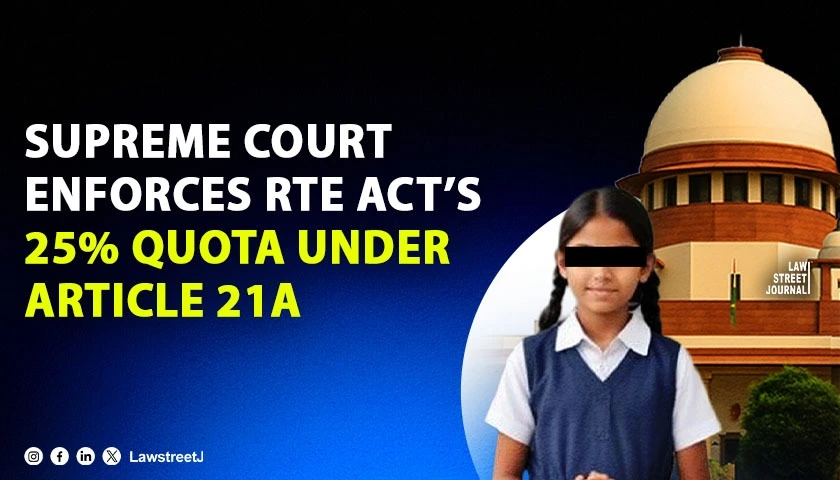
New Delhi: The Supreme Court’s reportable judgment in Dinesh Biwaji Ashtikar v. State of Maharashtra & Ors. represents one of the most consequential judicial interventions in the enforcement of Article 21A of the Constitution since the enactment of the Right of Children to Free and Compulsory Education Act, 2009. Moving beyond abstract affirmations of the right to education, the Court squarely addressed a chronic governance failure: the systematic non-implementation of the 25 per cent reservation mandate under Section 12(1)(c) of the RTE Act in private unaided non-minority schools.
At a structural level, the case exposed how constitutional rights can be hollowed out not by overt repeal, but by administrative inaction. Although Section 12(1)(c) imposes a clear obligation on private unaided schools to admit children from Economically Weaker Sections and Disadvantaged Groups at the entry level, States across the country have relied on executive guidelines, circulars, and standard operating procedures instead of framing statutory rules under Section 38 of the Act. This regulatory vacuum has led to widespread under-utilisation of RTE seats, opaque admission processes, and the exclusion of the very children the law was meant to protect.
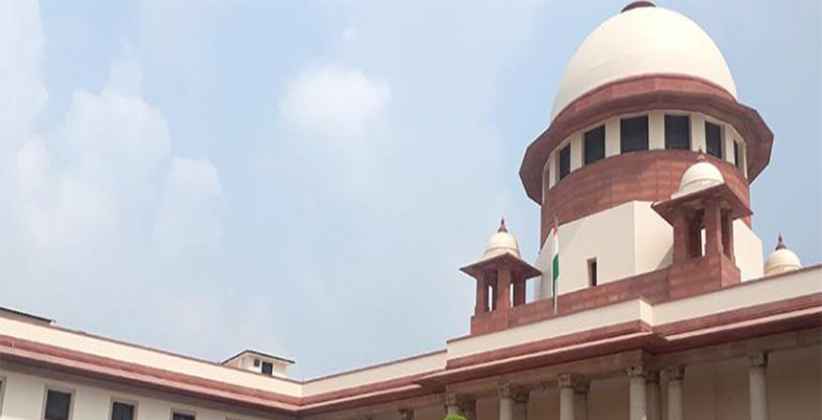
The Supreme Court’s judgment directly confronts this gap. Pronounced on 13 January 2026 by a Bench comprising Justice P. S. Narasimha and Justice A. S. Chandurkar, the ruling makes it clear that executive instructions cannot substitute rule-making when fundamental rights are at stake. The Court reaffirmed that Article 21A is a positive obligation, requiring the State not merely to recognise the right to education but to actively design enforceable systems that make the right real and accessible.
Importantly, the Court framed the issue not as a conflict between private school autonomy and State regulation, but as a constitutional compact. Private unaided schools, the judgment implicitly reiterates, function within a legal ecosystem shaped by constitutional values of equality and social justice. Compliance with Section 12(1)(c) is therefore not charity or policy discretion, but a constitutional obligation flowing from Article 21A read with the RTE Act.
A key institutional innovation in the judgment lies in its monitoring architecture. Recognising that declaratory judgments alone have failed in the past, the Court directed that the National Commission for Protection of Child Rights (NCPCR) be impleaded as a party respondent. The NCPCR has been tasked with collating State-wise information on the framing of rules and filing a consolidated affidavit before the Court by 31 March 2026. This transforms child rights bodies from passive recommendatory institutions into active compliance monitors, embedding accountability within the enforcement process.
The presence of a court-appointed amicus curiae, Senior Advocate Senthil Jagadeesan, assisted by a team of advocates, also signals the Court’s recognition of the complexity and nationwide implications of RTE enforcement. The matter has been listed for further hearing on 6 April 2026, underscoring that this is not a one-time directive but an exercise in continuing constitutional supervision of State compliance.
In constitutional terms, the judgment decisively rejects the idea that Article 21A can be satisfied through symbolic compliance. It reiterates a foundational principle of rights jurisprudence: a right without enforceable procedures is no right at all. By mandating statutory rule-making, inter-institutional consultation, and continuing judicial oversight, the Supreme Court has repositioned the RTE Act as a living instrument of social transformation rather than a dormant welfare statute.
For millions of children excluded from quality education due to poverty and structural barriers, the judgment marks a shift from promise to possibility. Whether that possibility becomes reality now depends on how sincerely States respond to the Court’s mandate.
Case Details:
- Case Title: Dinesh Biwaji Ashtikar v. State of Maharashtra & Ors.
- Court: Supreme Court of India
- Case Number: SLP (Civil) No. 10105 of 2017
- Arising From: WP No. 6415 of 2016, High Court of Judicature at Bombay, Nagpur Bench
- Bench: Justice P. S. Narasimha and Justice A. S. Chandurkar
- Date of Judgment: 13 January 2026