38.6c New Delhi, India, Thursday, January 08, 2026
Top Stories Supreme Court
Political NEWS Legislative Corner Celebstreet International Videos
Subscribe Contact Us
close
Judiciary

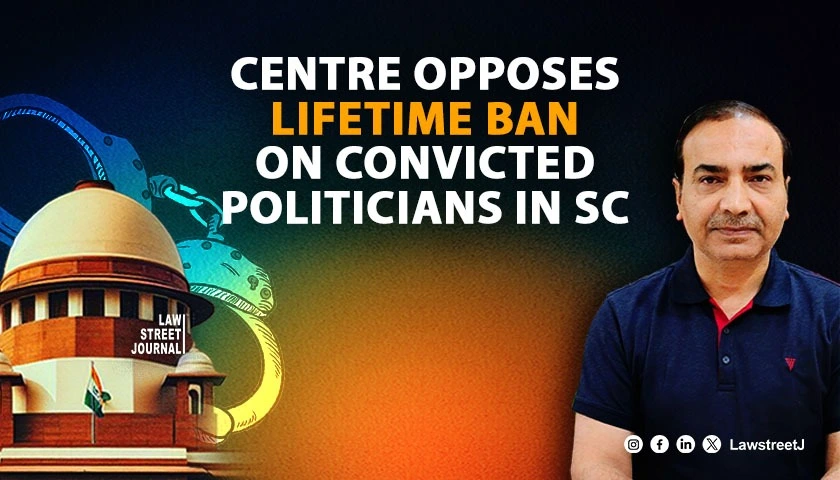
Govt opposes PIL in SC by Ashwini Upadhyay seeking lifetime ban on convicted politicians [Read Affidavit]

By Jhanak Sharma      27 February, 2025 01:35 PM      0 Comments
Govt opposes PIL in SC by Ashwini Upadhyay seeking lifetime ban on convicted politicians

NEW DELHI: The Centre has opposed before the Supreme Court a plea made by eminent advocate Ashwini Kumar Upadhyay, also known as a PIL man of India, seeking a life long ban on convicted politicians as against the existing disqualification for merely six years under the Representation of People Act.

Centre Defends Existing Law, Says Lifetime Ban on Convicted Politicians Not Mandatory

The government contended the issue whether life time ban would be appropriate or not fell within the domain of Parliament and there is nothing inherently unconstitutional in limiting the effect of penalities.

It also cited the principles of proportionality and reasonability, to indicate the proposition advanced by Upadhyay would be unduly harsh.

Supreme Court Hearing on Disqualification of Politicians: Govt Cites Proportionality Principle

The government said, "A lifetime disqualification is the maximum that can be imposed under the provisions and to impose such a disqualification is certainly within the power of Parliament. However, it is one thing to say that a power exists and another to say that it must necessarily be exercised in every case".

The response by the Law and Justice Ministry's legislative department came in the form of counter affidavit on February 24, 2025.

The court had on February 10, 2024 had asked the Centre to clarify its stand in the matter.

In its detailed written reply, the government defended the extant provisions and also pointed out a similar plea made by NGO Lok Prahari is pending consideration before the apex court wherein the government has filed an affidavit opposing it in November, 2023.

The government said that the provisions under the RP Act are constitutionally sound, do not suffer from the vice of excess delegation and are intra vires the powers of Parliament. All laws duly
passed by the Legislature are entitled to the presumption of constitutionality, it asserted.

It said the Upadhyay here failed to make the crucial distinction between basis and effect of disqualification. He also failed to make any cogent ground to show those provisions are constitutionally invalid, it said.

"It is true that the basis of disqualification is conviction for an offence and that this basis remains unchanged so long as the conviction stands. The effect of such conviction lasts for a fixed period of time. Therefore, there is nothing inherently unconstitutional in limiting the effect of penalties by time," the government said.

The petitioner's reliance on Articles 102 and 191 of the Constitution is "totally misplaced," the reply claimed.

"Clause (e) of Article 102 and Article 191 are enabling provisions that confer on Parliament the power to make laws governing disqualification. It is in exercise of this power that the RP Act has been enacted. The Constitution has left the field open to Parliament to enact such further law governing disqualifications as Parliament deems fit. Parliament has power both to determine the grounds for disqualification and the duration of disqualification," it said.

The grounds for disqualification given in those Articles are holding of an office of profit, unsoundness of mind, insolvency and not being a citizen of India. Those are not permanent disqualifications and can be removed, it said.

The Center said what the petitioner, however, wanted amounts to re-writing of the provision as his plea effectively sought to read "life-long" instead of "six years" in all Sub-Sections of Section 8 of RP Act.

"The said approach is unknown to judicial review and unknown to any canon of constitution law," it contended.

The plea sought a direction to Parliament to frame a law in a particular manner, which is wholly beyond the powers of judicial review, the government said.

It is trite law that the courts cannot direct Parliament to make a law or to legislate in a particular way, the government also stated.

"As a matter of law, in imposing any penalty, the Parliament seeks to maintain considering the principles of proportionality and reasonability," it said.

The Centre pointed out in numerous penal laws, restrictions are imposed on the exercise of rights and freedoms but those are time-limited. At the end of the prescribed time, the restrictions cease to operate automatically.

The government also said by confining the operation of the penalty to an appropriate length of time, deterrence is ensured while undue harshness is avoided.

[Read Affidavit]


Share this article:

About:

Jhanak is a lawyer by profession and legal journalist by passion. She graduated at the top of her cl...Read more

Follow:
FacebookTwitterLinkedinInstagram


Leave a feedback about this
Related Posts
View All

Another CBI Officer Investigating Rakesh Asthana Moves SC Against Transfer, Makes Startling Revelations Another CBI Officer Investigating Rakesh Asthana Moves SC Against Transfer, Makes Startling Revelations

After A.K. Bassi, another CBI officer who was investigating corruption allegations against Special Director Rakesh Asthana moved the Supreme Court.

Ayodhya verdict: SC rules in favour of Ram Lalla, Sunni Waqf Board gets alternate land Ayodhya verdict: SC rules in favour of Ram Lalla, Sunni Waqf Board gets alternate land

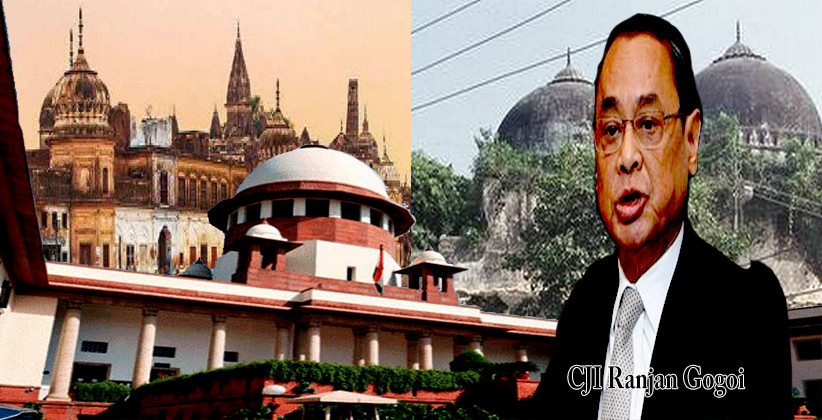
SC bench led by CJI Ranjan Gogoi has allotted the dispute site to Ram Janmabhoomi Nyas, while directing the government to allot an alternate 5 acre land within Ayodhya to Sunni Waqf Board to build a mosque.

Supreme Court: Money Spent On Judiciary Less Than 1% In All States Except Delhi Supreme Court: Money Spent On Judiciary Less Than 1% In All States Except Delhi

The court guided all states to document their response to the commission's report within four weeks. If any of the states fail to file a response, it will be presumed that they have no objections to the recommendations made by the commission, the court said.

Supreme Court Top Panel Names Chief Justices for Bombay, Orissa and Meghalaya High Courts Supreme Court Top Panel Names Chief Justices for Bombay, Orissa and Meghalaya High Courts

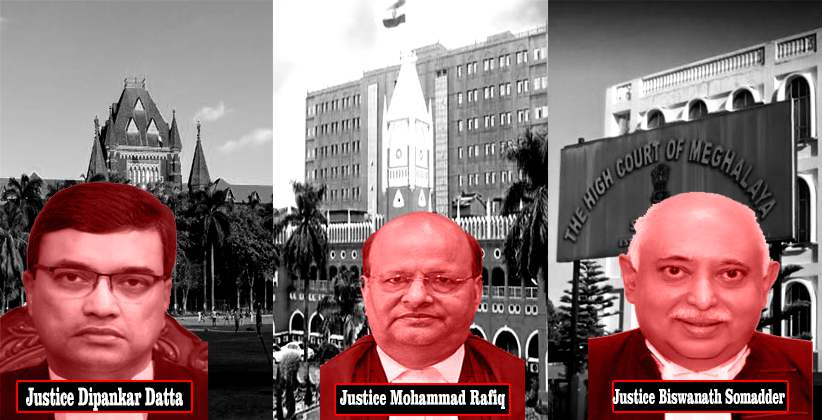
On April 18, 2020, the Supreme Court Collegium recommended new Chief Justices for three High Courts. Justice Dipankar Datta was proposed as Chief Justice of the Bombay High Court, succeeding Justice B.P. Dharmadhikari. Justice Biswanath Somadder was nominated as Chief Justice of Meghalaya High Court, while Justice Mohammad Rafiq was recommended for transfer as Chief Justice of Orissa High Court.

TRENDING NEWS

borrowers-cannot-invoke-writ-jurisdiction-to-compel-banks-to-extend-one-time-settlement-benefits-kerala-hc
Trending Judiciary
Borrowers Cannot Invoke Writ Jurisdiction to Compel Banks to Extend One-Time Settlement Benefits: Kerala HC [Read Judgment]

Kerala High Court holds borrowers cannot invoke writ jurisdiction to compel banks to grant One-Time Settlement benefits, as OTS is not a legal right.

07 January, 2026 09:22 PM
leela-palace-udaipur-ordered-to-pay-10-lakh-after-housekeeping-staff-enters-occupied-room-without-consent
Trending Business
Leela Palace Udaipur Ordered to Pay ₹10 Lakh After Housekeeping Staff Enters Occupied Room Without Consent [Read Order]

Chennai Consumer Commission orders Leela Palace Udaipur to pay ₹10 lakh and refund room tariff for breach of guest privacy by housekeeping staff.

07 January, 2026 09:43 PM

TOP STORIES

telangana-hc-cannot-seek-extension-beyond-45-day-limit-to-file-written-version-in-consumer-cases
Trending Judiciary
Telangana HC: Cannot Seek Extension Beyond 45-Day Limit to File Written Version in Consumer Cases [Read Order]

Telangana High Court rules written versions in consumer cases cannot be filed beyond the mandatory 45-day limit under the Consumer Protection Act, 2019.

02 January, 2026 07:13 PM
preventive-detention-cannot-be-used-to-silence-dissenting-voices-of-journalists-madras-hc
Trending Judiciary
Preventive Detention Cannot Be Used to Silence Dissenting Voices of Journalists: Madras HC [Read Order]

Madras High Court warns against misuse of preventive detention to silence journalists, calls it a threat to free speech and liberty.

02 January, 2026 08:04 PM
delhi-hc-upholds-discharge-of-accused-in-gang-rape-case-expresses-concern-over-misuse-of-sexual-offence-laws-and-victim-compensation
Trending Judiciary
Delhi HC Upholds Discharge of Accused in Gang Rape Case; Expresses Concern Over Misuse of Sexual Offence Laws and Victim Compensation [Read Judgment]

Delhi High Court upholds discharge in a gang rape case, flags misuse of sexual offence laws, and issues directions on recovery of victim compensation.

02 January, 2026 08:28 PM
gujarat-hc-rejects-sugar-mills-plea-to-restore-delay-condonation-application-filed-after-seven-years
Trending Judiciary
Gujarat HC Rejects Sugar Mill’s Plea to Restore Delay Condonation Application Filed After Seven Years [Read Judgment]

Gujarat High Court upheld CESTAT’s rejection of a sugar mill’s plea to restore a delay condonation application filed after a seven-year lapse.

02 January, 2026 09:40 PM

ADVERTISEMENT


Join Group

Signup for Our Newsletter

Get Exclusive access to members only content by email