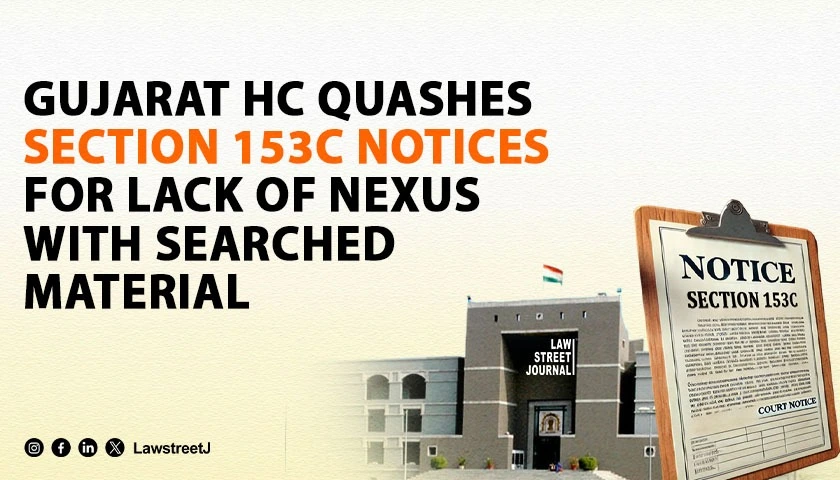
Gujarat: The Gujarat High Court has quashed income tax notices issued under Section 153C of the Income-tax Act, 1961, holding that assessment proceedings cannot be initiated against a person based on presumptions drawn from public domain information when no incriminating material directly linking them was found during a search operation.
A Division Bench comprising Justice A.S. Supehia and Justice Pranav Trivedi delivered the judgment on November 24, 2025, in a case where notices were issued to Sandhya Maulik Patel for Assessment Years 2014–15 to 2020–21 following a search operation conducted at the premises of a land broker.
The case originated from a search conducted under Section 132 of the Act on October 15, 2019 at the premises of Shri Dhaval Teli, a land broker in Ahmedabad. During the search, digital images of a Memorandum of Understanding (MoU) pertaining to land bearing Survey No. 329 were recovered from his mobile phone. The MoU was executed between seller Dilipbhai Patel and buyer Dhirenbhai Bharvad, reflecting a total sale consideration of ₹39,32,25,000, with ₹1,00,00,000 stated to have been paid in cash on March 1, 2016.
Based on this discovery, the Assessing Officer (AO) issued notices under Section 153C to the petitioners on October 13, 2021. The AO alleged that the petitioners had made an undisclosed investment of ₹27,32,00,000 in the purchase of the same land, which they had acquired for ₹12,00,00,000 under registered sale deed No. 885 dated April 12, 2018. This conclusion was drawn by ascertaining from public domain records that the land was purchased by the petitioners at a significantly lower price than the consideration mentioned in the earlier MoU.
The petitioners challenged these notices, contending that the information recovered during the search did not relate to them and that the MoU did not bear their names. They filed objections pointing out that the searched person, Shri Dhaval Teli, had categorically stated in his statement that the deal was not negotiated by him but by another broker, and that he had only supplied the latest 7/12 extracts or Form No. 6 of the land in question.
The petitioners argued that the AO’s reliance on the registered sale deed obtained through a public inquiry, coupled with a presumption of undisclosed investment, ran contrary to Section 153C. They emphasized that no incriminating material having any direct or indirect nexus with them was found during the search conducted on a third person.
The Revenue contended that the Court’s jurisdiction in reviewing the AO’s satisfaction was limited. The Standing Senior Counsel argued that since the petitioners’ names surfaced during the search and the broker had provided information about the land deal, the impugned notices should not be interfered with. The Revenue also relied on the amended provisions of Section 153C, effective June 1, 2015, adding the expression “pertains or pertain to,” and argued that any information recovered during the search relating to a person other than the searched person could trigger assessment proceedings.
After examining the submissions, the Court observed that the search against Shri Dhaval Teli and the satisfaction recorded by the AO had no nexus that could implicate the petitioners. It noted that the petitioners’ names did not appear in the MoU and that nothing in the document even remotely connected them to the transaction.
The Court further noted that the AO had specifically recorded that he ascertained from the public domain that the land was purchased by the petitioners. The Court held that the AO presumed that since the seller entered into the MoU for ₹39.32 crore, he could not have sold the same land to the petitioners for ₹12 crore without receiving on-money.
Significantly, the Court noted that the broker had stated before the AO that he did not broker the land deal and had only supplied the 7/12 extracts and Form No. 6 after the search. The Court emphasized that these documents were not seized during the search but were handed over later, and only thereafter did the AO obtain the sale deed information from the public domain.
The Court held that no incriminating material found during the search had any direct nexus with the petitioners. The documents collected by the AO from the broker or the seller could not constitute a live link implicating the petitioners, and the presumption of escaped income based on the difference between ₹39.32 crore and ₹12 crore was unsustainable.
The Court concluded that the search conducted against Shri Dhaval Teli did not yield any document relating to undisclosed income pertaining to the petitioners. The satisfaction recorded by the AO, roping the petitioners into assessment proceedings on the basis of digital data that had no nexus with them, was required to be quashed. The Court held that the AO had acted de hors Section 153C.
The Court also noted that the Revenue’s reliance on the Supreme Court judgment in Vikram Sujitkumar Bhatia did not assist them, as the issue before the Apex Court related to the applicability of the 2015 amendment to searches conducted prior to June 1, 2015.
Consequently, the High Court quashed the impugned notices and allowed the writ petitions, making the rule absolute with no order as to costs.

.jpg)
![Gujarat High Court Denies Bail to Man for Obscene Comments on PM and Late Mother [Read Order]](/secure/uploads/2023/06/lj_1661_9baa7d8a-0faf-4761-b395-81c631cd129f.jpg)