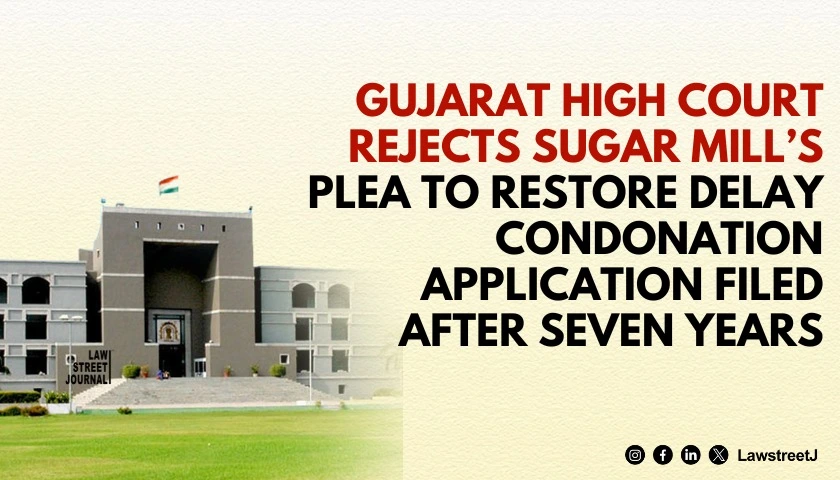
Gujarat: The Gujarat High Court, on December 11, 2025, dismissed a Special Civil Application filed by Shree Ukai Pradesh Sahakari Khand Udyog Mandali Ltd., challenging an order of the Customs, Central Excise and Service Tax Appellate Tribunal (CESTAT), which had rejected the Mandali’s application for restoration of a delay condonation application filed after a gap of seven years.
The petitioner, a co-operative society engaged in the manufacture of sugar and molasses, was facing recovery proceedings for Central Excise duty amounting to ₹1,12,23,672 for the period from May 2013 to August 2014, as confirmed by an Order-in-Original dated July 23, 2015. The Mandali filed an appeal before the CESTAT along with a Miscellaneous Application seeking condonation of a 98-day delay on February 26, 2016, citing an acute financial crisis that led to the closure of the factory.
The CESTAT, vide order dated September 19, 2017, dismissed the delay condonation application and, consequently, the appeal, due to the petitioner’s failure to file an affidavit explaining the delay, despite being specifically directed to do so on August 19, 2017. Thereafter, the petitioner Mandali filed a Miscellaneous Application for restoration of the delay condonation application on October 1, 2024—after a lapse of seven years—once again citing closure due to financial crisis. The CESTAT rejected this application on the ground that it was filed after an inordinate delay of seven years “without any convincing explanation.”
The High Court, comprising Honourable Mr. Justice A. S. Supehia and Honourable Mr. Justice Pranav Trivedi, upheld the CESTAT’s decision. The Court observed that the Mandali was negligent on four counts: “firstly, in filing the appeal belatedly by 98 days; secondly, in not explaining the delay of 98 days despite the directions of the CESTAT; thirdly, in not remaining present in the proceedings; and fourthly, in filing the restoration application after a gap of seven (7) years.”
The Court noted that the Mandali was represented by an advocate throughout the proceedings; however, “neither the advocate nor the petitioner was vigilant enough to pursue the proceedings.” The explanation offered for the seven-year delay—financial constraint—was held to be merely an “excuse.” The Court relied on the Supreme Court’s decision in Sheo Raj Singh v. Union of India, which cautioned that courts must distinguish between an “explanation” and an “excuse,” observing that an “excuse is often offered by a person to deny responsibility and consequences when under attack.”
Rejecting the petitioner’s reliance on another CESTAT order where a delay of over 2,000 days was condoned, the High Court clarified that, in that case, the order under challenge had not been served upon the appellant—a “vital distinguishing feature” absent in the present matter.
The Court concluded:
“We do not find any convincing reason to interfere with the order passed by the CESTAT in view of the fact that the petitioner Mandali has been negligent in pursuing the legal remedy before the CESTAT. We are not convinced that merely because the petitioner Mandali was closed down, it lost track of the proceedings which it had filed challenging the Order-in-Original dated 23.07.2015.”
Accordingly, the writ petition was dismissed.
Case Details:
Case Name: Shree Ukai Pradesh Sahakari Khand Udyog Mandali Ltd. v. Union of India & Ors.
Citation: C/SCA/15499/2025; 2025:GUJHC:71568-DB
Coram: Honourable Mr. Justice A. S. Supehia and Honourable Mr. Justice Pranav Trivedi
Date of Judgment: 11.12.2025
Appearance:
For the Petitioner: Mr. Dhaval Shah
For the Respondents: Ms. Hardika Vyas, Mr. C. B. Gupta

.jpg)
![Gujarat High Court Denies Bail to Man for Obscene Comments on PM and Late Mother [Read Order]](/secure/uploads/2023/06/lj_1661_9baa7d8a-0faf-4761-b395-81c631cd129f.jpg)