

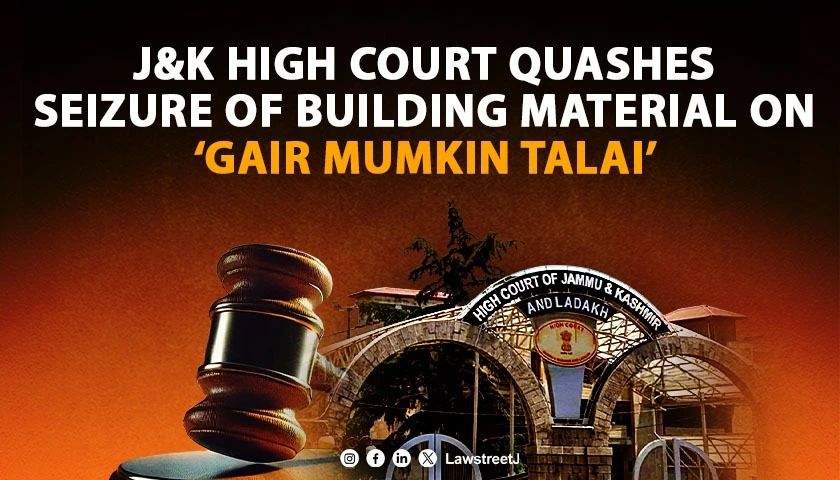
Jammu: The High Court of Jammu & Kashmir and Ladakh at Jammu has set aside an administrative order directing the seizure of building material and registration of an FIR against a trader for allegedly encroaching upon village common land, holding that the Jammu & Kashmir Common Lands (Regulation) Act, 1956 does not apply to land situated within municipal limits.
Justice Moksha Khajuria Kazmi, allowing a writ petition filed under Article 226 of the Constitution, ruled that the impugned action was legally unsustainable, having been taken by wrongly invoking the Common Lands Act and misapplying the Supreme Court’s directions in Jagpal Singh v. State of Punjab.
Background of the Case:
The petitioner, Shafiq Anjum, approached the High Court challenging an order dated 04 March 2017 issued by the Tehsildar, Udhampur, directing the seizure of building material stored by him on land falling under Khasra No. 1, Village Kallar Himitti, and further ordering the lodging of an FIR for alleged encroachment on common land.
The order was passed on the premise that the land was village common land and that the petitioner had violated the Supreme Court’s judgment in Jagpal Singh, which mandates eviction of illegal occupants from Gram Sabha and Panchayat lands.
According to the petitioner, the land in question—though recorded as ‘Gair Mumkin Talai’ (uncultivable pond)—was proprietary land owned by a private individual (respondent no. 6) and was neither Gram Panchayat nor shamlat land. The petitioner contended that he had merely stored building material on the land with the consent of the recorded owner, without claiming any title or possessory rights.
Stand of the Authorities:
The official respondents argued that land recorded as Gair Mumkin Talai could not be diverted for commercial use and that such land, even if filled or levelled, retained its original character. It was further contended that the land vested either in the State or the Municipal Council under statutory provisions.
However, the respondents also conceded that the land fell within the Municipal Council limits of Udhampur, thereby excluding the applicability of the Common Lands (Regulation) Act, 1956.
Court’s Findings:
The High Court noted that Section 1(4) of the Jammu & Kashmir Common Lands (Regulation) Act, 1956 expressly excludes municipal areas from its operation. Since the land admittedly fell within municipal limits, the very foundation of the impugned order was held to be erroneous.
The Court further clarified that the directions issued by the Supreme Court in Jagpal Singh v. State of Punjab are confined to Gram Sabha, Gram Panchayat, poramboke, and shamlat lands, and cannot be mechanically extended to land situated within municipal areas or to land recorded in private ownership.
Importantly, the Court observed that:
- Revenue records reflected private ownership of the land, albeit with restrictions on sale;
- The petitioner had not claimed ownership or possession, but had only stored material with the owner’s consent; and
- Even if any illegality existed, action ought to have been taken against the recorded owner, not against a third party like the petitioner.
Rejecting the argument that the land vested in the Government or Municipal Council under other statutes, the Court noted that no such vesting was reflected in the revenue records, nor had any proceedings been initiated under the relevant enactments.
Relief Granted:
Holding the impugned order to be unsustainable in law, the High Court set aside the order dated 04 March 2017 insofar as it concerned the petitioner. The Court clarified that the seized material had already been released earlier, rendering that relief infructuous.
The writ petition was accordingly allowed.
Case Details:
- Case Title: Shafiq Anjum v. State of Jammu and Kashmir & Ors.
- Court: High Court of Jammu & Kashmir and Ladakh at Jammu
- Bench: Justice Moksha Khajuria Kazmi
- Case Number: OWP No. 332/2017
- Date of Judgment: 23 December 2025

![Publicly slapping wife does not constitute outraging modesty: J&K HC [Read Order]](/secure/uploads/2024/02/lj_7549_husband-slapping-wife-publicly.webp)
![Jammu and Kashmir High Court Grants Bail To Gang Rape Accused, Emphasizes Presumption Of Innocence [Read Order]](/secure/uploads/2024/05/lj_6000_5007a767-4748-4bed-9dab-8fa14a4d262b.webp)
![Mere involvement of relatives in anti national activities in the past can not be a ground to deny Govt contracts: J&K and Ladakh HC [Read Judgment]](/secure/uploads/2024/06/lj_3301_79dd6df6-5b62-4057-8762-d0e460af98e6.webp)